
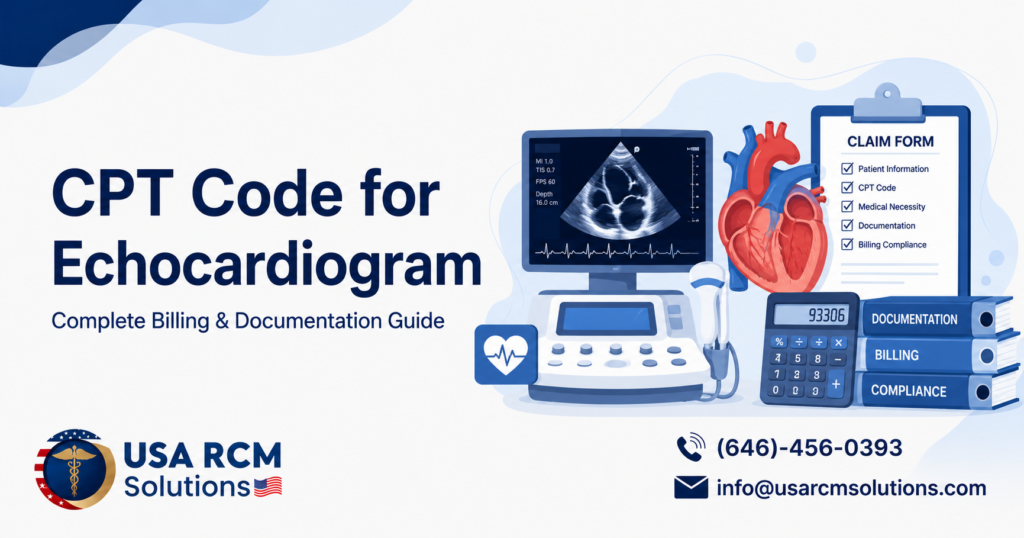
The cpt code for echocardiogram depends on the type of echo performed, the components documented, and the payer rules attached to the claim. A complete transthoracic echocardiogram is not coded the same way as a limited echo, stress echo, transesophageal echo, contrast echo, bubble study, or pediatric echocardiogram.
For most adult complete transthoracic echocardiograms, CPT code 93306 is the primary code billers review first. CMS lists 93306, 93307, 93308, 93320, 93321, 93325, C8923, C8924, and C8929 among applicable TTE billing codes, but coverage still depends on medical necessity and proper ICD-10 support.
Correct echocardiogram billing requires more than selecting a CPT code. The report must support the service performed, the diagnosis must explain why the test was needed, and the claim must use the right modifier when professional or technical billing applies.
What Is the Main CPT Code for Echocardiogram?
The main CPT Code for Echocardiogram for a complete adult transthoracic echocardiogram is 93306.
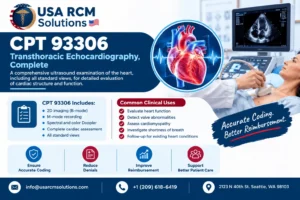
This code is commonly used for a complete TTE with 2D imaging, selected M-mode when performed, spectral Doppler, and color flow Doppler. It is also the common answer when billers search for the cpt code for complete echocardiogram, cpt code for 2d echocardiogram complete, or cpt code for transthoracic echocardiogram complete with color flow.
CPT Code 93306 for Complete Echocardiogram
CPT code 93306 applies when the provider performs a complete transthoracic echocardiogram and the documentation supports the full service.
A complete echo report should usually include:
- Left ventricular size and function
- Right ventricular size and function
- Atrial size
- Valve structure and function
- Wall motion findings
- Ejection fraction
- Spectral Doppler findings
- Color flow Doppler findings
- Final interpretation
The key billing rule is simple. Do not bill 93306 just because the order says “echo.” The final report must show that the full study was performed and interpreted.
What Is Included in CPT Code 93306?
CPT 93306 includes the core elements of a complete TTE with Doppler and color flow. This means it may support searches such as cpt code for echocardiogram with doppler and cpt code with doppler color flow.
If the study is complete but Doppler and color flow are not performed, 93307 may be more accurate. If the study is limited or follow-up only, 93308 may be the better code.
Common CPT Code for Echocardiogram
Medical billers should match the CPT code to the actual service documented in the report.
The table below gives a practical overview of common cpt codes for echocardiogram services.
Echocardiogram CPT Code Table
| CPT Code | Common Use | Billing Notes |
| 93306 | Complete transthoracic echocardiogram with Doppler and color flow | Common complete adult TTE code |
| 93307 | Complete transthoracic echocardiogram without Doppler and color flow | Used when the study is complete but Doppler/color flow are not included |
| 93308 | Limited or follow-up transthoracic echocardiogram | Used for focused or limited studies |
| 93320 | Complete spectral Doppler add-on | Used when separately reportable and documented |
| 93321 | Limited spectral Doppler add-on | Used for limited Doppler assessment |
| 93325 | Color flow Doppler add-on | Used when color flow mapping is separately supported |
| 93350 | Stress echocardiogram | Used for stress echo imaging and interpretation |
| 93351 | Stress echocardiogram with complete cardiovascular stress test | Used when stress test components are included and documented |
| 93352 | Contrast administration during stress echo | Used when contrast is medically necessary and documented |
| 93312 | Transesophageal echocardiogram | Common diagnostic TEE code |
| C8929 | Complete TTE with contrast | Often used in outpatient hospital billing |
93306 vs 93307 vs 93308
The most common confusion is between 93306, 93307, and 93308.
| Code | Study Type | Doppler and Color Flow | Best Use |
| 93306 | Complete TTE | Included | Complete echo with Doppler and color flow |
| 93307 | Complete TTE | Not included | Complete echo without Doppler/color flow |
| 93308 | Limited TTE | Not automatically included | Focused or follow-up echo |
Use 93306 when the complete study, Doppler, and color flow are documented. Use 93307 when the study is complete but does not include Doppler and color flow. Use 93308 when the provider performs a limited or focused assessment.
This distinction protects reimbursement and reduces denial risk.
CPT Code for Transthoracic Echocardiogram
A transthoracic echocardiogram, or TTE, is performed from the outside of the chest. It is commonly used to evaluate chamber size, valve function, blood flow, wall motion, and ejection fraction.
The cpt code for transthoracic echocardiogram depends on whether the study is complete, limited, performed with Doppler, or performed with color flow.
Complete Transthoracic CPT Code for Echocardiogram
The main transthoracic echocardiogram CPT code for a complete study with Doppler and color flow is 93306.
A complete TTE should show enough documentation to support cardiac structure and function. If the report only checks one issue, such as pericardial effusion or left ventricular function, a limited echo code may be more appropriate.
Transthoracic Echocardiogram Complete With Color Flow
The cpt code for transthoracic echocardiogram complete with color flow is usually 93306 when the report supports a complete TTE with spectral Doppler and color flow Doppler.
For billing, the report should not only mention that color flow was used. It should include findings that show how Doppler or color flow contributed to the interpretation.
CPT Code for Transesophageal Echocardiogram
A transesophageal echocardiogram, or TEE, uses a probe placed in the esophagus to obtain closer images of the heart.
The cpt code for transesophageal echocardiogram depends on whether the provider performed probe placement, image acquisition, interpretation, or congenital cardiac evaluation. CMS lists 93312, 93313, 93314, 93315, 93316, and 93317 among codes connected with TEE medical necessity coverage.
Common TEE CPT Codes
| CPT Code | Common Use |
| 93312 | TEE including probe placement, image acquisition, interpretation, and report |
| 93313 | TEE probe placement only |
| 93314 | TEE image acquisition, interpretation, and report only |
| 93315 | TEE for congenital cardiac anomalies, complete service |
| 93316 | TEE for congenital cardiac anomalies, probe placement only |
| 93317 | TEE for congenital cardiac anomalies, image acquisition, interpretation, and report only |
TEE documentation should state who placed the probe, who acquired the images, who interpreted the study, and why the test was medically necessary.
TEE With Cardioversion
The cpt code for transesophageal echocardiogram with cardioversion depends on the services performed. TEE and cardioversion are usually reviewed as separate services.
If TEE is performed before cardioversion to evaluate thrombus risk, the record should document the clinical reason, TEE findings, and separate cardioversion details when cardioversion is performed.
Do not assume one code covers both services.
CPT Code for Stress Echocardiogram
A stress echocardiogram evaluates cardiac function at rest and during stress. Stress may be caused by exercise or medication, such as dobutamine.
CMS includes 93350, 93351, and 93352 in stress echocardiography coverage-related coding guidance.
Exercise Stress CPT Code for Echocardiogram
The main CPT Code for Echocardiogram is usually 93350 or 93351.
| CPT Code | Use |
| 93350 | Stress echo imaging, interpretation, and report |
| 93351 | Stress echo with complete cardiovascular stress test components |
| 93352 | Contrast administration during stress echo |
The cpt code for exercise stress CPT Code for Echocardiogram depends on whether the full stress test service is included. The report should document resting findings, stress method, heart rate response, symptoms, ECG findings when applicable, wall motion findings, and final interpretation.
Dobutamine Stress CPT Code for Echocardiogram
The cpt code for dobutamine stress echocardiogram is usually selected from the same stress echo code family. The medication does not decide the code by itself.
The record should show why pharmacologic stress was needed, what medication was used, how the patient responded, and what the echo findings showed.
CPT Codes for Doppler, Contrast, and Bubble Echocardiogram
Doppler, contrast, and bubble studies affect billing only when they are performed, medically necessary, and documented.
They should not be added automatically to every echo claim.
Doppler Echocardiogram CPT Codes
Common Doppler-related codes include:
| CPT Code | Use |
| 93320 | Complete spectral Doppler |
| 93321 | Limited spectral Doppler |
| 93325 | Color flow Doppler mapping |
These may apply as add-on codes in certain echo scenarios. They should not be billed separately when already included in the primary code, such as a properly documented 93306.
Contrast and Bubble Echo CPT Codes
The cpt code for echocardiogram with contrast depends on the type of echo and billing setting. For stress echo, ASE states that 93350 or 93351 may be reported with contrast administration code 93352 when contrast is used, along with applicable contrast agent codes when appropriate.
A cpt code for bubble echocardiogram depends on the base echo service. A bubble study may be performed with a TTE or TEE to evaluate shunts, such as a patent foramen ovale or atrial septal defect.
Documentation should include the reason for contrast or bubble study, substance used, route, findings, and interpretation.
CPT Code for Pediatric Echocardiogram
The cpt code for pediatric echocardiogram depends on the patient’s age, the type of study, and whether congenital cardiac anatomy is being evaluated.
Some pediatric echo services may use standard TTE codes when appropriate. Others may require congenital or fetal echo coding based on the clinical scenario.
Pediatric and Fetal Echo Coding Notes
Pediatric echo documentation should include:
- Patient age
- Reason for study
- Congenital or acquired condition
- Chamber and valve findings
- Septal anatomy
- Shunt evaluation
- Doppler and color flow findings
- Final interpretation
Fetal echocardiography is separate from routine pediatric echo billing. It should be supported by the reason for fetal cardiac evaluation and the structures reviewed.
ICD-10 Codes and Medical Necessity for Echocardiogram Billing
The CPT code explains what was done. The ICD-10 code explains why it was needed.
CMS states that correct ICD-10 use does not guarantee coverage. The service must still be reasonable and necessary for the patient’s case.
Common ICD-10 Reasons for Echo Claims
Common medical necessity reasons include:
| Condition | Documentation Focus |
| Heart failure | Ejection fraction, symptoms, cardiac function |
| Chest pain | Cardiac concern and clinical reason for testing |
| Heart murmur | Valve assessment and provider findings |
| Shortness of breath | Reason cardiac cause is being evaluated |
| Cardiomyopathy | Ventricular size, wall motion, function |
| Atrial fibrillation | Chamber size, thrombus risk, valve disease |
| Pericardial effusion | Size, impact, and follow-up need |
| Valve disease | Valve structure, regurgitation, stenosis |
Billers should not choose an ICD-10 code only because it supports payment. The diagnosis must come from the provider’s documentation.
Documentation That Supports Medical Necessity
A strong echo record should show:
- Patient symptoms or condition
- Reason for the echocardiogram
- Complete or limited nature of the study
- Doppler and color flow when billed
- Ejection fraction
- Chamber size
- Valve function
- Wall motion findings
- Final provider interpretation
- ICD-10 code linked to the reason for testing
This helps support clean claims and protects reimbursement during payer review.
Echocardiogram Billing Modifiers and Reimbursement Rules
Many echo services include a professional component and a technical component. Correct modifier use helps prevent duplicate billing and reimbursement delays.
The professional component is the interpretation and report. The technical component includes equipment, technician work, supplies, and facility resources.
Modifier 26, TC, and Global Billing
| Billing Situation | Modifier |
| Physician interpretation only | Modifier 26 |
| Technical service only | Modifier TC |
| Same entity performs and interprets the full service | Global billing, when allowed |
Use modifier 26 when billing only the professional component. Use modifier TC when billing only the technical component. Use global billing only when the same provider or entity performs both parts and payer rules allow it.
Reimbursement and Payer Requirements
Before submitting an echo claim, check:
- CPT code accuracy
- ICD-10 medical necessity
- Complete vs limited study
- Modifier 26 or TC use
- Prior authorization
- Payer policy
- NCCI edits
- Documentation quality
Reimbursement problems often happen when the claim says one thing and the report says another.
Documentation Requirements for Echocardiogram CPT Codes
Good documentation is the difference between a clean claim and a preventable denial.
For CPT 93306 documentation requirements, the report should support a complete TTE with Doppler and color flow. For limited studies, the report should clearly support a limited code.
What Should Be Documented in the Echo Report?
The report should include:
- Type of echo performed
- Reason for the test
- Structures evaluated
- Doppler and color flow findings, when applicable
- Contrast or bubble study details, when used
- Measurements and clinically relevant findings
- Final interpretation
- Provider signature or authentication
Common Documentation Mistakes
Common errors include:
- Billing 93306 for a limited study
- Missing Doppler or color flow details
- Using unsupported ICD-10 codes
- Missing modifier 26 or TC
- Billing contrast without clear documentation
- Reporting TEE without component clarity
- Missing prior authorization
These mistakes can cause claim denials, underpayment, or payer audits.
Common Echocardiogram Billing Denials and How to Avoid Them
Echocardiogram denials often come from weak documentation, wrong code selection, missing authorization, or poor ICD-10 support.
A clean claim process should catch these issues before submission.
Clean Claim Checklist for Echocardiogram Billing
Before submitting, confirm:
- The CPT code matches the report
- The ICD-10 code supports medical necessity
- The study is complete or limited
- Doppler, color flow, contrast, or bubble study is documented
- Modifier 26 or TC is correct
- Prior authorization is verified
- Payer-specific rules are checked
- The final report is signed and complete
This checklist improves coding accuracy and helps reduce avoidable denials.
How USA RCM Solutions Helps With Echocardiogram Billing
USA RCM Solutions helps healthcare providers improve medical billing accuracy for echocardiogram services.
Our team focuses on correct CPT selection, ICD-10 support, modifier accuracy, payer rules, and clean claim submission. We help reduce denials by reviewing documentation before claims go out.
Coding Accuracy and Clean Claims
Accurate coding protects revenue. USA RCM Solutions helps providers identify whether the service supports 93306, 93307, 93308, TEE codes, stress echo codes, Doppler add-ons, contrast codes, or pediatric echo billing.
Faster Reimbursements and Denial Management
Clean claims lead to faster reimbursements. USA RCM Solutions also supports denial management by reviewing payer feedback, correcting errors, strengthening documentation, and helping prevent repeat issues.
Conclusion
Choosing the right cpt code for echocardiogram requires careful review of the echo type, documentation, ICD-10 medical necessity, modifiers, and payer rules. CPT 93306 is common for complete transthoracic echocardiograms, but it is not correct for every echo service. Strong documentation, accurate coding, and clean claim review help protect reimbursement and reduce preventable denials.
FAQs
What is the difference between CPT codes 93303 and 93308?
CPT 93303 represents a complete transthoracicCPT Code for Echocardiogram for congenital cardiac anomalies. CPT 93308 is used for a limited or follow-up transthoracic echocardiogram.
Does a repeat echocardiogram always require a limited study code?
No. Use 93308 when the repeat examination is focused or limited. A complete code may apply if a medically necessary full study is performed and properly documented.
Can a transthoracic and transesophageal echocardiogram be billed on the same day?
Yes, when both procedures are medically necessary, distinct, and separately documented. However, payer-specific rules and applicable modifiers must be checked before claim submission.
How should an echocardiogram be billed when poor image quality prevents completion?
Do not automatically report 93306 when the required complete-study elements are missing. Use the code supported by the completed work and documentation, following the payer’s reduced-service rules.