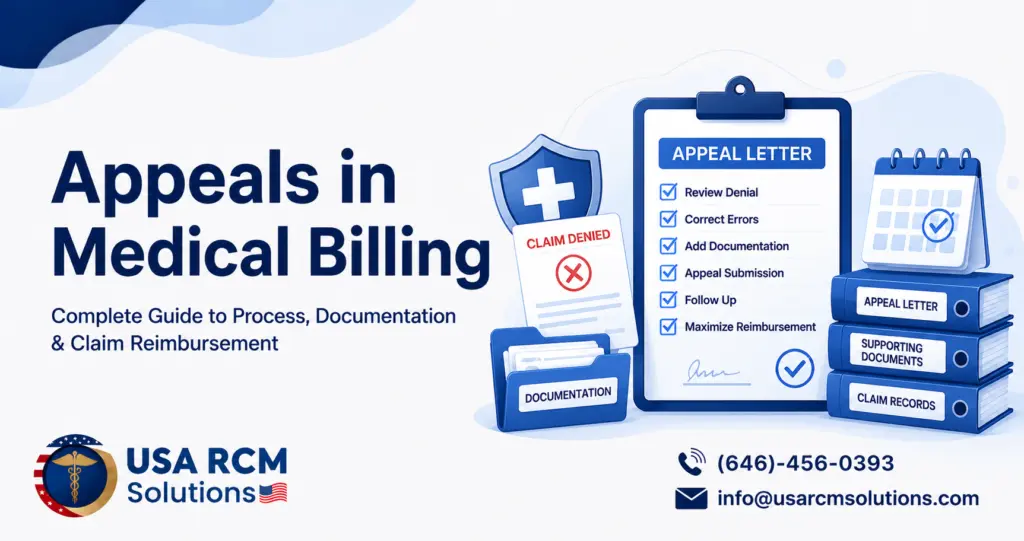
A Denied Medical Claim doesn’t mean lost revenue. It means more work.
Every practice deals with denials. Some come from small coding errors. Others come from missing documentation or payer-specific rules nobody flagged in time. Either way, the claim sits unpaid until someone submits a corrected claim or appeals it.
The appeals process in medical billing gives providers a formal path to challenge a payer’s decision and recover money they’ve already earned. But most appeals fail for the same reasons: missed deadlines, weak documentation, or a generic letter that doesn’t address the real denial code.
What Does It Mean to Appeal a Denied Medical Claim?
An appeal is a formal request asking the payer to reverse its decision on a claim. It’s not a resubmission. It’s a documented argument that the original denial was wrong, based on coding, medical necessity, or contract terms.
Common Reasons Claims Get Denied
Most denials fall into a few repeat categories:
- Incorrect or mismatched CPT and ICD-10 codes
- Missing or expired prior authorization
- Medical necessity not clearly documented
- Patient eligibility issues at the time of service
- Claims submitted after the timely filing limit
- Duplicate claim submissions
Identifying the exact denial code before doing anything else saves time. It tells you whether you’re dealing with a fixable error or a policy-based denial that needs a different approach.
Hard Denials vs Soft Denials
Not every denial is worth appealing. Soft denials are recoverable. They usually stem from a coding mistake, a missing modifier, or an incomplete form. Correct the issue and resubmit, and the claim often gets paid.
Hard denials are different. These are final decisions, often tied to a service the plan simply doesn’t cover. No amount of resubmission changes that outcome. Knowing which type you’re facing early prevents wasted time on claims that were never going to be reimbursed.
Levels of the Medical Billing Appeals Process
Most payers use a tiered appeal system. Each level gives you another chance to present evidence, but the process gets more formal and time-consuming as you move up.
First-Level Appeal (Claims Reconsideration)
This is the starting point for most soft denials. It’s a request to have the original decision reviewed again, usually with corrected information attached. Think fixed coding errors, added modifiers, or missing documentation submitted after the fact.
First-level appeals have the highest success rate. Most are resolved without escalating further, as long as the correction directly addresses the denial reason.
Second-Level Appeal
If the first-level appeal is denied, the Denied Medical Claim moves to a second-level review. This one carries more weight. The payer typically assigns a specialist or appeals committee instead of a standard claims processor.
Second-level appeals need stronger documentation than the first round. A copy of the same letter with no new evidence rarely changes the outcome here.
External Review
When internal appeals are exhausted, providers or patients can request an external review. An independent third party, not affiliated with the insurance company, evaluates the case. This level applies mainly to medical necessity and experimental treatment denials, and it carries legal weight under the Affordable Care Act for many plan types.
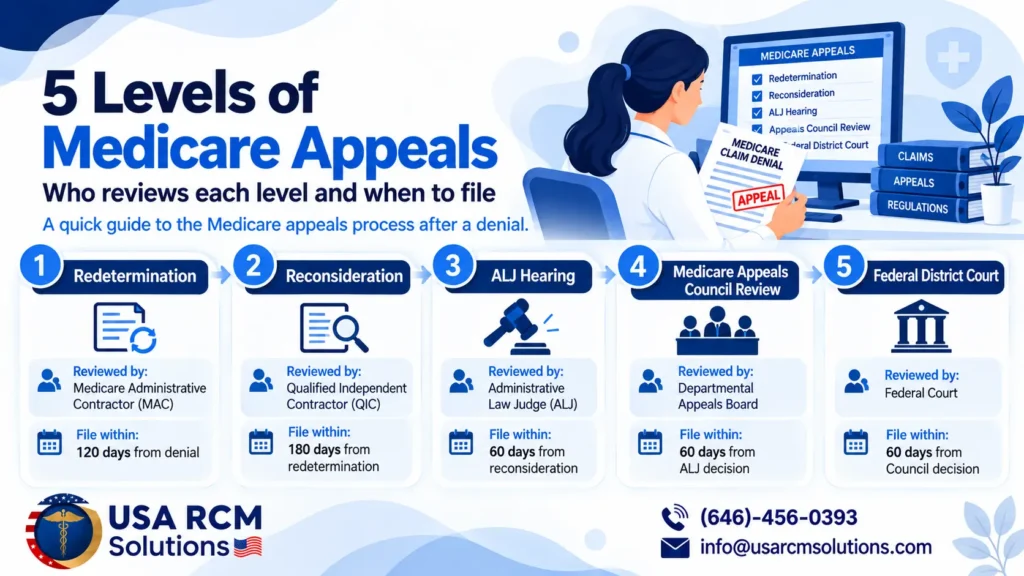
Medicare Redetermination and Appeal Levels
Medicare follows its own structured path:
| Appeal Level | Who Reviews It | Filing Deadline |
|---|---|---|
| Redetermination | Medicare Administrative Contractor (MAC) | 120 days from denial |
| Reconsideration | Qualified Independent Contractor (QIC) | 180 days from redetermination |
| Administrative Law Judge (ALJ) Hearing | ALJ | 60 days from reconsideration |
| Medicare Appeals Council Review | Departmental Appeals Board | 60 days from ALJ decision |
| Federal District Court | Federal Court | 60 days from Council decision |
Redetermination and reconsideration are the two levels billers encounter most often. Higher levels are rare and usually reserved for high-dollar or complex medical necessity disputes.
Appeal Deadlines You Cannot Miss
Deadlines make or break an appeal. Miss the window, and the claim is gone, regardless of how strong your documentation is.
Commercial Payer Deadlines
Commercial insurers set their own timelines, and they vary widely. Most fall somewhere between 30 and 180 days from the date of denial. The exact window is always listed on the denial notice or in the provider contract, so check it every time instead of assuming it matches a previous claim with the same payer.
Denied Medical Claim
Medicare deadlines are fixed and non-negotiable:
- Redetermination: 120 days from the denial notice
- Reconsideration: 180 days from the redetermination decision
- ALJ hearing: 60 days from the reconsideration decision
Medicare Part B claims specifically require appeals within 120 days of the denial notification. There’s no flexibility here, so tracking these dates needs to be built into your workflow, not handled case by case.
ERISA Plan Appeal Timeframes
Employer-sponsored health plans fall under ERISA regulations, which set their own appeal structure. These plans typically allow 180 days to file an internal appeal, followed by a defined window for external review if the internal appeal is denied. ERISA rules are federal, so they apply the same way regardless of which state the practice operates in.
A shared calendar across your billing team, tied to each payer’s specific deadlines, prevents claims from falling through simply because no one tracked the clock.
Documentation Required for a Strong Appeal
Weak documentation is the most common reason appeals fail, even when the underlying claim was legitimate. Payers need proof, not just a request for reconsideration.
Explanation of Benefits (EOB) and Claim Number
Every appeal starts with the EOB and the original claim number. Payers process thousands of claims daily, and without these identifiers, your appeal risks getting logged as a duplicate or lost entirely. Include the date of service, patient information, and denial code exactly as they appear on the EOB.
Clinical Notes and Medical Necessity Evidence
For denials tied to medical necessity, clinical documentation carries the appeal. This includes:
- Physician progress notes
- Diagnostic test results
- Treatment plans showing why the service was required
- Prior conservative treatments attempted, if applicable
Generic statements don’t work here. The documentation needs to directly connect the patient’s condition to the specific service billed.
Coding Support (CPT, ICD-10, LCD/NCD References)
When a denial stems from a coding or policy conflict, referencing the exact CPT and ICD-10 codes involved, along with the applicable LCD or NCD policy, strengthens the appeal significantly. Quoting the specific policy language that supports coverage shows the payer you’ve done the work, and it often speeds up the review.
A complete Denied Medical Claim appeal package pairs the EOB and claim number with clinical evidence and coding references in one submission. Sending pieces separately, or waiting to see what the payer asks for next, only slows down the process.
Step-by-Step Process to Appeal a Denied Medical Claim
Once the paperwork basics are clear, the actual appeal follows a repeatable sequence. Skipping steps is usually what causes delays later.
Step 1: Review the Denial Code and EOB
Start by reading the denial code carefully. Generic codes don’t always explain the real issue, so a quick call to the payer can clarify what’s actually missing or wrong. Record the date, the representative’s name, and a reference number for that call.
Step 2: Determine If the Denied Medical Claim Is Appeal-able
Not every denial deserves your time. Hard denials, like a service that’s excluded from the plan entirely, usually cannot be overturned. Confirm the denial is a soft denial or a disputable hard Denied Medical Claim before investing hours into an appeal that has no realistic path to payment.
Step 3: Gather Supporting Documentation
Pull together the EOB, claim number, clinical notes, and any coding references identified in the previous section. Organize them in the order the payer expects, since a scattered submission is more likely to get flagged as incomplete.
Step 4: Write and Submit the Appeal Letter
Draft a letter that states the claim details, the reason for the appeal, and the specific evidence supporting reconsideration. Use the payer’s standard appeal form when available. For medical necessity denials, a customized letter referencing clinical guidelines works better than a generic template.
Step 5: Track and Follow Up on the Appeal
Most payers respond within 30 to 60 days, though this varies. Follow up every 10 to 14 business days if you haven’t heard back. Log every interaction, including the date, the contact person, and what was said, so nothing gets lost if the appeal escalates to the next level.
How to Write an Effective Appeal Letter
The appeal letter is what a payer actually reads to make their decision. A well-structured letter speeds up approval. A vague one adds weeks to the process.
Key Elements Every Appeal Letter Needs
A strong appeal letter should include:
- Patient name, policy number, and date of service
- Original claim number and denial code
- A clear, one-paragraph summary of why the denial should be reversed
- Supporting documentation referenced directly, not just attached
- Contact information for follow-up questions
Keep the tone professional and factual. Avoid emotional language. Payers respond to evidence, not frustration.
Referencing Payer Policy and Coding Guidelines
Whenever possible, quote the specific payer policy, LCD, or NCD that supports your position. If the denial conflicts with CMS guidelines or the payer’s own published policy, state that directly in the letter. This shifts the burden back to the payer to justify their decision, rather than leaving your appeal open to a generic rejection.
Letters that reference exact policy language and coding logic get processed faster than letters that simply ask for reconsideration without backing it up.
Common Mistakes That Weaken an Appeal
Most Denied Medical Claim failed appeals aren’t due to a weak case. They’re due to avoidable errors in how the appeal was handled.
Missing Deadlines
This is the single biggest reason appeals get rejected outright, regardless of merit. Once the filing window closes, the payer has no obligation to review the case further. Tracking deadlines from the moment a denial is received, not weeks later, prevents this entirely.
Incomplete Documentation
Appeals submitted without the EOB, claim number, or full clinical support get delayed or denied on a technicality. Payers won’t chase down missing pieces on your behalf. Every required document needs to be in the initial submission.
Generic Appeal Letters
A copy-paste letter that doesn’t address the specific denial code rarely works. Payers can tell when a letter hasn’t been tailored to the actual reason for denial. Referencing the exact policy, code, or documentation gap shows the payer this appeal was prepared with intent, not just filed as a formality.
How USA RCM Solutions Helps Providers Win Appeals
Appealing a denied claim takes time most practices don’t have. USA RCM Solutions handles the entire process, so providers get paid faster without adding work to their staff’s plate.
Our team focuses on:
- Coding accuracy: Every claim is checked against current CPT and ICD-10 guidelines before submission, reducing the coding errors that trigger denials in the first place.
- Clean claims: We build claims correctly the first time, cutting down on the back-and-forth that delays reimbursement.
- Faster reimbursements: Our team tracks appeal deadlines and follows up on schedule, so claims don’t stall in a payer’s queue.
- Denial management: We review every denial by root cause, decide which ones are worth appealing, and build a documented case that addresses the payer’s specific reason for denial.
For small and solo practices, this means fewer denied claims sitting unresolved and more revenue actually collected.
Conclusion
Appealing a Denied Medical Claim is not complicated once the process is clear. It comes down to knowing the appeal level that applies, tracking the deadline before it closes, and submitting complete documentation the first time. Accuracy in coding and clinical evidence is what turns a denial into a payment, and every missed step in that chain adds delay and lost revenue. Practices that treat appeals as a repeatable process, not a reactive scramble, recover more of what they’ve already earned. That consistency is what protects a practice’s cash flow long term.