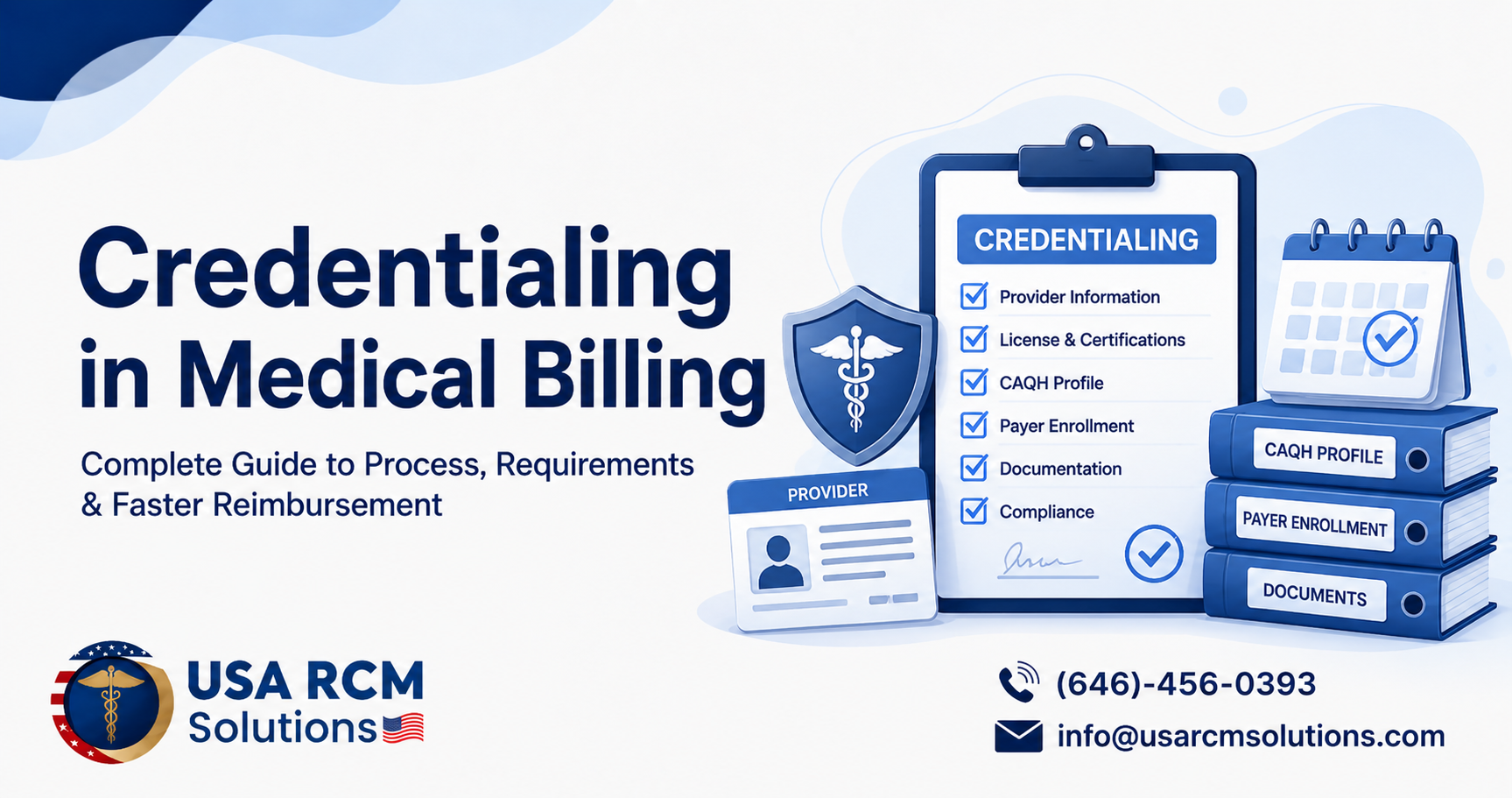
Credentialing in medical billing is the process of verifying a provider’s education, training, licensure, and work history before they can bill insurance companies. Payers use this process to confirm that a provider is qualified and legitimate before allowing them into their network.
Without it, a provider cannot submit claims to that payer. It doesn’t matter how good the documentation is or how clean the coding looks. If credentialing isn’t complete, the claim gets rejected before it’s even reviewed.
Credentialing typically covers:
- Medical school and residency verification
- State license validation
- Board certification checks
- Work history and malpractice history review
- DEA registration confirmation
- NPI number verification
Most payers require this information to be submitted through CAQH ProView, a centralized database that stores provider credentials and shares them with participating insurance companies. This reduces duplicate paperwork, but it doesn’t reduce the need for accuracy. One outdated license number or missing document can stall the entire process.
Why Credentialing in Medical Billing Matters for Providers and Practices
Credentialing isn’t just paperwork. It directly shapes how fast a practice gets paid and how much risk it carries.
Impact on Reimbursement and Cash Flow
A provider who isn’t credentialed with a payer cannot bill that payer, period. Any services rendered before credentialing is complete are often unbillable, which means the practice absorbs that cost. This is especially painful for new hires. A physician can start seeing patients on day one, but if credentialing takes 90 days, that’s 90 days of visits the practice may never get paid for.
Delays compound the problem. Since payers often deny claims tied to incomplete or expired credentials, cash flow takes a direct hit. This is why credentialing timelines need to start before a provider’s first patient visit, not after.
Impact on Compliance and Patient Trust
Credentialing in Medical Billing also protects the practice legally. It confirms that every provider meets state licensing rules, payer requirements, and federal standards like those set by CMS. Skipping steps or letting credentials lapse can expose a practice to compliance violations, audits, or even fraud investigations.
There’s also a trust factor. Patients assume their provider is properly vetted. When credentialing is handled correctly, it reinforces that trust and keeps the practice in good standing with both patients and payers.
The Credentialing in Medical Billing: Process, Steps & Benefits Process Step by Step
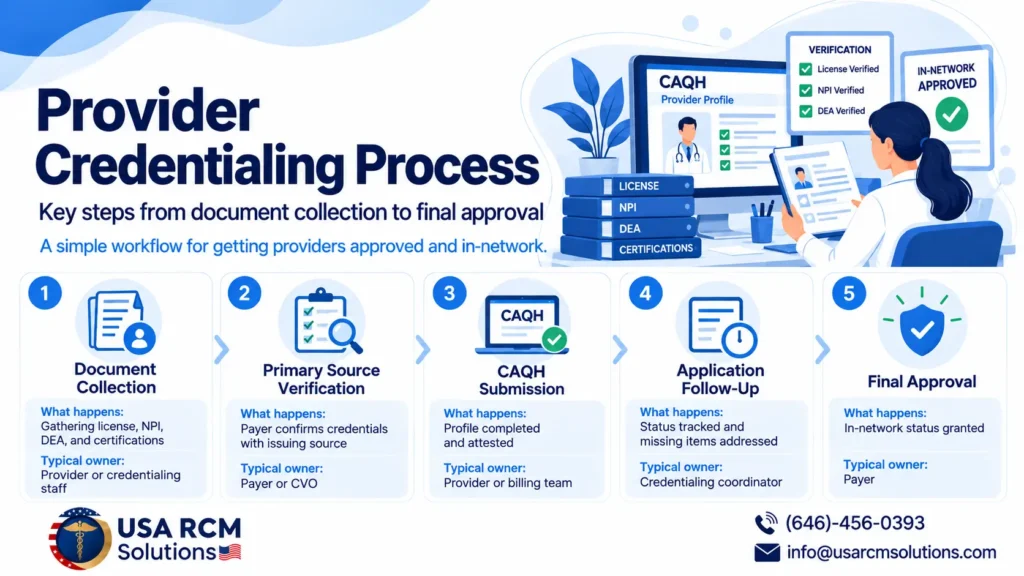
Credentialing in Medical Billing follows a set sequence. Skipping or rushing any step usually leads to delays later.
Gathering Provider Documentation
The process starts with collecting every document a payer will ask for. This includes the provider’s NPI number, state license, DEA registration, board certification, malpractice insurance, and work history. Missing even one document can push the timeline back by weeks.
Primary Source Verification (PSV)
Once documents are collected, payers verify them directly with the issuing source. This means contacting medical schools, licensing boards, and previous employers to confirm the information is accurate. PSV is the most time-consuming part of credentialing, and it’s also the part providers have the least control over.
CAQH ProView Submission
Most payers pull provider data from CAQH ProView. The provider’s profile needs to be complete, accurate, and re-attested regularly. An outdated CAQH profile is one of the most common reasons credentialing stalls.
Payer Application and Follow-Up
After CAQH is updated, the practice submits an application to each individual payer. This is not a one-and-done step. Applications need active follow-up. Payers rarely reach out proactively, so someone has to track status, respond to requests, and push applications forward.
Final Approval and In-Network Status
Once everything checks out, the payer approves the provider and grants in-network status. Only after this step can the provider legally bill that payer for services rendered.
| Step | What Happens | Typical Owner |
|---|---|---|
| Document collection | Gathering license, NPI, DEA, certifications | Provider or credentialing staff |
| Primary source verification | Payer confirms credentials with issuing source | Payer or CVO |
| CAQH submission | Profile completed and attested | Provider or billing team |
| Application follow-up | Status tracked, gaps addressed | Credentialing coordinator |
| Final approval | In-network status granted | Payer |
How Long Does Credentialing Take?
Credentialing rarely moves fast. Most providers wait anywhere from 60 to 120 days before they’re fully approved, and delays are common even with clean applications.
Average Timelines by Payer Type
Timelines vary depending on the payer and how complete the initial application is. Here’s a general breakdown based on typical processing windows.
| Payer Type | Typical Timeline |
|---|---|
| Medicare | 60 to 90 days |
| Medicaid | 45 to 90 days |
| Commercial Payers (BCBS, Aetna, etc.) | 90 to 120 days |
| Group Credentialing | 90 to 150 days |
These are averages, not guarantees. Missing documents, payer backlogs, or incomplete CAQH profiles can push timelines well past 120 days. This is why credentialing should start as early as possible, ideally before a provider’s start date, not after.
Individual vs. Group Credentialing
Not all Credentialing in Medical Billing works the same way. The path a provider takes depends on how the practice is structured.
Key Differences Providers Should Know
Individual Credentialing in Medical Billing means a provider is credentialed under their own NPI and tax ID. This gives them flexibility. They can move between practices without starting the process over each time, since their credentials stay tied to them personally.
Group credentialing works differently. Multiple providers are credentialed under one group application, tied to the practice’s tax ID. This is common in larger clinics or hospital systems. It simplifies the initial process, but if a provider leaves the group, they still need individual credentials to bill under a new tax ID elsewhere.
| Factor | Individual Credentialing | Group Credentialing |
|---|---|---|
| Billing structure | Tied to provider’s own NPI/tax ID | Tied to group’s tax ID |
| Portability | Moves with the provider | Does not transfer automatically |
| Best for | Solo practitioners, locum providers | Multi-provider practices, hospitals |
| Application complexity | Simpler per provider | More coordination required |
Choosing the right structure upfront saves time later, especially for practices planning to add providers or expand into new locations.
Common Credentialing Errors That Delay Payments
Most Credentialing in Medical Billing delays aren’t caused by payers. They’re caused by small, avoidable mistakes on the application side.
Incomplete or Inaccurate Applications
A single typo in an NPI number, license number, or address can trigger a rejection. Payers don’t fix these errors for you. The application goes back, and the clock resets. Even minor inconsistencies between CAQH data and payer applications can cause the same problem.
Missed Re-Credentialing Deadlines
Credentialing isn’t a one-time task. Most payers require re-credentialing every 2 to 3 years. If a provider’s credentials lapse, they can lose in-network status without warning, which means claims start denying immediately. Tracking renewal dates proactively is the only way to avoid this.
Credentialing and Claim Denials: The Hidden Connection
Many practices treat credentialing and claims processing as separate problems. They’re not. A large share of denials trace back to credentialing gaps that were never fixed at the source.
How Credentialing Gaps Lead to Revenue Loss
When a provider isn’t properly credentialed, every claim tied to their services is at risk. Payers deny these claims outright, and appealing them rarely works since the issue isn’t clinical. It’s administrative.
This creates a chain reaction. Denied claims mean delayed revenue. Delayed revenue means cash flow problems. And if the gap isn’t caught early, it can affect months of billing before anyone notices the root cause.
Practices that review credentialing status regularly, not just during onboarding, catch these gaps before they turn into denied claims. This is one of the most overlooked connections in revenue cycle management.
Best Practices to Speed Up the Credentialing Process
Credentialing takes time no matter what, but the right habits shorten the wait and reduce denials.
Staying Ahead of Re-Credentialing Cycles
Start credentialing at least 90 days before a provider’s expected start date. Waiting until hiring is finalized almost always causes gaps in billable time.
Keep CAQH profiles updated year-round, not just when a payer asks for it. An outdated profile is one of the fastest ways to stall an otherwise clean application.
Track re-credentialing deadlines the same way you track contract renewals. Set reminders well before expiration, since most payers don’t send warnings until it’s too late.
Follow up with payers consistently. Applications that sit untouched take longer. A quick status check every one to two weeks keeps things moving.
Finally, double-check every document before submission. A second set of eyes catches typos and mismatches that cause avoidable rejections.
How USA RCM Solutions Supports Provider Credentialing
Credentialing errors are avoidable, but only with the right process behind them. At USA RCM Solutions, we manage credentialing with the same accuracy we bring to coding and claims.
Our team handles documentation collection, CAQH profile management, and payer follow-up so nothing falls through the cracks. We track re-credentialing deadlines proactively, which means fewer lapses and fewer denied claims tied to expired credentials.
Because credentialing and billing are connected, our approach doesn’t stop at approval. We monitor how credentialing status affects claims downstream, catching gaps before they turn into revenue loss. This is what allows our clients to submit clean claims and get reimbursed faster, without the administrative back-and-forth that usually slows the process down.
Conclusion
Credentialing is not a side task in medical billing. It’s the foundation that determines whether a provider gets paid at all. Accurate documentation, timely CAQH updates, and consistent payer follow-up prevent the delays that cost practices real revenue. When credentialing is treated with the same discipline as coding and claims submission, denials drop and reimbursements arrive faster. For providers and practices, getting this process right isn’t optional. It’s what keeps the entire revenue cycle moving.