Radiology claims get denied more often than most billers expect. A big part of the problem comes down to one thing: code selection. CPT code 74177 is one of the most billed radiology codes in the country, yet many practices still lose revenue on it because of missing modifiers, weak documentation, or confusion with similar codes.
What Is CPT Code 74177
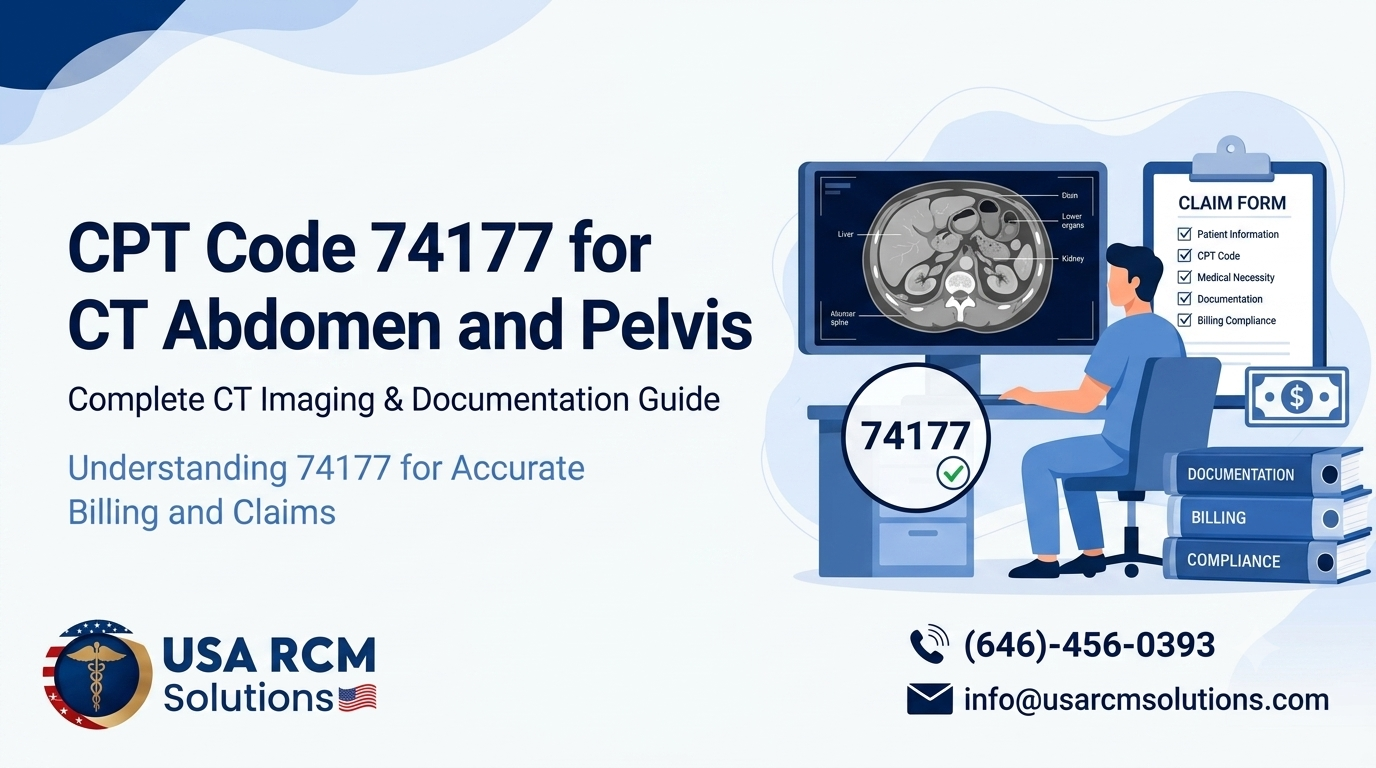
CPT code 74177 reports a CT scan of the abdomen and pelvis performed with contrast material. It falls under the diagnostic radiology section of the CPT code set. Providers use it when a single combined study covers both regions in one session.
Official CPT Description
The American Medical Association defines CPT 74177 as “computed tomography, abdomen and pelvis, with contrast material.” This means both the abdomen and the pelvis must be scanned together. If only one region is imaged, this code does not apply. Billers should always confirm that both anatomical areas appear in the radiology report before selecting this code.
Why Contrast Matters for This Code
Contrast is the deciding factor between CPT Code 74177 and its related codes. The contrast must be given intravenously to qualify. Oral or rectal contrast alone does not meet the definition of “with contrast” under CPT guidelines. If the radiology report does not clearly state that IV contrast was used, the claim can be flagged during payer review. This is one of the most common documentation gaps billers run into with this code.
CPT 74177 vs Similar CT Codes
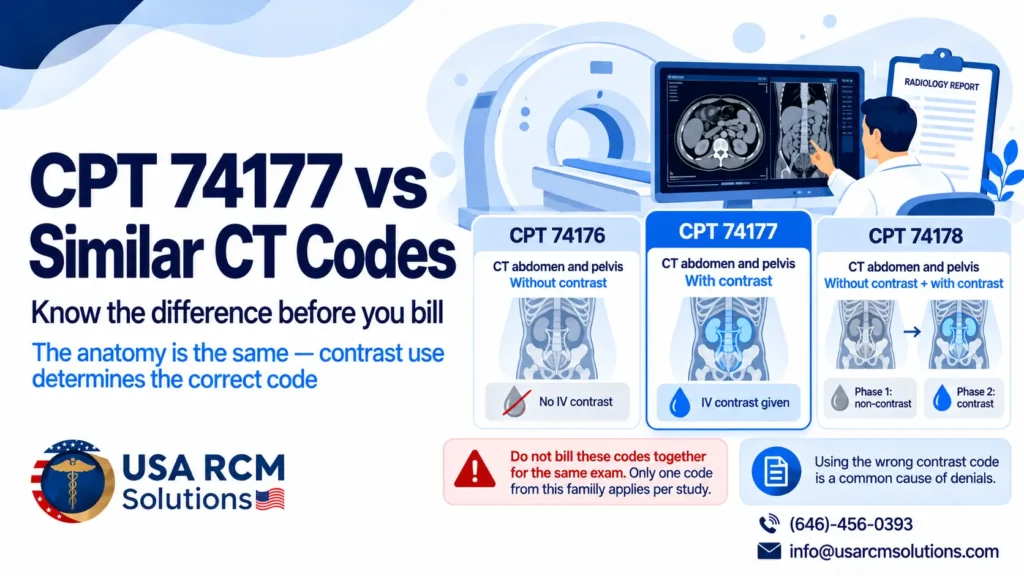
Coders often mix up CPT 74177 with the codes around it. The differences come down to anatomy and contrast use, and getting this wrong is one of the fastest ways to trigger a denial.
CPT 74176 vs CPT 74177
CPT 74176 reports the same combined abdomen and pelvis CT scan, but without contrast. If the radiology report shows no IV contrast was given, 74176 is the correct code, not 74177. These two codes should never be billed together for the same session. Only one code from this family applies per exam.
CPT 74177 vs CPT 74178
CPT 74178 applies when the exam includes both a non-contrast phase and a contrast phase for the same abdomen and pelvis study. This happens when the radiologist needs a baseline image first, then follows it with contrast enhancement. If both phases appear in the same report, 74178 is billed instead of 74177. Billing 74177 alone when a true dual-phase study was performed under-codes the service and can also raise compliance concerns during an audit.
When Is CPT Code 74177 Used
Physicians order this scan for a wide range of abdominal and pelvic complaints. Understanding the common clinical scenarios helps billers spot medical necessity gaps before a claim goes out the door.
Abdominal Pain and Appendicitis
CT abdomen and pelvis with contrast is a standard tool for diagnosing appendicitis in adults. It also helps rule out other causes of abdominal pain, like diverticulitis or bowel obstruction. A typical case involves a patient with right lower quadrant pain, fever, and elevated white blood cell count. The scan confirms or rules out inflammation, and the report should clearly state the clinical reason for the study.
Vascular Conditions
This code also applies when physicians suspect vascular problems in the abdominal or pelvic area, such as an abdominal aortic aneurysm. Contrast enhancement makes it easier to see blood vessels, blockages, and abnormal dilations. A patient presenting with back pain, a pulsing sensation in the abdomen, and a history of tobacco use is a common example that supports this code.
Cancer Staging and Inflammatory Disease
Oncologists frequently order this scan to stage cancers involving the colon, kidney, or reproductive organs. It also supports diagnosis and monitoring of inflammatory conditions like Crohn’s disease, ulcerative colitis, or pelvic inflammatory disease. In both cases, the ICD-10 code on the claim needs to match the clinical reason documented in the order and the final report.
ICD-10 Codes That Support CPT 74177
Medical necessity depends on pairing CPT Code 74177 with the right diagnosis code. Payers want to see a clear clinical reason for the scan, not just a generic complaint.
Common ICD-10 codes billed with this CPT code include:
| ICD-10 Code | Description |
|---|---|
| R10.9 | Unspecified abdominal pain |
| K35.80 | Unspecified acute appendicitis |
| K52.9 | Noninfective gastroenteritis and colitis |
| K85.9 | Acute pancreatitis, unspecified |
| C18.9 | Malignant neoplasm of colon, unspecified |
| C64.9 | Malignant neoplasm of kidney, unspecified |
| I71.4 | Abdominal aortic aneurysm, without rupture |
Coders should always confirm that the diagnosis code matches what the radiologist actually documented in the findings, not just what was written on the order. A mismatch between the order and the report is a common reason payers push claims into review.
Modifiers Used With CPT 74177
Modifiers tell the payer exactly how the service was performed and who performed which part of it. Using the wrong one, or leaving one off, is one of the most common reasons this code gets denied.
Modifier 26 and Modifier TC
Modifier 26 reports the professional component. This applies when a radiologist only interprets the images and does not own the equipment used to produce them. Modifier TC reports the technical component, which covers the equipment, staff, and supplies needed to perform the scan. When the same provider does both parts, no modifier is needed and the code is billed globally.
Modifier 59 and Modifier 52
Modifier 59 identifies a distinct procedural service when 74177 is billed alongside another CT code that might otherwise be bundled. Modifier 52 reports a reduced service, used when the scan was started but not fully completed for a valid clinical reason. Both modifiers require strong documentation to support their use. Payers will ask for the report if either one looks unclear.
Documentation Needed for Medical Necessity
Clean claims start with a complete radiology report. Missing details are one of the biggest drivers of denials for this code.
The report should always include:
- Clear clinical indication for the scan
- Confirmation that both the abdomen and pelvis were imaged
- Type of contrast used and how it was administered
- Detailed findings, including any abnormalities identified
- Physician’s final interpretation
Billers should review the report before submitting the claim, not after a denial comes back. Catching a documentation gap early saves time and protects revenue.
Reimbursement Rates and Medicare Fee Schedule
CPT Code 74177is listed on the Medicare Physician Fee Schedule (MPFS), and most commercial payers base their own rates on it. National averages for this code generally fall in the $300 to $500 range, though the exact number depends on several factors.
Factors That Affect Payment
Location plays a big role. The Geographic Practice Cost Index (GPCI) adjusts payment based on where the service was performed, so a scan in a high-cost metro area pays more than the same scan in a rural setting. Place of service also matters, since facility and non-facility rates differ. Payer-specific contracts add another layer, which means billers should check the exact rate with each MAC or commercial payer rather than assuming a flat number applies across the board.
Common Denial Reasons and How to Avoid Them
Most denials on this code come down to a handful of repeat issues. Knowing them in advance makes it easier to catch problems before submission.
- Wrong code selection: Billing 74177 when only one region was scanned, or when no contrast was used
- Missing modifiers: Submitting a claim without modifier 26 or TC when the components were split
- Medical necessity gaps: Documentation that does not clearly support why the scan was ordered
- Frequency issues: A repeat CT ordered too soon after a prior one, without a documented reason
- Authorization problems: Missing prior authorization for payers that require it
Practices that track denial reasons by code, rather than just overall denial rate, catch patterns faster and fix them at the source instead of appealing the same mistake over and over.
How USA RCM Solutions Helps With Radiology Billing
Radiology billing carries more risk than most specialties because of how easily codes like 74177 get denied. At USA RCM Solutions, we focus on getting these claims right the first time.
Our team checks every radiology report against the code selected, confirms modifier use before submission, and flags weak medical necessity documentation before it becomes a denial. This means cleaner claims, fewer rejections, and faster reimbursement for your practice. When denials do happen, our appeals process is built to recover revenue quickly instead of letting claims sit unresolved.
If your practice is losing revenue to radiology denials, we can help you find out exactly where the leaks are and fix them.
Conclusion
CPT code 74177 is a high-volume code, which means small errors add up fast across a practice’s claims. Getting the anatomy, contrast documentation, modifiers, and diagnosis codes right on the first submission protects revenue and keeps cash flow steady. Practices that treat this code with the same attention as more complex ones see fewer denials and faster payment.