

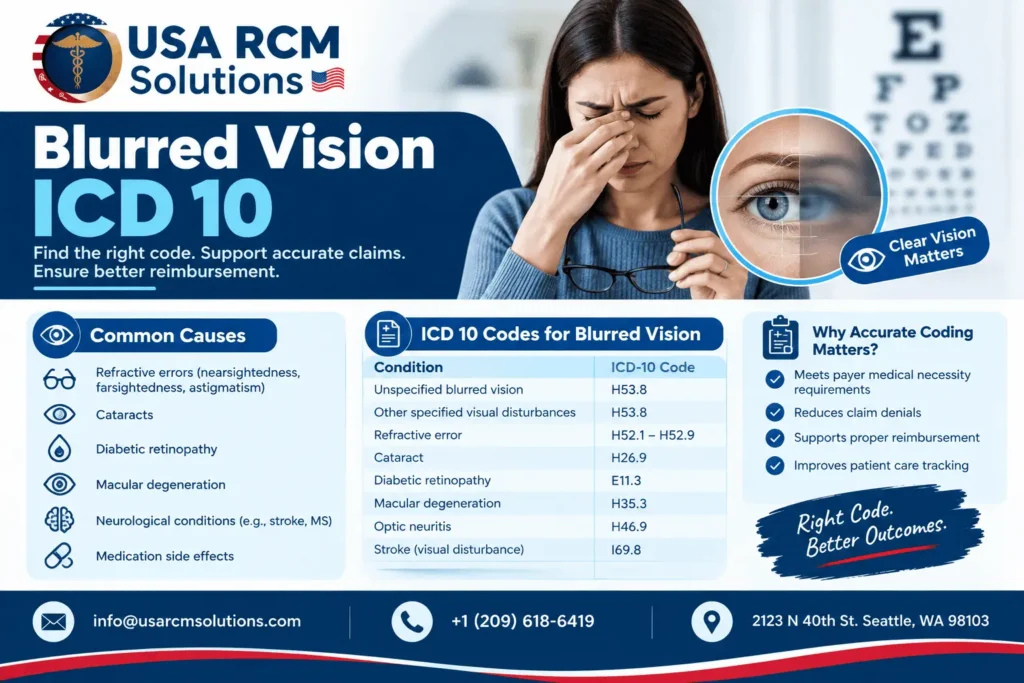
Blurred vision ICD 10 coding starts with code H53.8, which means “Other visual disturbances.” That is the short answer. However, the right code depends on what the provider writes in the chart. So a quick lookup often leads to the wrong pick.
Here is why the topic confuses people. Blurred vision ICD 10 is a symptom, not a disease. Therefore, coders use H53.8 only when the provider finds no cause. If the note says “visual disturbance” with no detail, H53.9 fits better. And if the provider confirms a cataract or diabetic retinopathy, that diagnosis replaces the symptom code.
Consider a patient who says, “My right eye looks foggy.” The front desk hears one complaint. But the chart may show a symptom, a test result, or a confirmed disease. Each version leads to a different code. So the same complaint can produce three different claims.
Wrong codes cost real money. Payers deny claims when the diagnosis does not support the visit or test. Billers then spend hours on rework and appeals. Meanwhile, the practice waits longer to get paid.
This guide walks through each step. You will learn which code fits which note. Along the way, you will see how to bill the claim and avoid common errors. Finally, you will learn where to find official resources from the CDC and CMS.
Blurred Vision ICD 10 Code at a Glance
Most coders want a fast answer first. Therefore, here is the short version. The ICD-10-CM index sends “blurred vision” to code H53.8. That code belongs to the visual disturbances group, H53.
What Is the ICD 10 Code for Blurred Vision?
The ICD 10 code for blurred vision is H53.8. Its official title is “Other visual disturbances.” The H53.8 ICD 10 description covers blurring that the provider has not tied to a cause. If the note only says “visual disturbance,” coders use H53.9 instead. That code means “Unspecified visual disturbance.”
Many people search for the ICD 10 code for blurry vision, and the answer stays the same. Blurred vision ICD 10 lookup point to H53.8. The two words mean the same thing in coding.
| Code | Description | When to Use It |
| H53.8 | Other visual disturbances | Blurred or blurry vision with no known cause |
| H53.9 | Unspecified visual disturbance | Note says only “vision problem” or “visual disturbance” |
| H53.2 | Diplopia | Patient sees double, not blurred |
| H53.12- | Transient visual loss | Vision dims or fades briefly, then returns |
| H53.13- | Sudden visual loss | Vision drops quickly and stays reduced |
What Does an ICD-10 Code for Blurry Vision Reveal About My Condition?
A symptom code tells your insurer why you saw the doctor. It does not name a disease. So H53.8 says you had blurred vision, but it does not say why.
This matters for patients. Your code does not mean you have a serious eye disease. It often means the provider is still investigating. After tests, the provider may replace the symptom code with a firm diagnosis.
Coders follow a simple rule here. They code a symptom only when no confirmed diagnosis explains it. If the provider diagnoses a cataract, the cataract code replaces H53.8. This rule keeps claims accurate and clean.
What Is a Medical Term for Blurry Vision?
Doctors usually write “blurred vision” or “visual blurring” in the chart. Some also write “decreased visual acuity.” That phrase refers to a measured drop on an eye chart. It differs slightly from a patient’s complaint.
Another term is “asthenopia,” which means eye strain. Strain can cause temporary blur after long screen use. Coders should match the code to the exact words the provider writes. They should never guess a diagnosis from a symptom.
A visual disturbance ICD 10 search brings up the same H53 family. The family includes blur, double vision, halos, and flashes. So the exact wording in the note drives the final code.
Common Causes of Unclear Vision That Require an ICD-10 Classification
Many conditions cause unclear vision. Once the provider confirms one, the code changes. Therefore, coders must read the full note before they pick a code.
| Cause | Example ICD-10 Range | What Providers Often Document |
| Refractive error | H52.- | Nearsightedness, farsightedness, astigmatism |
| Presbyopia | H52.4- | Trouble reading up close after age 40 |
| Cataract | H25.- to H26.- | Clouded lens, glare, faded colors |
| Diabetic retinopathy | E11.3- | Blur in a patient with diabetes |
| Glaucoma | H40.- | Optic nerve damage, pressure changes |
| Macular degeneration | H35.3- | Blur or distortion in central vision |
| Dry eye disease | H04.12- | Blur that clears with blinking |
| Migraine with aura | G43.- | Short visual disturbance before headache |
Systemic problems also matter. High blood pressure, diabetes, and stroke can all blur vision. So a provider may refer the patient to a specialist. That referral often changes the diagnosis code on later claims.
ICD-10 Code for Transient Blurred Vision
Transient means the blur comes and goes. Patients often say their sight “greyed out” for a few minutes. The code depends on how the provider documents it.
If the note says transient blurred vision, many coders still use H53.8. However, if the provider documents transient visual loss, the H53.12- codes apply. These codes include laterality. For example, H53.121 means the right eye. H53.122 means the left eye. H53.123 covers both eyes, and H53.129 covers an unspecified eye.
Transient vision problems can signal a vascular event. So providers sometimes order a cardiac workup. For example, an echocardiogram billed under CPT 93306 may support an embolic source search. The diagnosis code must show why the test was necessary. Otherwise, the payer may deny the claim.
Right Eye Blurred vision ICD 10: How to Code It
Many coders ask about right eye Blurred vision ICD 10 codes. The plain answer surprises them. H53.8 has no right or left option. It applies to the patient whichever eye is affected.
However, you can still document the side in the note. Some related codes do carry laterality. Here are common examples.
| Situation | Code Option | Eye |
| Transient visual loss | H53.121 | Right |
| Sudden visual loss | H53.131 | Right |
| Visual discomfort (eye strain) | H53.141 | Right |
| Blurred vision, cause unknown | H53.8 | No laterality |
Choose a laterality code only when the provider documents that diagnosis. Do not swap codes just to show the side. That habit creates mismatches and denials.
Related and Alternative ICD-10 Codes
Sometimes H53.8 is not the best fit. The ICD 10 code for vision changes depends on what the provider found. Here are the most common alternatives.
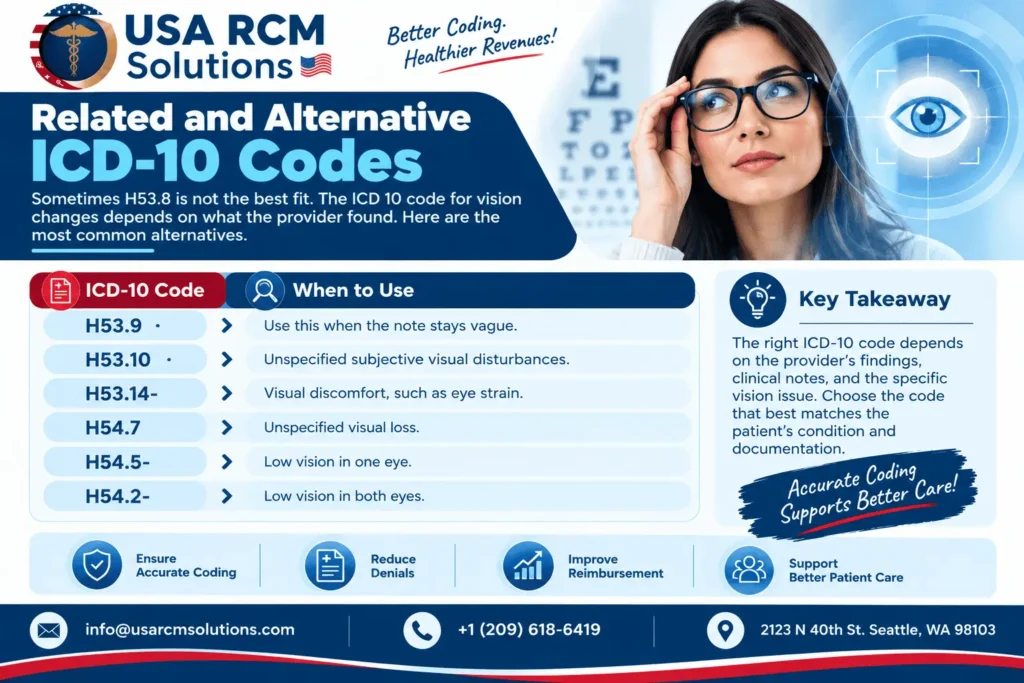
- H53.9: Use this when the note stays vague.
- H53.10: Unspecified subjective visual disturbances.
- H53.14-: Visual discomfort, such as eye strain.
- H54.7: Unspecified visual loss.
- H54.5-: Low vision in one eye.
- H54.2-: Low vision in both eyes.
Vision loss ICD 10 coding needs extra care. The H54 range covers blindness and low vision. These codes describe a measured loss. They do not describe simple blur. Therefore, use them only when the provider documents the level of loss.
Another rule helps here. Never code both a symptom and its confirmed cause on the same claim line. The confirmed cause already explains the symptom.
Where Can I Find Official ICD 10 Coding Resources for Blurred Vision?
Always verify codes against official sources. Third-party lists sometimes lag behind updates. These sources stay reliable:
- CDC and NCHS: They publish the ICD-10-CM code files and guidelines each year.
- CMS: The agency posts annual updates, code tables, and billing rules.
- WHO ICD browser: It shows the international ICD-10 structure.
- American Academy of Ophthalmology: It offers coding guidance for eye care teams.
- Your payer portals: They list payer-specific coverage rules.
New code sets take effect each October. Today is October 26, 2026, so the fiscal year 2027 set is already active. Check the current tables before you submit any claim.
Understanding Medical Billing for Blurred vision ICD 10 Diagnosis Codes
A Blurred vision ICD 10 diagnosis code alone does not get a claim paid. The claim needs a matching service, clear notes, and verified coverage. So billing teams follow a set process.
Step-by-Step Billing Process
- Verify coverage. Confirm the plan is active before the visit.
- Collect the complaint. Record when the blur started and which eye it affects.
- Document the exam. The provider writes findings, tests, and the assessment.
- Assign the code. The coder picks H53.8, H53.9, or a confirmed diagnosis.
- Link the procedure. Match the visit or test code to the diagnosis.
- Submit and track. Send the claim and watch for edits or denials.
Step one matters more than most teams think. Eligibility and Verification of Benefits in Medical Billing tells you whether the plan covers medical eye visits. It also shows whether the plan treats the visit as routine vision care. Many denials start because the team skipped this check.
A Real Example
Consider a 58-year-old patient with diabetes. She visits her primary care provider because of blurry vision in her right eye. The provider finds no cause that day and orders a referral. The practice bills the visit with H53.8 as the reason for the visit.
Next, an ophthalmologist finds diabetic retinopathy. That specialist bills the confirmed diagnosis, not H53.8. The first claim stays valid because the first provider only saw a symptom. This example shows why each provider codes only what they find.
Which Healthcare Providers Accept ICD 10 Codes for Blurred Vision Claims?
Providers do not “accept” codes in the way many people think. Instead, payers process claims that carry valid ICD-10-CM codes. Every provider who bills insurance in the United States must use the code set.
These providers regularly bill Blurred vision ICD 10 claims:
- Ophthalmologists and optometrists
- Primary care physicians
- Neurologists and endocrinologists
- Emergency departments and urgent care centers
- Telehealth clinics that offer eye triage
Payers include Medicare, Medicaid, and commercial plans. However, each plan sets its own coverage rules. Some plans cover medical eye exams under the health benefit. Others send them to a separate vision plan. So the billing team should confirm the benefit path first.
Key Optimization Methods
Strong coding habits protect revenue. Here are proven methods that practices use.
| Method | What It Means | Benefit |
| Document specifics | Record onset, duration, and affected eye | Fewer queries and denials |
| Code to the highest certainty | Use confirmed diagnoses over symptoms | Better medical necessity |
| Link codes to services | Match each test to a supporting diagnosis | Cleaner claim edits |
| Verify benefits early | Check eligibility before the visit | Fewer surprise denials |
| Audit monthly | Review a sample of eye claims | Spot patterns early |
Best Tools and Practices
Good tools reduce manual errors. Good habits make those tools work better.
| Tool or Practice | Purpose | Tip |
| Encoder software | Searches and validates ICD-10-CM codes | Update it every October |
| Claim scrubber | Flags mismatched diagnosis and procedure codes | Review edits daily |
| EHR templates | Prompts providers for laterality and onset | Keep templates short |
| Payer policy library | Stores local coverage rules | Review it each quarter |
| Coder education | Keeps staff current on guideline changes | Hold short monthly sessions |
Common Mistakes
Even experienced teams repeat the same errors. Watch for these.
| Mistake | Why It Hurts | Fix |
| Using H53.9 when the note supports H53.8 | Payers see the claim as vague | Read the exact wording |
| Coding the symptom and the confirmed cause | Creates a redundant claim line | Code only the cause |
| Skipping laterality when it exists | Triggers rejections on some codes | Check the code options |
| Ignoring payer medical necessity rules | Leads to denied tests | Review local policies |
| Using outdated code sets | Produces invalid codes | Update each October |
Future Trends
Eye care billing keeps evolving. These trends deserve attention.
| Trend | What to Expect | Action | |
| AI-assisted coding | Software suggests codes from notes | Keep human review in place | |
| Teleophthalmology growth | More remote visits for vision complaints | Confirm telehealth payer rules | |
| Stricter prior authorization | More payers question imaging and tests | Document necessity clearly | |
| Real-time eligibility tools | Instant benefit checks at scheduling | Adopt them early | |
| Value-based eye care | Payment ties to quality measures | Track outcomes data |
How USA RCM Solutions Supports Eye Care and Medical Practices
Eye care billing needs accurate codes and steady follow-up. USA RCM Solutions helps practices handle both.
The team offers Medical Billing & Coding Services for symptom and diagnosis claims.
Practices also use its Medical Credentialing Services to join payer networks faster.
Cash flow improves with its Accounts Receivable Services.
When claims fail, Denial Management Services helps recover lost revenue.
A Virtual Medical Scribe can capture exam details so notes support the right code.
Finally, Healthcare Marketing Services help practices reach new patients.
Conclusion
Blurred vision ICD 10 coding starts with H53.8 for most cases. Use H53.9 when the note stays unspecified. Move to a confirmed diagnosis once the provider finds the cause. Remember that H53.8 has no laterality, so related codes handle right or left eye needs.
Accurate notes, early benefit checks, and current code sets prevent most denials. Therefore, build these habits into your daily workflow. Review official CDC and CMS resources each October. With clear documentation, your claims for blurred vision can move through payers with fewer delays.
FAQs
Can I bill H53.8 together with a confirmed diagnosis like cataract?
Usually, you should not. Coding rules say a symptom code should not appear when a confirmed diagnosis explains it. The cataract code already accounts for the blur. However, if the blur has a separate unexplained part, the provider must document that clearly.
Does Medicare cover an eye exam for Blurred vision ICD 10?
Original Medicare does not cover routine eye exams or glasses. However, it may cover a medical eye visit when a symptom needs evaluation. The claim must show medical necessity through proper diagnosis codes. Patients should check their specific plan before the visit.
When do new ICD-10-CM codes take effect each year?
New and revised codes take effect on October 1 each year. That date starts the federal fiscal year. Because of this, billing teams should update encoders and templates in September. Using an outdated code after the start date can cause rejections.
Can a telehealth visit use the Blurred vision ICD 10 code?
Yes, in many cases. A provider can evaluate a vision complaint by video and assign H53.8. However, the payer’s telehealth rules still apply. The claim needs the correct place of service and any required modifier. Providers should also document why the visit needed no in-person exam.