
Getting the COPD exacerbation ICD 10 code right matters for every respiratory claim. The condition sends many patients to the emergency room and the hospital. However, coders often pick the wrong code when an infection appears in the chart. Therefore, this guide explains each code, its use, and its documentation needs.
You will learn how J44.1, J44.0, and J44.9 differ. Moreover, you will see how asthma, bronchitis, and pneumonia fit in. Because rules change each October, we use plain steps and real examples.
What Is COPD? A Quick Background
COPD stands for chronic obstructive pulmonary disease. It is a long-term lung disease that blocks airflow. Emphysema and chronic bronchitis both fall under this label. Smoking is the leading cause, but air pollution and dust also play a role.
Patients feel short of breath, cough often, and bring up mucus. Over time, symptoms get worse. So doctors treat COPD with inhalers, lifestyle changes, and sometimes oxygen.
Chronic Obstructive Pulmonary Disease ICD 10 Basics
The chronic obstructive pulmonary disease ICD 10 category is J44. It sits in Chapter 10 of ICD-10-CM, which covers diseases of the respiratory system. The category splits into several codes. Each code tells a different story about the patient’s condition.
Most coders start with COPD ICD 10 lookups in the index. Then they check the tabular list to confirm the details. This two-step habit prevents many errors.
Is COPD Exacerbation the Same as COPD?
No, they are not the same. COPD is the ongoing disease. An exacerbation is a sudden worsening of symptoms. During an exacerbation, breathing gets harder, cough increases, and mucus changes.
Think of COPD as a long road. An exacerbation is a sharp storm on it. The patient still has COPD before and after the storm. So the coding system treats them as related but separate states. That split shapes every COPD exacerbation ICD 10 decision.
ICD-10-CM defines an acute exacerbation as a worsening or decompensation of a chronic condition. It is not the same as an infection on top of the disease. However, an infection can trigger an exacerbation.
What Is the COPD Exacerbation ICD 10 Code?
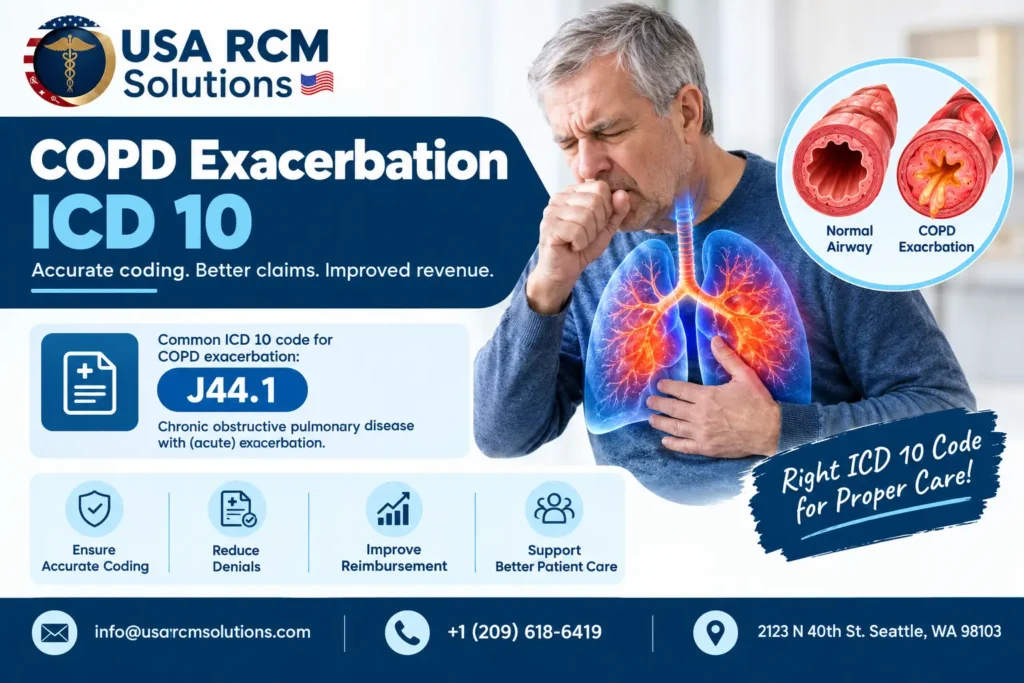
The COPD exacerbation ICD 10 code is J44.1. Its full title is “Chronic obstructive pulmonary disease with (acute) exacerbation.” Coders also call it the COPD with acute exacerbation code.
Use J44.1 when the provider documents a flare of COPD without an infection. It is also the most common COPD exacerbation diagnosis code in hospital records. Because it carries more weight than J44.9, payers review it closely.
COPD Codes at a Glance
The table below lists the main codes in the J44 family.
| ICD-10 Code | Description | When to Use It |
| J44.0 | COPD with acute lower respiratory infection | COPD plus pneumonia or acute bronchitis |
| J44.1 | COPD with (acute) exacerbation | Flare-up without a stated infection |
| J44.9 | COPD, unspecified | Stable COPD with no detail |
| J44.81 | Bronchiolitis obliterans and bronchiolitis obliterans syndrome | Specific rare condition |
| J44.89 | Other specified COPD | Specified type not listed elsewhere |
Always verify codes against the current ICD-10-CM book. Updates take effect every October.
J44.9: When Nothing Else Fits
The J44.9 code means COPD, unspecified. Providers use it for routine visits when the disease is stable. For instance, a patient comes in for a medication refill with no new symptoms.
However, J44.9 should not appear on a claim when the chart describes a flare. In that case, J44.1 is the better match. Otherwise, the claim understates the patient’s condition.
Acute Exacerbation of COPD in Plain Words
Doctors describe acute exacerbation of COPD in many ways. They may write “COPD flare,” “COPD decompensation,” or “AECOPD.” All of these point to J44.1. So read the full note before you choose.
COPD Exacerbation Without Pneumonia
Many exacerbations have no infection at all. For COPD exacerbation without pneumonia, J44.1 is the right code. The chart should show worsening symptoms and a change in treatment.
Here is a simple example. A 70-year-old man with COPD wakes up more breathless than usual. His cough grows, and his inhaler no longer helps. The doctor diagnoses an acute COPD exacerbation ICD 10 case and starts steroids. Therefore, the coder reports J44.1.
COPD Exacerbation With Infection
Infection changes the coding path. When a provider documents an infection, J44.0 comes into play. This code covers COPD with a lower respiratory infection. It also carries a “code also” note, so you must add a code for the infection.
COPD With Lower Respiratory Infection
COPD with lower respiratory infection includes pneumonia and acute bronchitis. The coder reports J44.0 and then adds the specific infection code. For example, pneumonia due to a named germ gets its own code.
COPD With Pneumonia ICD-10
For COPD with pneumonia ICD-10 coding, report J44.0 plus the pneumonia code. A common pairing is J44.0 with J18.9 for unspecified pneumonia. Sequencing depends on the reason for admission. So follow the official guidelines and the facility’s rules.
COPD With Acute Bronchitis
COPD with acute bronchitis also uses J44.0. Add J20.- to name the acute bronchitis. This pairing confuses many coders, because chronic bronchitis already sits inside COPD. Therefore, do not report chronic bronchitis separately.
Can You Report Both J44.0 and J44.1?
Yes, in many cases. A patient may have an infection and a true exacerbation at the same time. Coding Clinic guidance supports reporting both when the provider documents both. However, the note must clearly show each condition. Check current guidance before you apply this rule.
What Are the Main Causes of COPD Exacerbations?
Doctors link exacerbations to a few common triggers. Understanding them helps providers document the cause. It also helps coders spot supporting codes.
| Cause | Examples | Coding Note |
| Viral infection | Flu, RSV, rhinovirus, COVID-19 | Add the virus code when confirmed |
| Bacterial infection | Pneumonia, bronchitis | Use J44.0 with the infection code |
| Air pollution | Smoke, dust, strong fumes | Add an exposure code if documented |
| Missed medicine | Skipped inhalers or steroids | Document noncompliance when stated |
| Cold weather | Sudden temperature drops | Rarely coded on its own |
| Other illness | Heart failure, blood clots | Code each condition separately |
Smoking remains a major factor. So coders should also look for tobacco use or history codes. Examples include F17.210 and Z87.891.
What Is the Best Treatment for a COPD Exacerbation?
This section gives general education, not medical advice. Treatment depends on the patient and the doctor’s judgment. Still, most plans follow a similar pattern.
- Rescue inhalers. Short-acting bronchodilators open the airways fast.
- Steroids. A short course of oral steroids reduces inflammation.
- Antibiotics. Doctors use them when signs point to a bacterial cause.
- Oxygen. Staff adjust oxygen to keep levels in a safe range.
- Breathing support. Severe cases may need noninvasive ventilation.
- Follow-up. Patients need a check-up and a review of their inhaler technique.
Treatment details matter for coding. For example, a chart that lists steroids and nebulizers supports medical necessity. So good notes protect payment.
What Is the Difference Between a COPD Exacerbation and Bronchitis?
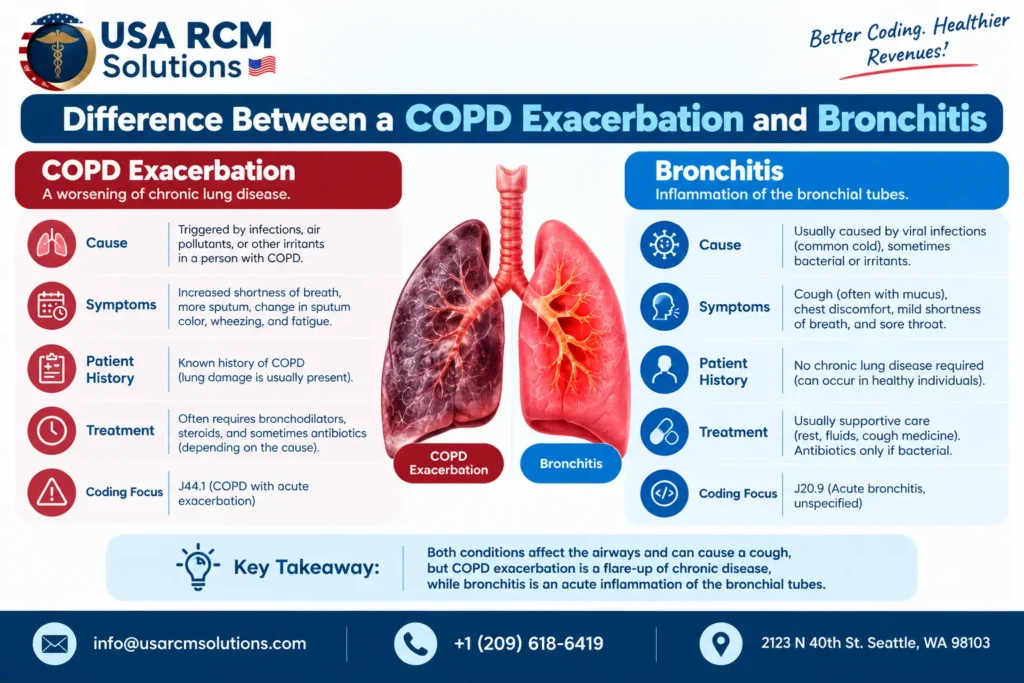
These terms overlap, and so people confuse them. However, they describe different things.
| Feature | COPD Exacerbation | Acute Bronchitis |
| Meaning | Sudden worsening of existing COPD | New infection of the bronchial tubes |
| Patient history | Known COPD | Often a healthy lung before |
| Duration | Days to weeks | Usually one to three weeks |
| Main cause | Infection, pollution, or missed medicine | Mostly viruses |
| Common code | J44.1 | J20.9 |
Chronic bronchitis is different again. It is part of COPD and lasts for months or years. Acute bronchitis in a COPD patient uses J44.0 with J20.-, as noted earlier.
COPD and Asthma: ICD 10 Code for Asthma
Some patients have both COPD and asthma. The ICD 10 code for asthma depends on severity and control. For example, J45.909 means unspecified asthma without complication. J45.901 means unspecified asthma with acute exacerbation.
The J44 category carries a “code also” note for asthma. So a patient with both conditions may need codes from both families. However, never replace one with the other. Their causes and treatments differ.
Real Examples of COPD Exacerbation Coding
Examples make the rules clear. Here are three common cases.
Case 1:
Simple flare. A 66-year-old woman visits urgent care with worse breathing and cough. The doctor documents “acute exacerbation of COPD” and prescribes steroids. So the coder reports J44.1.
Case 2:
Flare with pneumonia. A 72-year-old man arrives with fever and a chest X-ray showing pneumonia. The doctor documents COPD with pneumonia. So the coder reports J44.0 plus the pneumonia code. If the doctor also documents a flare, J44.1 may apply too.
Case 3:
Stable COPD with other conditions. A patient with stable COPD takes long-term steroids. At a checkup, the doctor notes low bone density. The coder reports J44.9 and the osteopenia ICD 10 code, M85.8-. Meanwhile, the doctor also treats a scalp rash. That visit may add the seborrheic dermatitis ICD 10 code, L21.9. Each code needs its own documentation.
Step-by-Step Process to Apply the COPD Exacerbation ICD 10 Code
Follow these steps for every encounter.
- Read the full note. Look for words like flare, worsening, or exacerbation.
- Check for infection. Look for pneumonia, bronchitis, or another lower respiratory infection.
- Pick the main code. Use J44.1 for a flare and J44.0 for infection.
- Add the infection code. Follow the “code also” note.
- Look for respiratory failure. Add J96.- codes only when the provider documents it.
- Add supporting codes. Include tobacco status and related conditions.
- Link codes to services. Point each test or treatment to the right diagnosis.
- Scrub before submission. Catch errors before the payer does.
Guidelines for Documentation and Medical Necessity
Strong notes protect revenue on every COPD exacerbation ICD 10 claim. A reviewer must see why the service was needed. So the chart should include a few key details.
- Symptoms and how they changed from baseline.
- Oxygen levels and respiratory rate.
- Chest imaging and lab results.
- Treatments given and the patient’s response.
- The provider’s final diagnosis in clear words.
A note that says only “SOB” invites questions. Instead, write “acute exacerbation of COPD with increased dyspnea and sputum.” That sentence supports J44.1 clearly.
Eligibility and Verification of Benefits in Medical Billing
COPD care often includes costly services. Examples include home oxygen, nebulizers, and pulmonary rehab. Therefore, eligibility and verification of benefits in medical billing deserves attention before these services begin.
Check coverage, limits, and approval rules at scheduling. Then record the results in the chart. As a result, your team avoids surprise denials and patient bills.
Common Mistakes
Most denials trace back to a few repeat errors in COPD exacerbation ICD 10 coding. The table below shows them with fixes.
| Mistake | Why It Causes Problems | How to Fix It |
| Using J44.9 for a flare | Understates severity | Use J44.1 when the note says flare |
| Skipping the infection code | Violates the “code also” note | Add the pneumonia or bronchitis code |
| Reporting chronic bronchitis separately | It is already part of COPD | Drop the extra code |
| Adding respiratory failure without support | Auditors flag it | Require provider documentation |
| Mixing up asthma and COPD codes | Different disease families | Code each condition on its own |
| Vague “SOB” notes | Coder cannot choose a specific code | Send a provider query |
Key Optimization Methods
Smart workflows keep COPD exacerbation ICD 10 claims clean. These methods work well in clinics and hospitals.
| Optimization Method | What It Does | Expected Benefit |
| Documentation templates | Prompt for flare, infection, and cause | More specific codes |
| Clinical documentation improvement | Queries providers on vague notes | Better severity capture |
| Pre-bill claim scrubbing | Flags missing infection codes | Higher first-pass rates |
| Payer policy tracker | Stores oxygen and rehab rules | Fewer surprise denials |
| Monthly coding audits | Finds repeat errors early | Targeted training |
Start with documentation templates, because they fix problems at the source. Then add scrubbing and audits.
Best Tools and Practices
The right tools help coders pick the COPD exacerbation ICD 10 code faster. Pair them with steady habits.
| Tool or Practice | Purpose | Tip |
| Current ICD-10-CM codebook | Confirm code details | Replace it each October |
| Encoder software | Guides code choice | Verify every suggestion |
| Claim scrubber | Catches edit conflicts | Update edits each quarter |
| Provider query forms | Resolve unclear notes | Keep questions short and neutral |
| Quarterly training | Refresh rules | Review recent denials together |
Future Trends
COPD exacerbation ICD 10 coding keeps evolving. Teams should watch these shifts.
| Trend | What to Expect | How to Prepare |
| Remote patient monitoring | More home tracking of oxygen and symptoms | Learn payer rules for monitoring codes |
| AI-assisted coding | Faster code suggestions | Keep human review in place |
| Readmission penalties | Tighter focus on COPD returns | Track thirty-day readmissions |
| Telehealth follow-up | More virtual COPD visits | Confirm payer telehealth policy |
| Stricter specificity rules | Fewer payments for vague codes | Push providers for detail |
Technology will help, but it will not replace judgment. Coders still need to read the note carefully.
How USA RCM Solutions Can Help
Respiratory coding takes skill and steady attention. USA RCM Solutions supports practices with experienced teams. The team writes clear notes, uses real examples, and follows step-by-step workflows.
The company offers Medical Billing & Coding Services for accurate claim submission. Its Denial Management Services help find the root cause behind repeat denials. In addition, the team appeals denied claims with strong records.
Providers also use Medical Credentialing Services to enroll with payers faster. Meanwhile, Accounts Receivable Services keep unpaid claims from aging past filing limits.
Documentation quality matters here too. A Virtual Medical Scribe can capture symptoms, oxygen levels, and treatments during the visit. As a result, notes support the right COPD exacerbation ICD 10 code from the start.
Finally, growth matters as much as collections. Healthcare Marketing Services help practices attract new patients and build local trust. Together, these services strengthen the revenue cycle from visit to payment.
Conclusion
The COPD exacerbation ICD 10 code is J44.1 for a flare without infection. When an infection appears, J44.0 applies with a code for the infection. For stable disease, J44.9 is the usual choice.
Remember the core points. Read the note for words like flare and worsening. Look for pneumonia or bronchitis. Then support every claim with clear documentation and a matching diagnosis.
Good habits protect revenue. Document symptoms, treatments, and test results. Check payer rules before you bill. With these steps, your team can cut denials and keep claims clean.
FAQs
How long does a COPD exacerbation usually last?
Most flares improve within one to two weeks with treatment. Some last longer, especially after a severe infection. Recovery can also take weeks for lung function to return to baseline. So providers should schedule a follow-up visit soon after discharge.
Does a COPD exacerbation always require a hospital stay?
No, many patients recover at home with inhalers, steroids, and sometimes antibiotics. Doctors consider a hospital stay when breathing is severe or oxygen levels drop. Other warning signs include confusion, chest pain, or no response to home care. The setting of care also affects which codes and rates apply on the claim.
What is a 30-day readmission, and why does it matter for COPD billing?
A 30-day readmission means the patient returns to the hospital within 30 days of discharge. Medicare tracks COPD readmissions under its hospital readmissions program. Hospitals with high rates can face payment reductions. Therefore, clear discharge plans and follow-up visits protect both patients and revenue.
Can a patient get pulmonary rehabilitation after an exacerbation?
Yes, pulmonary rehab often helps patients rebuild strength and breathing control. Medicare covers it for moderate to very severe COPD when criteria are met. Many plans also cover it after a hospital stay. So check the patient’s coverage and document the COPD stage before you schedule.