
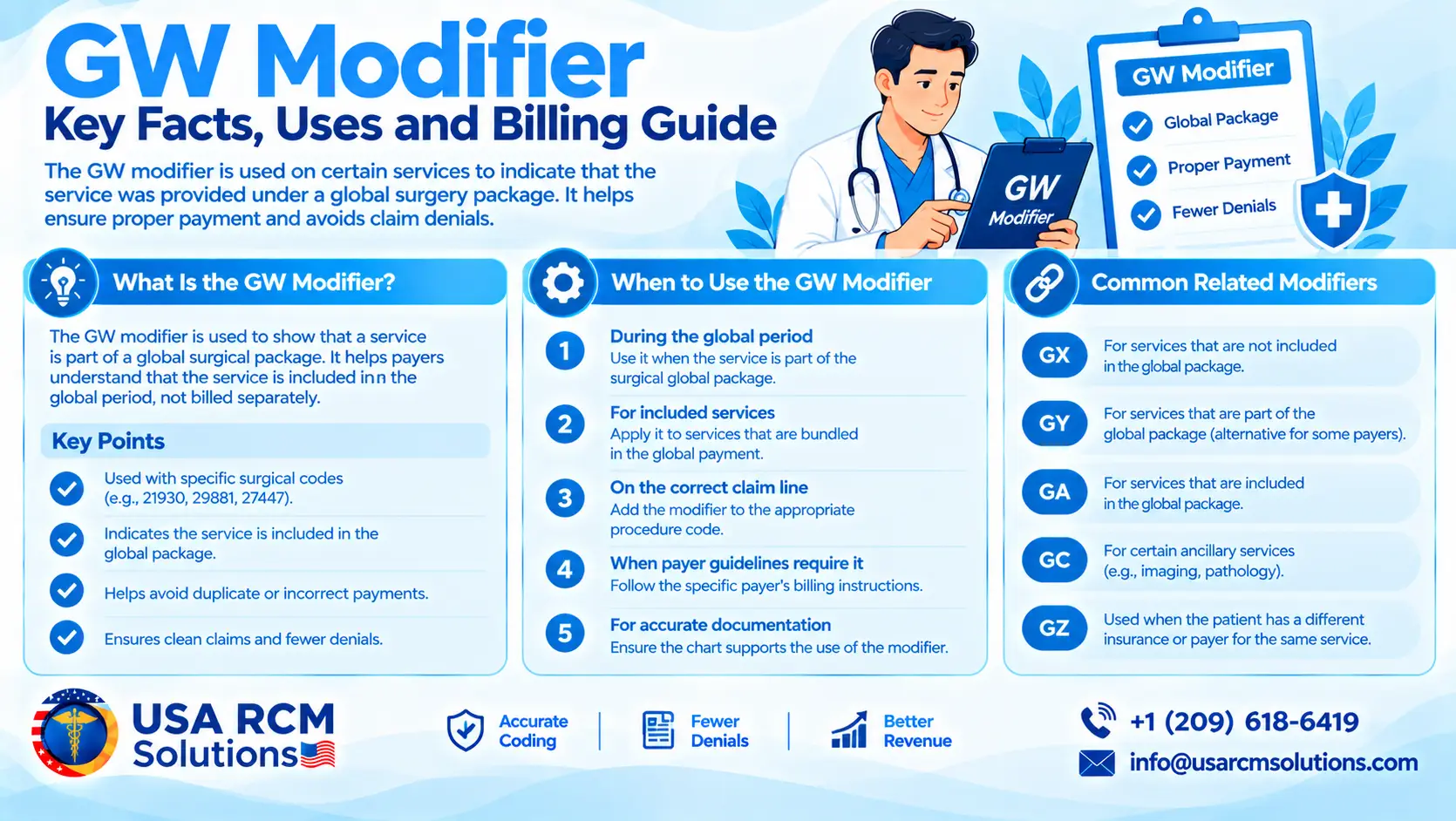
The GW modifier confuses many billers, and the confusion costs practices real money. This two-character code tells Medicare that a service has no link to a patient’s terminal illness. Therefore, Medicare Part B can pay for it instead of the hospice benefit. However, one wrong entry can trigger a denial and weeks of rework.
In this guide, you will learn what the GW-modifier means and when to use it. You will also see how it works with other modifiers, plans, and claim forms. Because the rules are strict, we will use simple steps and real examples.
What Is the GW Modifier?
The GW code is a HCPCS Level II modifier used on Medicare claims. It flags a service as unrelated to a hospice patient’s terminal condition. Hospice care normally covers everything linked to that condition. So Medicare needs a clear signal when a provider bills outside the hospice benefit.
GW Modifier Description in Plain Words
The official gw modifier description reads “service not related to the hospice patient’s terminal condition.” That wording is short, but it carries a lot of weight. It tells the payer that the hospice should not pay for this visit. Instead, the claim goes to Medicare Part B for processing.
Many people search for “modifier gw” when they see it on a remittance advice. The meaning stays the same in every case. The service happened, and it had nothing to do with the terminal diagnosis.
Why Hospice Modifiers Exist
Hospice modifiers protect Medicare from duplicate payments. When a patient elects hospice, Medicare pays the hospice a daily rate. That rate covers care related to the terminal illness and related conditions. Therefore, outside providers must explain why they are billing separately.
Hospice modifiers give that explanation in a standard form. Without them, claims would reject or pay the wrong entity. So every biller who touches hospice patients should know these codes well.
What Do the Medicare Hospice Modifiers GW and GV Mean?
Two hospice modifiers appear most often on professional claims. They are GV and GW. Both relate to hospice patients, but they describe different situations.
The GV Modifier Explained
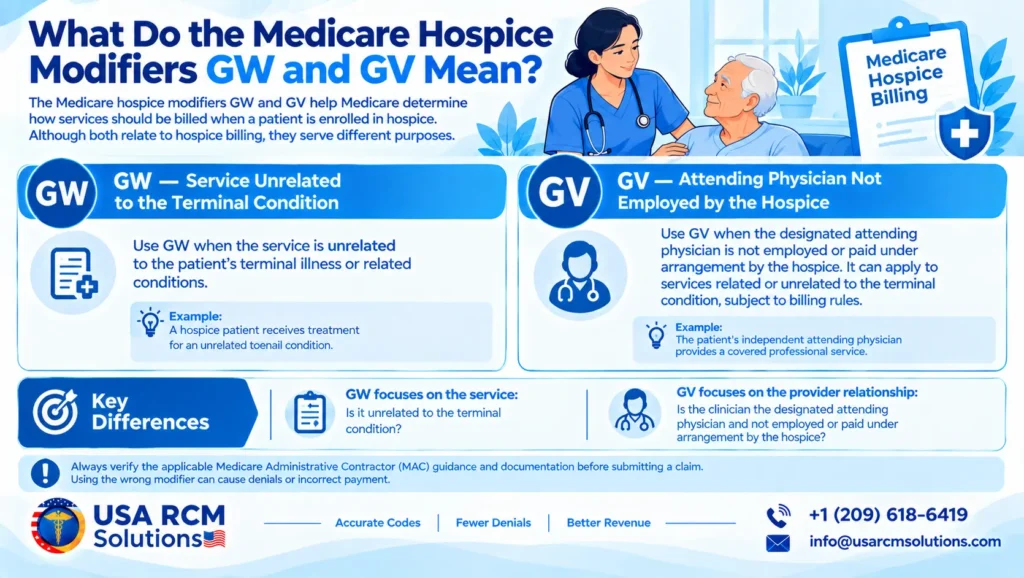
The gv modifier means the attending physician is not employed or paid by the patient’s hospice. The physician still treats the patient for the terminal condition. However, the hospice does not pay that physician through a staff arrangement.
For example, a patient’s longtime oncologist continues to manage cancer care. The hospice does not employ that oncologist. In this case, the oncologist bills Medicare Part B with the GV modifier.
The GW Code Explained
The GW code covers a different case. Here, the service does not relate to the terminal diagnosis at all. Any physician can bill it, including the hospice’s own doctor.
Consider a hospice patient with advanced lung cancer who breaks a wrist. The orthopedic care has nothing to do with the cancer. So the orthopedist bills with the GW code.
GV vs GW: Quick Comparison
Many billers mix these two codes up. The table below shows the gv vs gw modifier difference in a clear way.
| Feature | GV Modifier | GW |
| Meaning | Attending physician not employed by hospice | Service unrelated to terminal condition |
| Link to terminal illness | Related | Not related |
| Who bills Medicare Part B | Attending physician | Any qualifying provider |
| Typical example | Outside oncologist treating the cancer | Orthopedic care for a fracture |
| Documentation focus | Attending status and hospice election | Proof of no connection to terminal illness |
Remember this rule of thumb. GV answers “who is the physician?” and GW answers “what was the service for?”
Purpose of the GW Modifier in Medical Billing
The main purpose is to route payment correctly. Hospice patients still get care for problems outside their terminal diagnosis. Medicare wants those claims paid, but it does not want the hospice to pay twice.
The GW code also supports audit trails. Reviewers can see that the provider made a deliberate decision. Because of that, a well-documented claim stands up better during review.
In addition, the modifier protects patient access. Patients should not lose coverage for unrelated care because they chose hospice. Therefore, the GW code keeps those benefits available.
When Should You Apply the GW Modifier to Healthcare Claims?
Apply the GW code when three conditions are true. First, the patient has elected the Medicare hospice benefit. Second, the service is not related to the terminal illness or related conditions. Third, the provider bills Medicare Part B directly.
Timing matters too. The patient must be in an active hospice election on the date of service. If the election ended, the modifier does not apply.
Step-by-Step Process for Using the GW Code
Follow these steps for every hospice patient encounter.
- Check eligibility. Confirm the hospice election dates in the Medicare eligibility system.
- Identify the terminal diagnosis. Ask the hospice or review the notice of election.
- Review the visit reason. Decide if the problem links to the terminal condition.
- Document the decision. Write a clear note that explains why the service is unrelated.
- Select diagnosis codes. Choose codes that match the unrelated problem.
- Add the modifier. Place the GW code on each qualifying service line.
- Review before submission. Scrub the claim for errors and missing details.
Real Example: Chest Pain in a Hospice Patient
A patient with end-stage kidney disease enters hospice. Later, the patient visits a cardiologist for chest pain. The cardiologist finds a musculoskeletal cause, not a cardiac or renal one.
The coder uses the ICD 10 Code for Chest Pain that fits the documentation. For unspecified chest pain, that is usually R07.9. For other specified chest pain, R07.89 may apply. Many users search for acute chest pain ICD 10 because no code reads “acute” by name. Coders pick the closest documented option instead.
Because the chest pain has no tie to kidney disease, the GW code applies. The note must say so clearly. If the note is vague, the claim may deny.
Real Example: Generalized Weakness
Generalized weakness ICD 10 coding needs more care. Coders often use R53.1 for weakness. However, weakness can be a symptom of the terminal illness itself. In that case, the GW code would be wrong.
Suppose a hospice cancer patient reports weakness after a new medication. The physician ties it to cancer progression. Therefore, the service relates to the terminal condition, and hospice must cover it.
Now suppose the weakness comes from a separate vitamin deficiency. The physician documents that link clearly. Here, the GW code can apply. The diagnosis and the note must agree with each other.
Which Modifier Is First, 25 or GW?
This question comes up often, and the answer depends on the claim logic. Modifier 25 marks a significant, separately identifiable E/M service on the same day as a procedure. The GW code is informational and describes hospice relatedness.
In most billing systems, list the payment-impacting modifier first. That means modifier 25 usually comes before the GW code. For example, you would report 99214-25-GW.
However, payer rules can differ. Some Medicare Administrative Contractors publish their own guidance. So check your contractor’s instructions before you build a billing template.
Whatever order you pick, include both when both apply. Dropping either one can lead to a GW denial or a bundling edit. Moreover, keep the order consistent across your practice.
GW Modifier on CMS 1500 Claim
Professional claims use the CMS-1500 form or its electronic equivalent, the 837P. The modifier goes in Item 24D, next to the CPT or HCPCS code. Item 24D has room for up to four modifiers.
Here is a simple layout for a GW modifier on CMS 1500 claim entries.
| Field | What to Enter |
| Item 24D | CPT code followed by modifiers, such as 99213 25 GW |
| Item 21 | ICD-10 diagnosis codes for the unrelated condition |
| Item 24E | Diagnosis pointer matching the unrelated problem |
| Item 17 | Referring or ordering provider, when required |
Use only the diagnosis that supports the unrelated service. Do not point to the terminal diagnosis on a GW line. Otherwise, the claim contradicts itself and will likely deny.
Guidelines for Using the GW Modifier With Different Insurance Plans
GW modifier billing rules are a Medicare concept first. Other payers treat hospice differently. So never assume one rule fits every plan.
Original Medicare
Original Medicare follows the rules described above. Providers bill the Part B contractor with the GW code. The Medicare Claims Processing Manual guides this process.
Medicare Advantage
Medicare Advantage plans work differently when a member elects hospice. Original Medicare usually pays hospice and related services during the election. Unrelated services may still fall under the Advantage plan. Therefore, verify which payer owns the claim before you bill.
Medicaid
State Medicaid programs set their own hospice rules. Some require hospice modifiers, and others use different indicators. Always read your state provider manual first.
Commercial Plans
Commercial insurers rarely use Medicare hospice modifiers in the same way. Some accept the GW code, but others ignore it. A quick call to provider relations can save you a denial.
| Plan Type | GW Use | Key Tip |
| Original Medicare | Required for unrelated services | Follow MAC guidance on modifier order |
| Medicare Advantage | Depends on plan and election | Confirm the responsible payer |
| Medicaid | Varies by state | Check the state manual |
| Commercial | Often optional or unused | Verify policy before billing |
GW Modifier Physician Services and Professional Claims
The GW modifier physician services rules apply to many specialties. Primary care, cardiology, orthopedics, and dermatology all see hospice patients. Each specialty must judge relatedness for its own visits.
For GW modifier professional claims, documentation carries the most weight. The note should state the hospice status. It should also name the terminal diagnosis and explain why the new problem is unrelated.
Here is a sample documentation line. “Patient is enrolled in hospice for metastatic breast cancer. Today’s visit addresses a urinary tract infection, which is unrelated to the terminal diagnosis.”
That sentence is short, but it answers the reviewer’s main question. As a result, the claim faces fewer challenges.
Non-physician practitioners follow similar logic. Nurse practitioners and physician assistants can use the GW code when they bill under their own numbers. However, hospice attending rules may limit who counts as the attending provider.
GW Modifier Palliative Care
Palliative care and hospice are not the same thing. Palliative care can start at any stage of serious illness. Hospice requires a prognosis of six months or less and an election of the benefit.
Because of this difference, the GW modifier palliative care question needs a careful answer. If the patient has not elected hospice, the GW code does not apply. The modifier only works when a hospice election is active.
A palliative care specialist might see a hospice patient for symptoms of the terminal illness. That visit relates to the terminal condition, so the GW code would be wrong. Instead, the hospice or a GV-eligible attending physician handles billing.
Common Errors to Avoid When Submitting Claims With the GW Modifier
Most denials trace back to a few repeat mistakes. Fixing them early protects your revenue cycle. The table below lists the most common ones.
Common Mistakes
| Mistake | Why It Causes Problems | How to Fix It |
| Using GW on a related service | Hospice should pay, so Medicare denies | Review the terminal diagnosis first |
| Confusing GV and GW | Each code describes a different situation | Train staff with a simple decision chart |
| Missing hospice election check | Dates may not match the service | Verify eligibility every visit |
| Weak documentation | Reviewers cannot see why it is unrelated | Add a clear relatedness statement |
| Wrong modifier order | Edits may reject the line | Follow contractor guidance, often 25 before GW |
| Pointing to the terminal diagnosis | Claim contradicts the modifier | Link only the unrelated diagnosis |
A GW modifier denial often arrives with a hospice-related reason code. Do not resubmit the same claim unchanged. Instead, read the remark codes, fix the cause, and correct the claim.
Key Optimization Methods
Strong processes reduce errors before claims leave your office. These methods help practices keep clean claim rates high.
| Optimization Method | What It Does | Expected Benefit |
| Real-time eligibility checks | Confirms hospice election dates | Fewer date-of-service denials |
| Front-end diagnosis review | Flags related versus unrelated visits | Better modifier accuracy |
| Provider query templates | Prompts clear relatedness notes | Stronger audit defense |
| Claim scrubbing rules | Catches missing or misordered modifiers | Higher first-pass acceptance |
| Denial trend reports | Shows repeat GW errors by provider | Targeted staff education |
Start with eligibility checks because they stop the most expensive errors. Then add scrubbing rules and trend reports over time.
Best Tools and Practices
The right tools make modifier decisions faster and safer. Pair them with steady habits.
| Tool or Practice | Purpose | Tip |
| Medicare eligibility portal | Verify hospice status | Check before each encounter |
| Claim scrubber software | Detect modifier conflicts | Update edits every quarter |
| EHR smart phrases | Standardize relatedness language | Keep wording short and specific |
| Coding reference library | Confirm HCPCS and ICD-10 details | Use current-year code sets |
| Monthly coding audits | Spot patterns early | Sample ten hospice claims per coder |
Good practice also includes ongoing education. Hospice rules change, and CMS updates guidance regularly. So schedule short training sessions each quarter.
Future Trends
Hospice billing continues to evolve. Practices that prepare now will adapt more easily.
| Trend | What to Expect | How to Prepare |
| Stricter hospice audits | More review of relatedness decisions | Strengthen documentation habits |
| Automated modifier logic | EHRs may suggest GW or GV automatically | Validate every suggestion manually |
| AI-assisted coding | Faster code selection with human review | Keep coders involved in final checks |
| Value-based hospice models | New payment structures and reporting | Watch CMS announcements closely |
| Telehealth in hospice | More virtual visits for unrelated issues | Confirm telehealth modifier rules |
Technology will help, but it will not replace judgment. A coder still must decide whether a service relates to the terminal illness.
How USA RCM Solutions Can Help
Hospice rules take time to master, and many practices lack spare staff. USA RCM Solutions supports providers with experienced billing and coding teams. The team writes in clear terms, uses real examples, and follows step-by-step workflows.
The company offers Medical Billing & Coding Services for accurate claim submission. Its Denial Management Services help practices find the root cause behind repeat GW denials. In addition, the team appeals denied claims with proper documentation.
Providers also use Medical Credentialing Services to enroll with payers faster. Meanwhile, Accounts Receivable Services keep unpaid claims from aging past timely filing limits.
Documentation quality matters here too. A Virtual Medical Scribe can capture relatedness statements during the visit. As a result, notes support the modifier choice from the start.
Finally, growth matters as much as collections. Healthcare Marketing Services help practices attract new patients and build local trust. Together, these services keep the revenue cycle strong from front desk to final payment.
Conclusion
The GW modifier is small, but it carries real financial weight. It tells Medicare that a service does not relate to the hospice patient’s terminal illness. Therefore, correct use sends payment to the right place.
Remember the core points. Check hospice election dates first. Decide relatedness with care. Document your reasoning in plain words. Then place the GW code on the right service lines and point to the right diagnosis.
Know the difference between the hospice modifiers, especially in the gv vs GW modifier comparison. Watch modifier order when 25 applies. Confirm each plan’s rules before you bill. With these habits, your practice can cut denials and protect revenue.
FAQs
How do I appeal a claim denied for a GW issue?
Start by reading the denial reason and remark codes carefully. Then gather the visit note, the hospice election dates, and any physician statement about relatedness. Submit a redetermination request within 120 days of the initial determination. If the denial came from a simple coding error, a corrected claim may be faster than a formal appeal.
Does the GW code change how much Medicare pays?
No, the GW code does not change the fee schedule rate. It acts as an informational modifier that routes the claim to Part B. However, a missing or wrong modifier can cause a denial, and then you get no payment at all. So the modifier protects payment rather than raising it.
Can a nurse practitioner use the GW code on a claim?
Yes, a nurse practitioner can use it when billing Medicare under their own national provider identifier. The service must still be unrelated to the terminal condition. Hospice attending rules may limit who qualifies as the attending provider, so check those rules for GV billing. Always document the hospice status and the reason for the visit.
What is the timely filing limit for claims with the GW code?
Medicare Part B generally allows 12 months from the date of service. Late claims usually face denial unless an exception applies. Because corrected claims also count against that window, fix errors quickly. Many practices set an internal deadline of 60 to 90 days to stay safe.