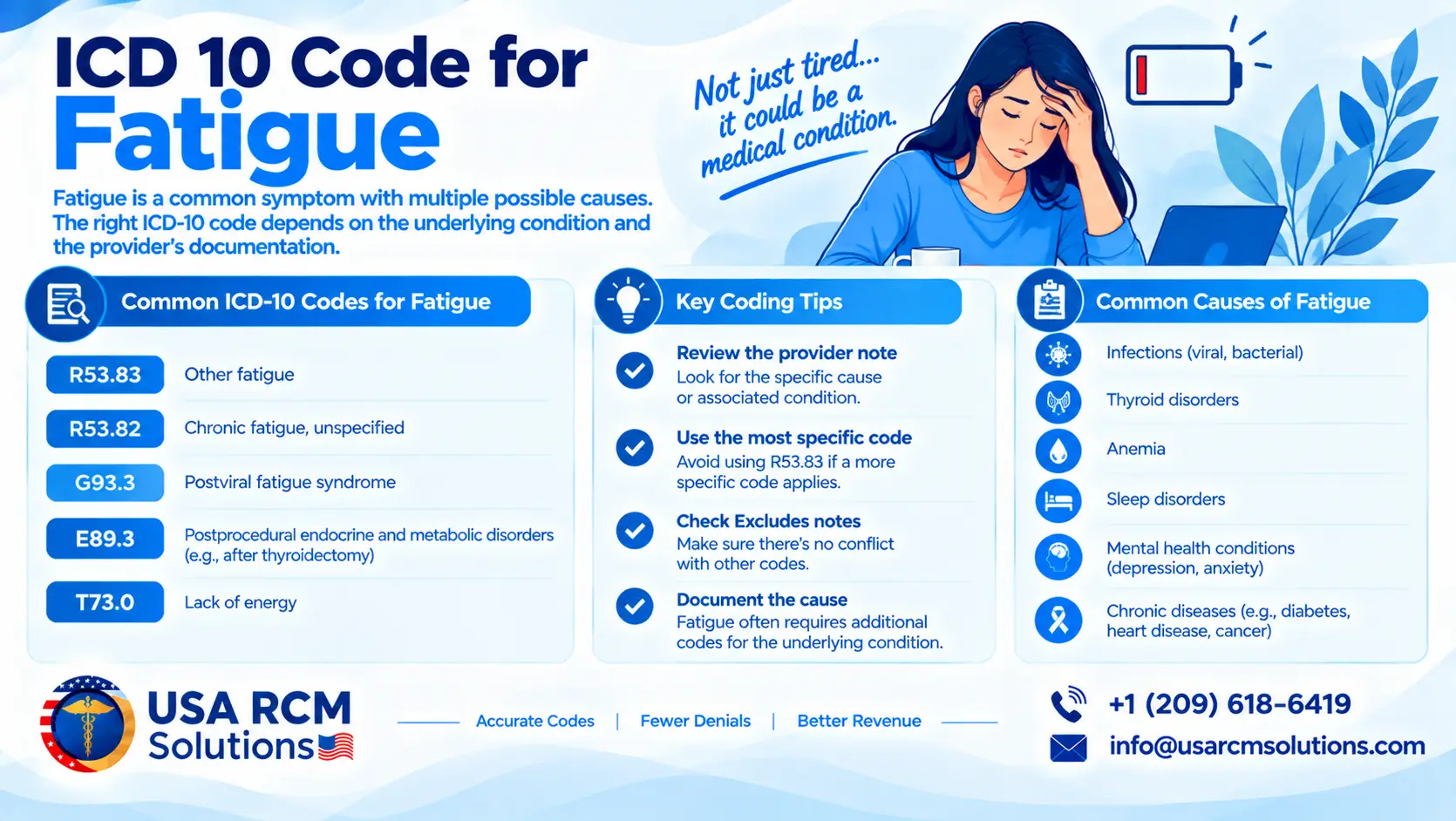
The ICD 10 code for fatigue is R53.83, which means other fatigue. Coders use it when a provider documents tiredness or lack of energy without a cause. However, ICD-10-CM also offers codes for chronic fatigue, malaise, and specific syndromes. Choosing the right one affects claims and medical necessity. This guide explains each option in plain words.
Fatigue is one of the most common complaints in primary care. Therefore, billing teams see these claims every day. You will find tables, real examples, and a step-by-step process below. So let us start with the code itself.
ICD 10 Code for Fatigue: What R53.83 Means
R53.83 is the ICD-10-CM code for other fatigue. It sits in category R53, malaise and fatigue. That category belongs to the symptoms and signs chapter. Therefore, R53.83 describes a symptom, not a disease. Many people also search fatigue icd 10 or icd 10 for tiredness, and all of those searches lead here.
R53.83 ICD-10 Code: Other Fatigue Explained
The official name of R53.83 is other fatigue. Its inclusion terms are fatigue NOS, lack of energy, lethargy, and tiredness. So the icd 10 code for fatigue unspecified is R53.83 too. Use it when the provider writes fatigue and gives no cause.
You may also see R53.83 ICD 10 or R53.83 ICD-10-CM in coding tools. Both labels mean the same code. The suffix CM simply marks the clinical modification used in the United States.
Is R53.83 a Billable ICD 10 Code for Fatigue?
Yes, R53.83 is a billable ICD 10 code for fatigue. Current listings mark it as a complete, billable code. It needs no extra characters, so it is final as written. The R53.8 level above it is only a subcategory.
Billable means you can report it on a claim. It does not mean every service gets covered. Therefore, medical necessity still matters.
Excludes Notes You Should Know
The R53.8 level carries Excludes1 notes. These block fatigue due to excessive exertion, heat, exposure, pregnancy, and recurrent depression. Combat exhaustion and age-related debility also sit outside this code. So read the tabular list before you finalize.
ICD-10 Codes for Different Types of Fatigue
Not all fatigue is the same. The right code depends on duration, cause, and the provider’s wording. The table below shows the most common options.
| Code | Description | When to Use |
| R53.83 | Other fatigue | Fatigue, tiredness, lack of energy, or lethargy without a cause |
| R53.82 | Chronic fatigue, unspecified | Documented chronic fatigue without a named syndrome |
| R53.81 | Other malaise | Malaise or debility NOS |
| R53.0 | Neoplastic (malignant) related fatigue | Fatigue linked to cancer |
| R53.1 | Weakness | Weakness or asthenia NOS |
| G93.32 | Myalgic encephalomyelitis/chronic fatigue syndrome | Provider documents ME/CFS |
| G93.31 | Postviral fatigue syndrome | Provider documents postviral fatigue syndrome |
| O26.81- | Pregnancy-related exhaustion and fatigue | Fatigue due to pregnancy |
| T73.3- | Exhaustion due to excessive exertion | Fatigue caused by overexertion |
R53.82 ICD 10 Code: Chronic Fatigue
R53.82 means chronic fatigue, unspecified. Use it when the provider documents chronic fatigue without a named syndrome. ICD-10-CM sets no exact cutoff, but clinicians often use six months. However, R53.82 cannot be reported with the ME/CFS or postviral fatigue syndrome codes.
Chronic Fatigue Syndrome ICD 10
Searches for chronic fatigue syndrome icd 10 often lead to R53.82. However, a provider-documented ME/CFS diagnosis uses G93.32. Some third-party sites still show older advice. So confirm the code in the official tabular list.
R53.81 ICD 10 Code: Other Malaise
R53.81 means other malaise. It includes malaise NOS, debility NOS, and general physical deterioration. So the icd 10 code for fatigue and malaise depends on the provider’s wording. Fatigue points to R53.83, and malaise points to R53.81.
Searches for icd 10 fatigue malaise usually expect one answer. In truth, the note decides. Therefore, providers should state which symptom leads the visit.
Fatigue ICD-10 Coding Guidelines and Documentation Requirements
Clear rules guide this work. The tips below fit most primary care and specialty charts. Choosing the right icd 10 code for fatigue starts with provider documentation.
Core Fatigue ICD-10 Coding Guidelines
- Code from provider documentation only.
- Do not code symptoms that routinely belong to a confirmed diagnosis.
- In outpatient care, code symptoms instead of suspected or probable diagnoses.
- Use the most specific fatigue code the note supports.
- Review Excludes1 notes before you finalize.
- Use the code set effective on the date of service.
Fatigue often comes with anemia, thyroid disease, or depression. In those cases, the confirmed diagnosis explains the fatigue. Therefore, R53.83 usually drops off once the cause is documented.
Documentation Requirements for Providers
Good coding begins with good notes. Share this checklist with your clinical team.
- Onset, duration, and pattern of the fatigue.
- Severity and effect on daily activities.
- Associated symptoms, such as poor sleep, pain, or low mood.
- Medications, alcohol use, and recent illnesses.
- Tests ordered and the reason for each.
- Assessment and plan, including follow-up.
A Virtual Medical Scribe can capture these details during the visit. Therefore, providers spend more time with patients.
Step-by-Step Process for Coding Fatigue
- Read the full note. Find the stated symptom and the reason for the visit.
- Check for a confirmed cause. Look for anemia, thyroid disease, depression, or infection.
- Check the duration. Note whether the provider calls it chronic.
- Check for a named syndrome. Look for ME/CFS or postviral fatigue syndrome.
- Pick the most specific code. Use R53.83 only when no cause or type appears.
- Review Excludes notes. Confirm no code pair conflicts.
- Link the services. Match labs and visits to the diagnosis.
- Submit and track. Watch for denials and payer questions.
An Illustrative Example: New Fatigue With Normal Labs
Here is an illustrative example. A patient reports three weeks of tiredness. The provider orders a CBC, a thyroid test, and a metabolic panel. All results return normal. Therefore, the coder reports R53.83 for the visit and the labs.
Later, the provider finds another cause. The documented diagnosis then replaces the symptom code at the next visit.
An Illustrative Example: Long-Term Fatigue
A second patient has eight months of fatigue with no clear cause. The provider documents chronic fatigue and says ME/CFS criteria are not met. So the coder reports R53.82. If the provider later documents ME/CFS, the coder switches to G93.32.
Impact of R53.83 on Insurance Reimbursement
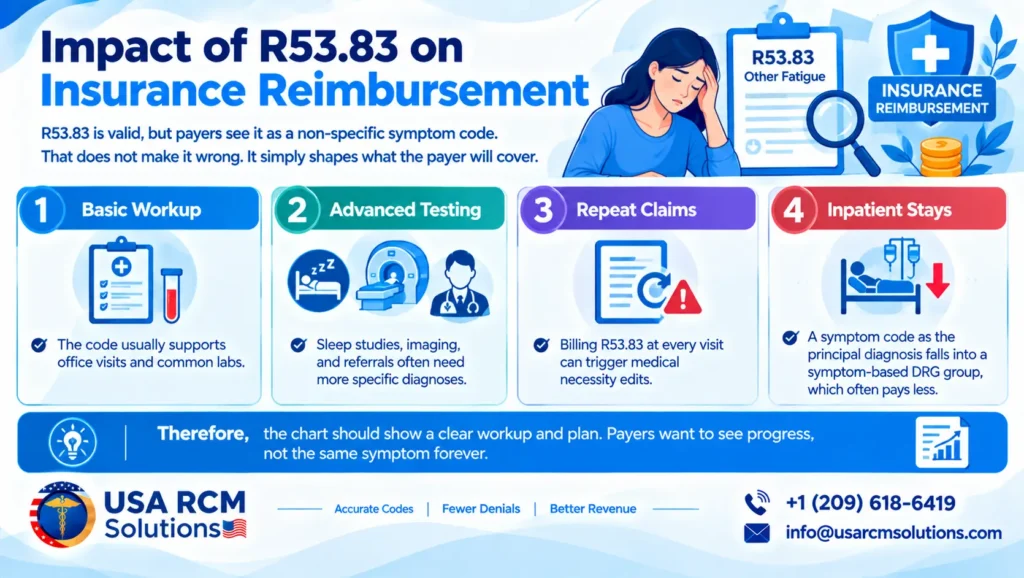
R53.83 is valid, but payers see it as a non-specific symptom code. That does not make it wrong. It simply shapes what the payer will cover.
- Basic workup: The code usually supports office visits and common labs.
- Advanced testing: Sleep studies, imaging, and referrals often need more specific diagnoses.
- Repeat claims: Billing R53.83 at every visit can trigger medical necessity edits.
- Inpatient stays: A symptom code as the principal diagnosis falls into a symptom-based DRG group, which often pays less.
Therefore, the chart should show a clear workup and plan. Payers want to see progress, not the same symptom forever.
Linking Fatigue Diagnoses to Services
A fatigue workup uses CPT codes for visits and labs. Common examples include 85025 for a CBC, 84443 for a thyroid test, and 80053 for a metabolic panel. Understanding HCPCS vs CPT also helps when supplies or drugs appear on the same claim. So keep service codes and diagnosis codes in their own fields.
Sometimes the provider suspects depression. A behavioral health evaluation may then use CPT Code 90791. The diagnosis should match the documented findings, not the symptom alone.
An Illustrative Denial Case
Here is another illustrative case. A clinic billed a sleep study with R53.83 alone. The payer denied it for weak medical necessity. However, the note already described loud snoring and witnessed pauses in breathing. So the team added the documented snoring code and appealed with the full note. Then the payer approved the study.
Key Optimization Methods
The table below shows practical ways to improve fatigue coding.
| Method | What It Does | Expected Result |
| Structured fatigue templates | Prompt for duration, severity, and associated symptoms | Better specificity |
| Compliant clinical queries | Ask providers to clarify vague notes | Accurate code selection |
| Workup tracking | Links labs and follow-up to the diagnosis | Stronger medical necessity |
| Claim scrubbing | Flags Excludes 1 conflicts | Cleaner claims |
| Coder education | Reviews annual R53 and G93 updates | Fewer coding errors |
| Denial trend review | Tracks rejections by symptom code | Targeted fixes |
Best Tools and Practices
Strong tools support strong habits. The table below shows what works well together.
| Tool or Practice | Purpose | Why It Helps |
| Encoder software | Guides code search and edits | Faster, more accurate selection |
| Official ICD-10-CM guidelines | Sets rules for code use | Reliable reference |
| EHR templates for fatigue visits | Prompt for cause, duration, and mood | Complete notes |
| Payer policy lookup tools | Show covered diagnoses and limits | Fewer surprises |
| Coding audits | Sample symptom-code claims | Finds patterns early |
| KPI dashboards | Track denial rate by diagnosis | Shows problem areas |
Common Mistakes With the ICD 10 Code for Fatigue
Even experienced teams repeat the same errors. The table below shows the most common ones and better options.
| Common Mistake | Why It Hurts | Better Approach |
| Using R53.83 when a cause is documented | Hides the real diagnosis | Code the confirmed condition |
| Using R53.82 without documented chronicity | Invites payer review | Record duration clearly |
| Coding ME/CFS as R53.82 | Violates the Excludes1 note | Use G93.32 when ME/CFS is documented |
| Coding R53.83 with an excluded condition | Rejects the claim | Review Excludes notes first |
| Confusing HCPCS vs CPT for labs and supplies | Causes wrong code selection | Use CPT for services and Level II for items |
| Billing CPT Code 90791 with only a symptom code | Weakens necessity for a behavioral health evaluation | Document and code the behavioral health findings |
| Repeating R53.83 at every visit | Triggers medical necessity edits | Update the diagnosis as the workup progresses |
Support for Coding and Revenue Teams
Coding does not happen in isolation. Documentation, enrollment, billing, and follow-up all affect payment. Therefore, many practices look for outside help.
Full-Service Support for Coding and Revenue Teams
USA RCM Solutions helps practices manage coding and revenue tasks together. Its service range supports the full cycle. The list below shows the main offerings.
- Medical Billing & Coding Services: accurate claims built on correct diagnosis codes.
- Medical Credentialing Services: payer enrollment and provider onboarding.
- Accounts Receivable Services: steady follow-up on aging claims.
- Virtual Medical Scribe: documentation support that saves provider time.
- Denial Management Services: root cause review, appeals, and prevention.
- Healthcare Marketing Services: patient acquisition and online visibility.
These services support one another. For instance, richer notes improve diagnosis detail, and specific codes reduce denials. Denial Management Services also review symptom-code rejections, so teams learn what payers question. Meanwhile, Healthcare Marketing Services help practices reach patients who search for primary care and fatigue evaluations. As a result, teams fix root problems and grow at the same time.
How to Choose a Coding Partner
Choose a partner the way you would hire a key employee. Ask direct questions and expect clear answers.
- Coding credentials: Ask about certifications and ongoing education.
- Specialty experience: Confirm they understand primary care and symptom coding.
- Audit support: Check how they handle payer reviews and appeals.
- Reporting: Request sample dashboards and monthly reports.
- Compliance: Confirm HIPAA safeguards and staff training.
- Clear pricing: Understand fees, contract terms, and exit options.
Future Trends in Fatigue Coding
Coding keeps changing because technology and payer rules keep changing. The table below highlights trends worth watching.
| Trend | What It Means | Likely Impact |
| AI-assisted coding | Software suggests codes from clinical notes | Faster coding with human review |
| Wearable health data | Sleep and activity data feed the chart | Stronger clinical support |
| Telehealth primary care | Virtual fatigue visits keep growing | Higher need for clear documentation |
| Automated medical necessity checks | Systems match tests to diagnoses | Fewer lab denials |
| Predictive denial analytics | Models flag risky claims early | Fewer denials |
| Virtual documentation support | Remote scribes capture visit detail | Clearer clinical notes |
Technology helps, but coders still make the final call. Experts must review every suggested code. Therefore, the best teams blend smart tools with trained people.
Conclusion
So, what should you remember about the icd 10 code for fatigue? R53.83 covers fatigue, tiredness, and lack of energy without a cause. R53.82 covers documented chronic fatigue, and R53.81 covers malaise. A provider-documented ME/CFS diagnosis uses G93.32.
Strong documentation drives every correct choice. Providers should record duration, severity, and the workup plan. Meanwhile, coders should replace the symptom code once a cause is confirmed.
You can build this process in-house or add outside support. A partner like USA RCM Solutions can cover coding, billing, and follow-up together. Either way, start with a claim audit this week. Then fix your top documentation gaps, and review progress each month.
FAQs
What is the ICD 10 code for fatigue in pregnancy?
The ICD-10 code for fatigue during pregnancy depends on the cause and documentation. Pregnancy-related exhaustion and fatigue may be coded using O26.81- when fatigue is associated with pregnancy.
What is the ICD 10 code for fatigue due to depression?
Fatigue related to depression is generally coded based on the documented depressive disorder rather than only the symptom. The provider should code the confirmed mental health condition causing fatigue.
What is Acute fatigue ICD 10?
There is no specific ICD-10 code named “acute fatigue.” Acute fatigue without an identified cause is usually coded using R53.83 (Other fatigue) based on provider documentation.
What is ICD 10 fatigue with exertion?
Fatigue caused by excessive exertion may not be coded with R53.83 because exclusions apply. The correct code depends on the documented cause and circumstances of the exertion.