HCPCS vs CPT confuses many new coders. Both are medical coding systems, and both appear on claims. However, they serve different purposes. CPT describes medical services and procedures. HCPCS Level II covers supplies, drugs, and equipment. This guide explains the difference in plain words.
Getting the right code affects payment, so accuracy matters. Therefore, billing teams need a clear process. You will find tables, real examples, and a step-by-step method below. So let us start with the basics.
HCPCS vs CPT: What Are These Medical Coding Systems?
Healthcare billing codes tell payers what happened during care. Different code sets answer different questions. Three code families appear on most claims. ICD-10-CM explains why the patient came in. CPT and HCPCS explain what the practice did.
CPT Codes Explained
CPT stands for Current Procedural Terminology. The American Medical Association owns and updates it. CPT codes explained in one line: they describe what a clinician did. Each one has five characters, and they cover visits, surgeries, lab tests, and imaging. Because of this, nearly every provider type relies on them.
- Category I: five-digit numeric codes for established services, such as 99214.
- Category II: four digits plus F, used for quality reporting.
- Category III: four digits plus T, used for emerging technology.
HCPCS Codes Explained
HCPCS stands for Healthcare Common Procedure Coding System. CMS manages it for Medicare and other programs. HCPCS codes explained briefly: the system has two levels. Level I is CPT itself. The second level, Level II, uses one letter followed by four digits.
Level II codes cover items that CPT does not, such as drugs, supplies, equipment, and ambulance rides. Medicare claims use them often.
CPT Level I vs HCPCS Level II
Think of HCPCS as the umbrella. CPT Level I vs HCPCS Level II is not a competition. Level I sits inside the system, and Level II adds to it. So a CPT code is technically part of HCPCS. However, people usually say CPT for Level I and HCPCS for Level II.
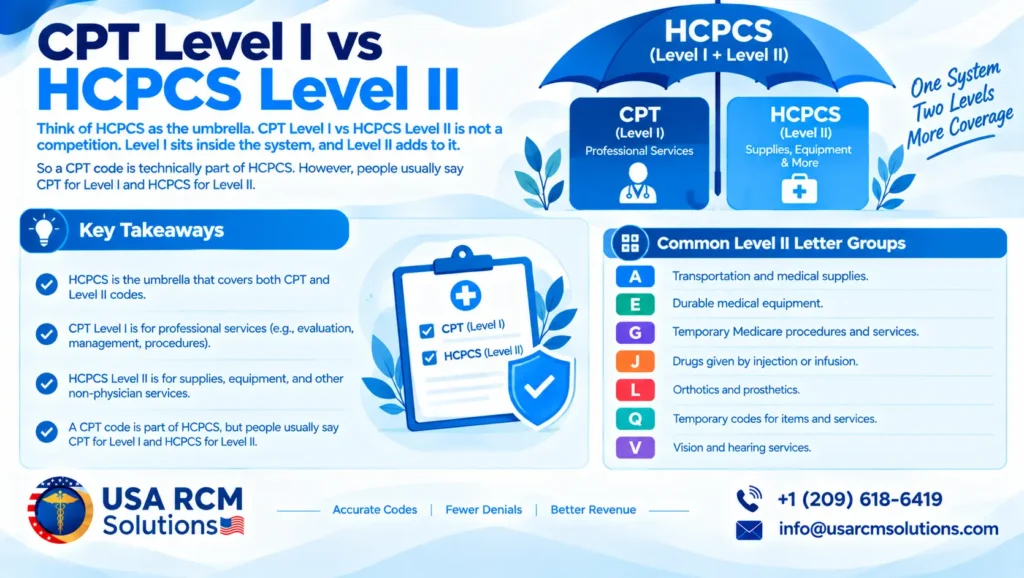
Common Level II letter groups include these.
- A: transportation and medical supplies.
- E: durable medical equipment.
- G: temporary Medicare procedures and services.
- J: drugs given by injection or infusion.
- L: orthotics and prosthetics.
- Q: temporary codes for items and services.
- V: vision and hearing services.
What Is the Primary Difference Between CPT and HCPCS Codes?
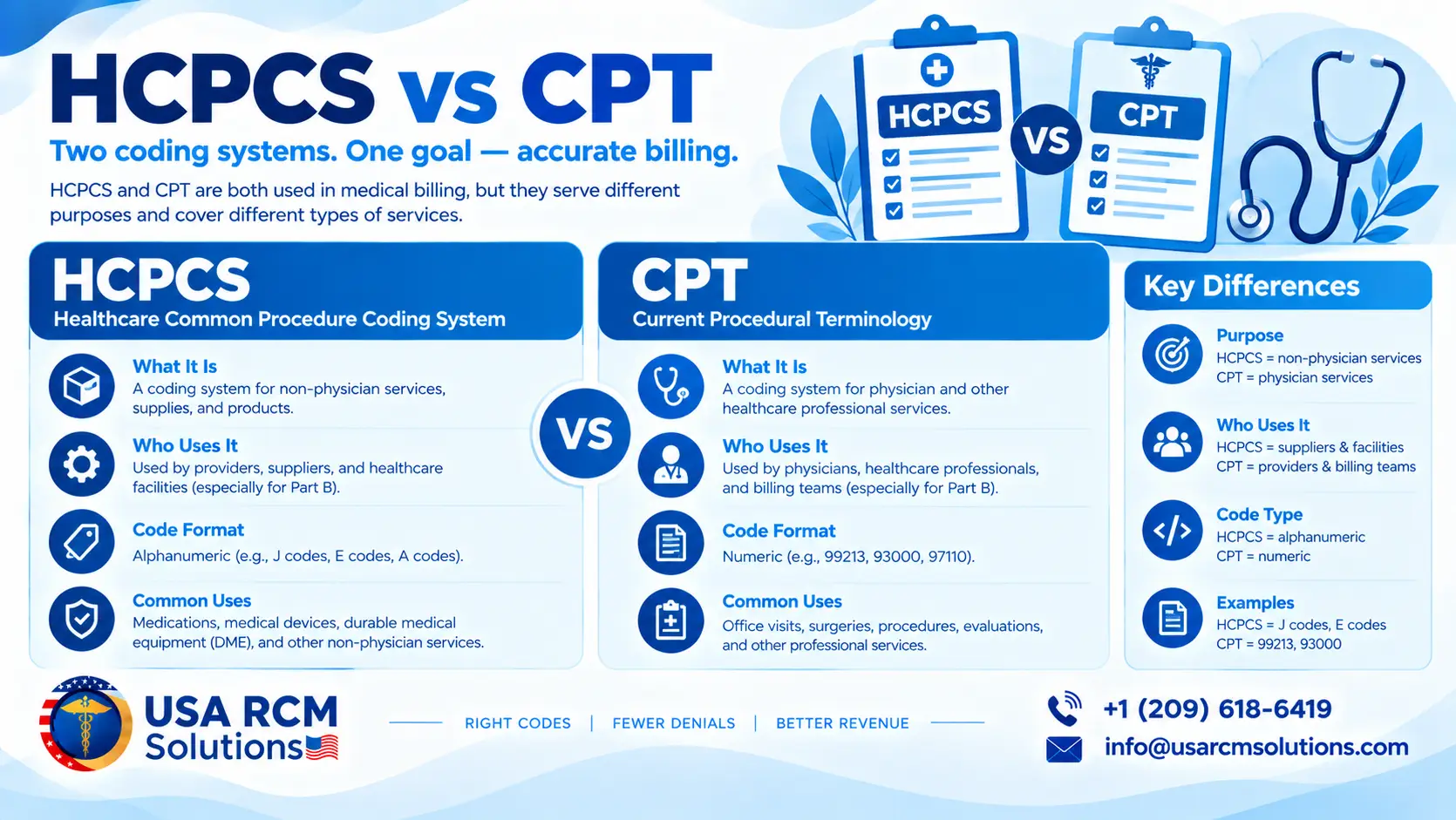
The primary difference between CPT and HCPCS codes is scope. CPT describes procedures and services that clinicians perform. HCPCS Level II describes items and services that CPT does not cover. Therefore, one covers the act of care, and the other covers products and extras.
The difference between CPT and HCPCS also affects ownership. The AMA owns CPT, and users pay a license fee. CMS maintains Level II, and anyone can use it for free.
Key Differences Between HCPCS and CPT
The table below shows the key differences at a glance.
| Feature | CPT (Level I) | HCPCS Level II |
| Maintained by | American Medical Association | CMS |
| Format | Five digits for Category I | One letter plus four digits |
| Main purpose | Procedures and clinical services | Supplies, drugs, equipment, and some services |
| Common examples | 99214, 97140, 81003 | J3490, E0143, L0120 |
| Update schedule | Annual, effective January | Quarterly updates |
| Cost | License required | Free to use |
| Typical users | Clinicians, labs, and imaging centers | Suppliers, pharmacies, ambulance services, and clinics billing items |
Modifiers also differ. CPT modifiers use two digits, such as 25 or 59. Level II modifiers use letters, such as RT, LT, and JW. So HCPCS codes vs CPT codes follow different modifier styles.
Is 99214 a CPT or HCPCS Code?
99214 is a CPT code. It describes an established patient office or outpatient visit with moderate complexity. Providers choose it based on medical decision making or total time. However, CPT is also Level I of HCPCS. So technically, 99214 belongs to both. In daily billing, most teams simply call it CPT.
Payers often review visit levels closely. Therefore, the note must support the level you bill.
Is J3490 a CPT or HCPCS Code?
J3490 is a HCPCS Level II code. It stands for unclassified drugs. The J category covers drugs given by injection or infusion. Practices use J3490 when no specific J code exists for a drug.
Payers often ask for the drug name, dose, and NDC. So attach clear documentation. Because J3490 is a catch-all code, payers review it closely. Once a drug gets a permanent code, switch to it.
When Should I Use a CPT Code Versus a HCPCS Level II Code for Medical Billing?
Use the code that best describes the service or item. These simple rules help most teams.
- Use CPT for clinician services, office visits, procedures, labs, and imaging.
- Use HCPCS Level II for drugs, supplies, equipment, and ambulance services.
- Use a Level II code when CPT has no matching code and the payer accepts it.
- Use G-codes when Medicare requires them in place of a CPT code.
- Always check the payer’s policy before you submit.
Many claims need both types. For example, a clinic gives an injection. CPT describes the injection service, and HCPCS Level II names the drug. So the two code sets work together.
Step-by-Step Process for Choosing the Right Code
- Read the documentation. Identify the service, item, or drug.
- Search CPT first. Look for a code that describes the clinician’s work.
- Search HCPCS Level II. Look for supplies, drugs, or equipment.
- Check payer rules. Confirm which code the payer wants.
- Add modifiers. Use the right CPT or Level II modifiers.
- Link the diagnosis. Match each line to an ICD-10 code.
- Review edits. Check bundling and medical necessity.
- Submit and track. Watch for denials and fix patterns.
How Do Insurance Companies Use HCPCS vs CPT Codes for Claims?
Payers read every claim line as a code plus a diagnosis. The code tells the payer what happened. The diagnosis tells why it happened. Together, they decide payment.
Insurers use these codes in several ways.
- They price each line using fee schedules.
- They apply bundling edits, such as NCCI, to prevent duplicate payment.
- They check medical necessity by linking diagnoses to codes.
- They apply coverage rules, such as local policies and prior authorization.
- They track utilization and trends across providers.
On the CMS-1500 form, item 24D lists CPT and HCPCS codes together. Medicare also requires HCPCS-specific codes in many situations. Private payers may add their own rules. Therefore, always check each payer’s manual.
CPT vs ICD: How the Code Sets Work Together
CPT vs ICD is a common training topic. ICD-10-CM describes the diagnosis, and CPT describes the service. They answer different questions, so you need both. For example, the ICD-10 Code for UTI is N39.0, which means urinary tract infection, site not specified. A urinalysis, such as CPT 81003, then supports that diagnosis.
Here is another example across all three code sets. M54.2 means cervicalgia, or neck pain. A manual therapy visit uses CPT 97140. A soft cervical collar uses HCPCS L0120. So one claim can use ICD-10, CPT, and HCPCS together.
An Illustrative Example: A UTI Visit With an Injection
Here is an illustrative example. A patient visits with burning and urgency. The provider documents a urinary tract infection and gives a ceftriaxone injection. Therefore, the claim lists N39.0 as the diagnosis. It also lists an E/M code, a CPT urinalysis, and CPT 96372 for the injection service. The drug itself uses HCPCS J0696, billed per 250 mg.
An Illustrative Denial Case
Here is another illustrative case. A clinic billed an unlisted drug with J3490. However, a specific J code already existed for that drug. So the payer denied the line. The team updated the code, added the NDC and units, and resubmitted. Then the claim paid.
Why Accurate Code Selection Matters
Accurate codes protect payment and compliance. A wrong code can delay or deny a claim. A missing modifier can cut payment. Therefore, small fixes bring real money back.
Code sets also change often. CPT updates each January, and HCPCS Level II updates quarterly. So teams must load new codes on time.
Documentation Tips for Providers
Good coding begins with good notes. Share these tips with your clinical team.
- Name the drug, dose, route, and units.
- Record time spent for time-based visit levels.
- List supplies and equipment given to the patient.
- Note the reason for each service.
- Record who performed the service.
Key Optimization Methods
The table below shows practical ways to improve code selection.
| Method | What It Does | Expected Result |
| Code set training | Teaches staff when to use CPT, Level II, or ICD-10 | Fewer wrong-code claims |
| Charge master reviews | Checks codes, units, and descriptions each quarter | Cleaner charges |
| Payer policy tracking | Records payer-specific code rules | Fewer rejections |
| Claim scrubbing | Flags missing modifiers, units, or NDCs | Higher first-pass acceptance |
| Provider documentation prompts | Capture drug, dose, and time details | Stronger claim support |
| Denial trend review | Tracks rejections by code type | Targeted fixes |
Best Tools and Practices
Strong tools support strong habits. The table below shows what works well together.
| Tool or Practice | Purpose | Why It Helps |
| Encoder software | Searches CPT, HCPCS, and ICD-10 codes | Faster, more accurate selection |
| Official CMS HCPCS files | Provide current Level II code sets | Reliable updates |
| AMA CPT resources | Provide official descriptions and guidelines | Correct usage |
| NCCI edit lookup | Shows bundling rules | Fewer bundling denials |
| Payer portals | Show coverage and policy details | Fewer surprises |
| Coding audits | Sample claims by code type | Finds patterns early |
Common Mistakes When Comparing HCPCS vs CPT
Even experienced teams repeat the same errors. Most of them come from mixing up the code sets. The table below shows the most common mistakes and better options.
| Common Mistake | Why It Hurts | Better Approach |
| Calling every code a CPT code | Leads to wrong lookups | Check whether the code starts with a letter |
| Using J3490 when a specific J code exists | Triggers denials | Search for the specific code first |
| Skipping units and NDC on drug lines | Causes pricing errors | Add units and NDC when required |
| Using CPT when the payer requires a G-code | Rejects the claim | Review payer and Medicare policies |
| Mixing diagnosis and procedure codes | Rejects the claim | Keep ICD-10 and CPT fields separate |
| Using outdated codes | Rejects the line | Load updates on schedule |
| Missing modifiers | Changes payment | Review modifier rules for each line |
Support for Coding and Revenue Teams
Coding does not happen in isolation. Documentation, enrollment, billing, and follow-up all affect payment. Therefore, many practices look for outside help.
Full-Service Support for Coding and Revenue Teams
USA RCM Solutions helps practices manage coding and revenue tasks together. Its service range supports the full cycle. The list below shows the main offerings.
- Medical Billing & Coding Services: accurate claims built on correct CPT, HCPCS, and ICD-10 codes.
- Medical Credentialing Services: payer enrollment and provider onboarding.
- Accounts Receivable Services: steady follow-up on aging claims.
- Virtual Medical Scribe: documentation support that saves provider time.
- Denial Management Services: root cause review, appeals, and prevention.
- Healthcare Marketing Services: patient acquisition and online visibility.
These services support one another. For instance, richer notes improve code selection, and correct codes reduce denials. Accounts Receivable Services also help chase underpaid claims when code errors change the payment. Meanwhile, payers pay only enrolled providers, so Medical Credentialing Services protect every claim. As a result, teams fix root problems instead of resubmitting the same claim.
How to Choose a Coding Partner
Choose a partner the way you would hire a key employee. Ask direct questions and expect clear answers.
- Coding credentials: Ask about certifications and ongoing education.
- Specialty experience: Confirm they know your drugs, supplies, and procedures.
- Audit support: Check how they handle payer reviews and appeals.
- Reporting: Request sample dashboards and monthly reports.
- Compliance: Confirm HIPAA safeguards and staff training.
- Clear pricing: Understand fees, contract terms, and exit options.
Future Trends in Medical Coding
Coding keeps changing because technology and payer rules keep changing. The table below highlights trends worth watching.
| Trend | What It Means | Likely Impact |
| AI-assisted coding | Software suggests CPT and HCPCS codes from notes | Faster coding with human review |
| Real-time payer edits | Systems check code pairs during charting | Fewer errors before billing |
| Automated charge capture | EHRs link supplies and drugs to codes | Fewer missed charges |
| Quarterly update automation | Systems load new Level II codes on time | Fewer outdated codes |
| Telehealth coding growth | Virtual care adds new codes and modifiers | Higher need for clear documentation |
| Virtual documentation support | Remote scribes capture visit detail | Clearer clinical notes |
Technology helps, but coders still make the final call. Experts must review every suggested code. Therefore, the best teams blend smart tools with trained people.
Conclusion
So, what should you remember about hcpcs vs cpt? CPT describes clinician services and procedures. HCPCS Level II covers drugs, supplies, equipment, and other items. Together, they appear on one claim with ICD-10 diagnosis codes.
Use CPT first for services, and use Level II for items and payer-required codes. For example, 99214 is a CPT code, and J3490 is a HCPCS Level II code. Always follow payer rules and the current code set.
You can build this process in-house or add outside support. A partner like USA RCM Solutions can cover coding, billing, and follow-up together. Either way, start with a code audit this week. Then fix your top error patterns, and review progress each month.
FAQs
Why Are CPT and HCPCS Codes Used Together on Medical Claims?
CPT and HCPCS codes are used together because they explain different parts of a medical claim. CPT codes show the services or procedures performed, while HCPCS Level II codes cover items like drugs, supplies, and equipment. Together, they help payers understand and process claims correctly.
How often do these code sets change?
CPT updates once a year, and the new codes take effect in January. HCPCS Level II updates quarterly, so new codes can start during the year. ICD-10-CM updates mainly each October. Therefore, billing teams should schedule regular code updates.
Do I still need ICD-10 codes if I use CPT?
Yes, you need both. CPT and HCPCS explain what the practice did. ICD-10 explains why the patient needed the service. Payers use the pair to judge medical necessity, so missing one can cause a denial.