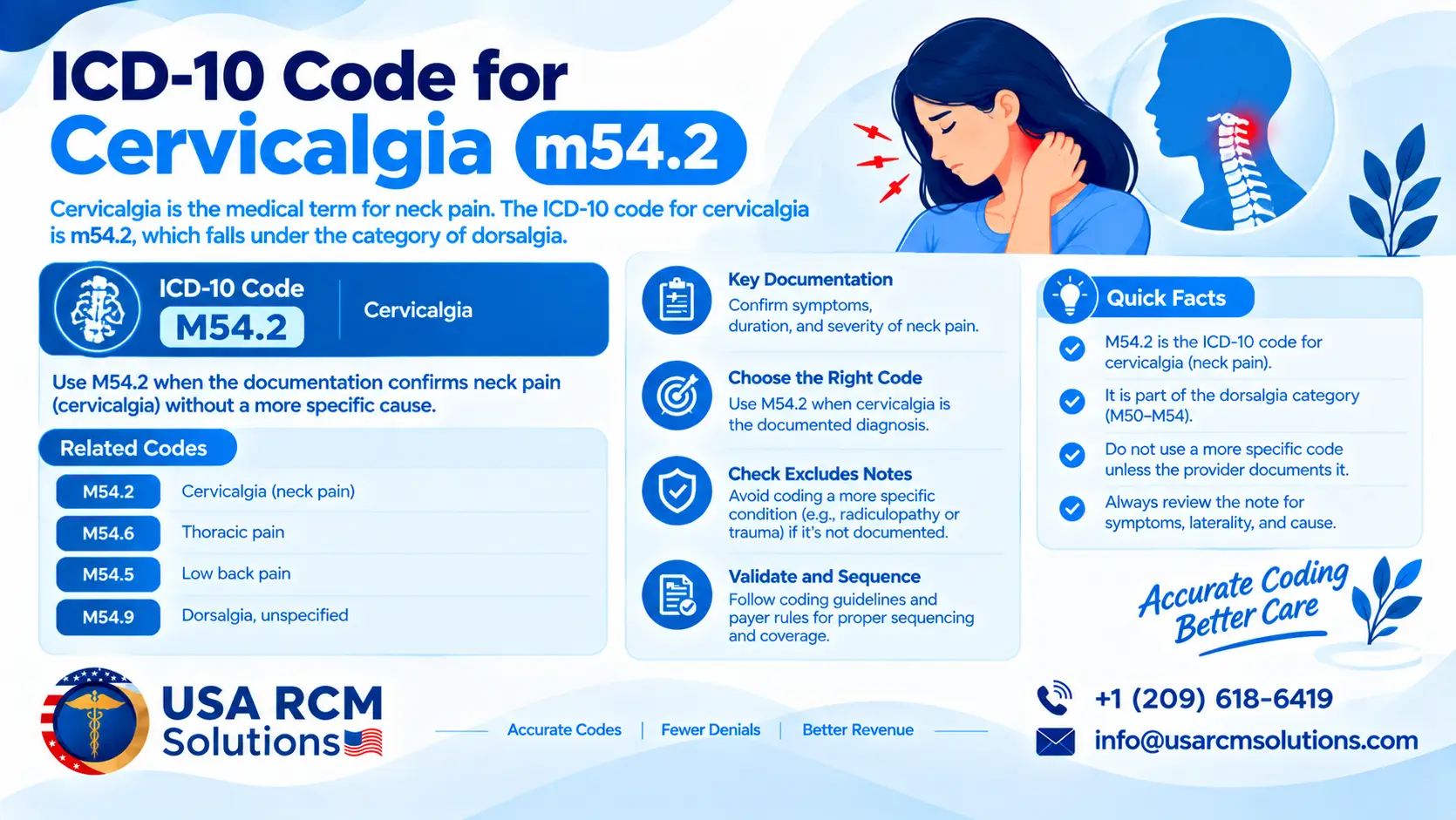
M54.2 is the ICD-10-CM code for cervicalgia, which means neck pain. It is a valid, billable code for many claims. Coders use it when the provider documents neck pain without a more specific cause. However, many neck problems need a more specific code. So this guide explains when M54-2 fits and when it does not.
Neck pain is one of the most common reasons patients visit clinics. Therefore, billing teams see this code every week. You will find tables, real examples, and a step-by-step process below. So let us start with the code itself.
What Does the Medical Code M54.2 Refer To?
M54.2 refers to cervicalgia. Cervicalgia is a medical word for neck pain. The code sits in the musculoskeletal chapter of ICD-10-CM. That chapter covers conditions of muscles, bones, and joints. Therefore, this code describes a symptom of the neck region.
M54-2 Code Description
The M54-2 code description is cervicalgia, also called neck pain. People search it as m54-2 icd 10 or the m54-2 diagnosis code. Others type ICD 10 neck pain or cervical spine pain ICD 10. All of these searches lead to the same code.
Cervicalgia ICD 10 Code at a Glance
- Code: M54.2
- Name: cervicalgia
- Plain meaning: neck pain
- Chapter: musculoskeletal system and connective tissue
- Billable: yes
Is M54.2 a Billable Code?
Yes, M54.2 is a valid ICD 10 code, and it is billable. It needs no extra characters, so it is complete as written. Payers accept it as a diagnosis on claims. However, acceptance does not guarantee payment. Many payers prefer more specific diagnoses for imaging and long therapy plans.
Billable means you can report it on a claim. It does not mean every service gets covered. Therefore, medical necessity still matters.
Excludes Notes and Related Neck Codes
This code has an Excludes1 note for cervicalgia due to a cervical disc disorder. In that case, use the M50 codes instead. Never report both on the same claim. So read the tabular list before you finalize.
- M50.-: cervical disc disorders.
- M47.812: cervical spondylosis without myelopathy or radiculopathy.
- M54.12: radiculopathy, cervical region.
- M43.6: torticollis.
- M62.838: other muscle spasm.
- S13.4XXA: cervical sprain, initial encounter.
What About M54.16 ICD 10?
People often mix up M54.16 icd 10 with neck codes. M54.16 means radiculopathy of the lumbar region, which is the low back. It does not describe the neck. For cervical radiculopathy, use M54.12. Therefore, double-check the body region before you code.
What Are the Common Causes of Persistent Neck Discomfort?
Neck pain has many causes. Some are simple, but others need prompt care. Providers review the full history before they choose a diagnosis.
- Poor posture, especially during long screen time.
- Muscle strain from lifting or sudden movement
. - Whiplash from car accidents or falls.
- Cervical arthritis, also called spondylosis.
- Herniated or degenerated discs.
- Nerve compression that causes arm pain or numbness.
- Stress and muscle tension.
- Sleeping in an awkward position.
Rare causes include infection, tumors, and meningitis. These causes usually come with other warning signs.
How Serious Is Cervicalgia?
Most cervicalgia is mild and improves within days or weeks. Rest, gentle movement, and simple pain relief often help. However, some cases need urgent care. Providers look for red flags first.
- Neck pain after major trauma.
- Fever, stiff neck, and severe headache together.
- Arm weakness, numbness, or tingling.
- Trouble walking or loss of bladder control.
- Unexplained weight loss or night pain.
Any of these signs needs prompt medical review. Pain that lasts beyond three months is often called chronic. Chronic pain deserves a full evaluation. This guide supports coders and billers, and it does not replace medical advice.
How Is M54-2 Usually Treated?
People sometimes write M54-2 or M54 2, but the correct format is M54.2. Treatment depends on the cause and the severity. Providers usually start with conservative care.
- Short rest and activity changes.
- Heat or cold therapy.
- Over-the-counter pain relievers, as the provider advises.
- Physical therapy and neck exercises.
- Posture and workstation changes.
- Massage or chiropractic care for some patients.
- Injections for selected cases.
- Surgery only for severe nerve or spinal problems.
Most patients improve with conservative care. Therefore, payers often expect it before advanced imaging.
Neck Pain Billing Code: Linking Diagnosis to Services
A neck pain billing code claim needs both diagnosis and procedure codes. The diagnosis explains why the patient came in. CPT codes explain what the practice did. Examples include 97110 for therapeutic exercise and 97140 for manual therapy. A cervical spine x-ray may use 72040, and an MRI may use 72141. Payers set their own coverage rules, so check each policy.
Diagnosis codes are not procedure codes. For example, the CPT Code for Echocardiogram, such as 93306, describes a heart test, not a condition. Never mix the two code types on one line.
Step-by-Step Process for Coding Neck Pain
- Read the provider note. Find the documented diagnosis and symptoms.
- Check for a specific cause. Look for disc disease, radiculopathy, sprain, or spasm.
- Choose the most specific code. Use M54.2 only when no cause appears.
- Review Excludes notes. Confirm no conflict with M50 codes.
- Link the services. Match therapy, imaging, or visits to the diagnosis.
- Check payer policy. Review visit limits and prior authorization rules.
- Submit a clean claim. Run your edits first.
- Track results. Review denials and fix root causes.
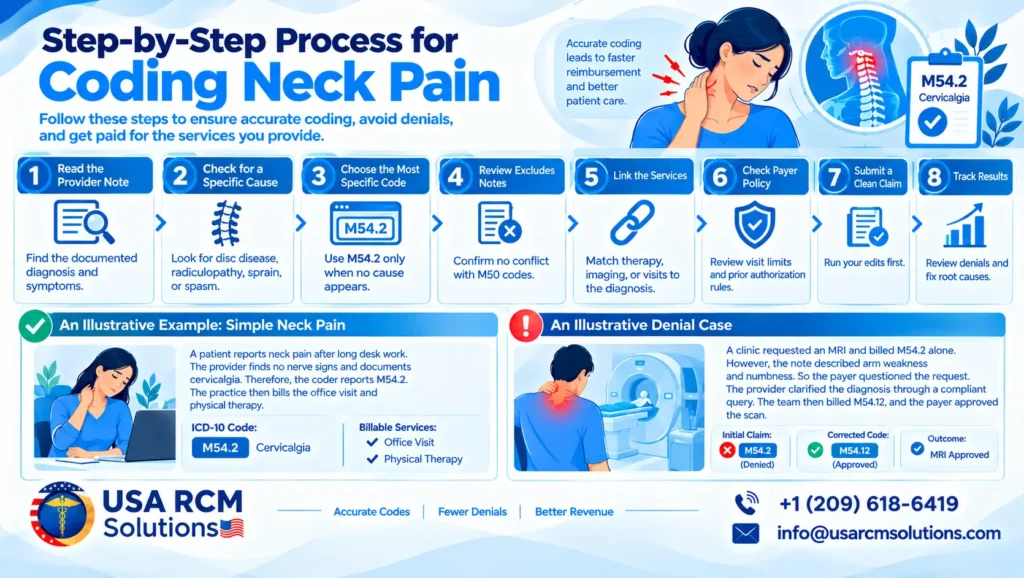
An Illustrative Example: Simple Neck Pain
Here is an illustrative example. A patient reports neck pain after long desk work. The provider finds no nerve signs and documents cervicalgia. Therefore, the coder reports M54.2. The practice then bills the office visit and physical therapy.
An Illustrative Denial Case
Here is another illustrative case. A clinic requested an MRI and billed M54.2 alone. However, the note described arm weakness and numbness. So the payer questioned the request. The provider clarified the diagnosis through a compliant query. The team then billed M54.12, and the payer approved the scan.
Why Accurate Coding Matters for M54.2
Accurate codes protect patient records and payment. A vague code can invite payer questions. A wrong code can deny a therapy or imaging claim. Therefore, small fixes bring real money back.
Neck pain is common, so payers watch these claims closely. They often review visit counts, imaging requests, and long treatment plans. So the chart should show the exam, the symptoms, and the plan.
Documentation Tips for Providers
Good coding begins with good notes. Share these tips with your clinical team.
- State the diagnosis clearly, such as cervicalgia or cervical radiculopathy.
- Record onset, duration, and pain level.
- Document nerve findings, such as numbness or weakness.
- Note the cause when known, such as injury or arthritis.
- List treatments tried and the patient’s response.
Key Optimization Methods
The table below shows practical ways to improve neck pain coding.
| Method | What It Does | Expected Result |
| Specific diagnosis documentation | Records cause, region, and nerve findings | Fewer claims with only a symptom code |
| Compliant clinical queries | Ask providers to clarify vague pain notes | More accurate codes |
| Medical necessity checks | Match imaging and therapy to documented findings | Fewer necessity denials |
| Claim scrubbing | Flags Excludes 1 conflicts with M50 codes | Cleaner claims |
| Visit limit tracking | Monitors therapy and chiropractic caps | Fewer surprise denials |
| Denial trend review | Tracks rejections by code and payer | Targeted fixes |
Best Tools and Practices
Strong tools support strong habits. The table below shows what works well together.
| Tool or Practice | Purpose | Why It Helps |
| Encoder software | Guides code search and edits | Faster, more accurate selection |
| Official ICD-10-CM guidelines | Sets rules for code use | Reliable reference |
| EHR templates for neck pain | Prompt for cause, duration, and nerve signs | Complete notes |
| Payer policy lookup tools | Show coverage and limits | Fewer surprises |
| Coding audits | Sample musculoskeletal claims | Finds patterns early |
| KPI dashboards | Track denial rate by diagnosis | Shows problem areas |
Common Mistakes With the M54.2 Diagnosis Code
Even experienced teams repeat the same errors. Specificity rules apply in every specialty. For example, the Epilepsy ICD 10 Code family changes with type and intractability. Neck pain works the same way. The table below shows the most common errors and better options.
| Common Mistake | Why It Hurts | Better Approach |
| Using M54.2 when a disc disorder is documented | Violates the Excludes1 note | Use the matching M50 code |
| Writing M54-2 or M54 2 on claims | Causes format rejections | Use M54.2 with the decimal point |
| Confusing M54.16 with a neck code | Reports the wrong body region | Use M54.12 for cervical radiculopathy |
| Using one symptom code for every neck complaint | Weakens necessity support | Code the most specific documented cause |
| Mixing CPT and ICD-10 codes | Rejects the claim | Keep diagnosis and procedure codes separate |
| Skipping visit limit checks | Triggers denials | Verify benefits first |
Support for Coding and Revenue Teams
Coding does not happen in isolation. Documentation, enrollment, billing, and follow-up all affect payment. Therefore, many practices look for outside help.
Full-Service Support for Coding and Revenue Teams
USA RCM Solutions helps practices manage coding and revenue tasks together. Its service range supports the full cycle. The list below shows the main offerings.
- Medical Billing & Coding Services: accurate claims built on correct diagnosis codes.
- Medical Credentialing Services: payer enrollment and provider onboarding.
- Accounts Receivable Services: steady follow-up on aging claims.
- Virtual Medical Scribe: documentation support that saves provider time.
- Denial Management Services: root cause review, appeals, and prevention.
- Healthcare Marketing Services: patient acquisition and online visibility.
These services support one another. For instance, richer notes improve diagnosis detail, and specific codes reduce denials. Strong Medical Billing & Coding helps teams catch Excludes 1 conflicts before submission. Denial Management Services then review rejected claims, so teams learn which neck pain codes payers question. As a result, teams fix root problems instead of resubmitting the same claim.
How to Choose a Coding Partner
Choose a partner the way you would hire a key employee. Ask direct questions and expect clear answers.
- Coding credentials: Ask about certifications and ongoing education.
- Specialty experience: Confirm they understand orthopedic and therapy billing.
- Audit support: Check how they handle payer reviews and appeals.
- Reporting: Request sample dashboards and monthly reports.
- Compliance: Confirm HIPAA safeguards and staff training.
- Clear pricing: Understand fees, contract terms, and exit options.
Future Trends in Neck Pain Coding
Coding keeps changing because technology and payer rules keep changing. The table below highlights trends worth watching.
| Trend | What It Means | Likely Impact |
| AI-assisted coding | Software suggests codes from clinical notes | Faster coding with human review |
| Telehealth physical therapy | Virtual visits for neck care | Higher need for clear documentation |
| Wearable posture trackers | Devices record posture and movement data | Stronger clinical support |
| Automated prior authorization | Electronic requests for imaging | Faster approvals |
| Predictive denial analytics | Models flag risky claims early | Fewer denials |
| Virtual documentation support | Remote scribes capture visit detail | Clearer clinical notes |
Technology helps, but coders still make the final call. Experts must review every suggested code. Therefore, the best teams blend smart tools with trained people.
Conclusion
So, what should you remember about M54.2? It means cervicalgia, or neck pain, and it is a valid, billable code. Use it only when the provider documents neck pain without a more specific cause. Disc disorders, radiculopathy, and sprains need their own codes.
Strong documentation drives every correct choice. Providers should record the cause, the duration, and any nerve findings. Meanwhile, billing teams should verify benefits before therapy or imaging and track denials by code.
You can build this process in-house or add outside support. A partner like USA RCM Solutions can cover coding, billing, and follow-up together. Either way, start with a claim audit this week. Then fix your top documentation gaps, and review progress each month.
FAQs
What does M54.2 mean?
M54.2 means cervicalgia, which is neck pain. It belongs to the musculoskeletal chapter of ICD-10-CM. Providers use it when they document neck pain without a more specific cause. If a cause appears, a more specific code usually fits better.
How serious is cervicalgia?
Most cervicalgia is mild and improves with simple care. However, red flags need prompt review, such as trauma, fever, or arm weakness. Pain that lasts beyond three months also needs a full evaluation. So patients should see a provider when symptoms persist or worsen.
What code should I use when neck pain comes from a disc problem?
Use the M50 codes when the provider documents a cervical disc disorder. M54.2 has an Excludes1 note for cervicalgia due to disc disorders. Therefore, you should not report both codes together. Always read the tabular list and the provider’s note before you choose.