The epilepsy icd 10 code starts with category G40. Most coders use G40.909 when a provider documents epilepsy without more detail. However, ICD-10-CM offers many other options. Type, intractability, and status epilepticus all change the final code. This guide explains each choice in plain words.
Neurology claims carry high stakes, so accuracy matters. Therefore, small coding errors can delay care and payment. You will find tables, real examples, and a step-by-step process below. So let us begin with the basics.
Epilepsy ICD 10 Code: Understanding Epilepsy and Seizures
Epilepsy is a brain disorder that causes repeated seizures. A seizure is a burst of abnormal electrical activity. Some seizures are brief, but others last for minutes. Doctors diagnose epilepsy after a pattern of unprovoked seizures.
Causes vary. Genetics, brain injury, stroke, infection, and tumors can all play a role. In many patients, no cause appears. Many users simply type epilepsy icd into a search box, but the right code depends on the full note.
What Is the Difference Between a Seizure and Epilepsy?
One seizure does not always mean epilepsy. The icd code 10 for seizure is often R56.9, which means unspecified convulsions. Epilepsy, however, means recurrent seizures, and it uses G40 codes. Therefore, coders must read the diagnosis carefully.
Symptom codes work much like the ICD 10 for Diarrhea. R19.7 names a symptom, and R56.9 does the same for seizures. Once a diagnosis appears, the disease code takes over.
Febrile seizures use R56.0- codes, and post-traumatic seizures use R56.1. Psychogenic nonepileptic seizures may use F44.5. So never assume every seizure belongs in G40.
What Is the ICD-10 Code for Epilepsy?
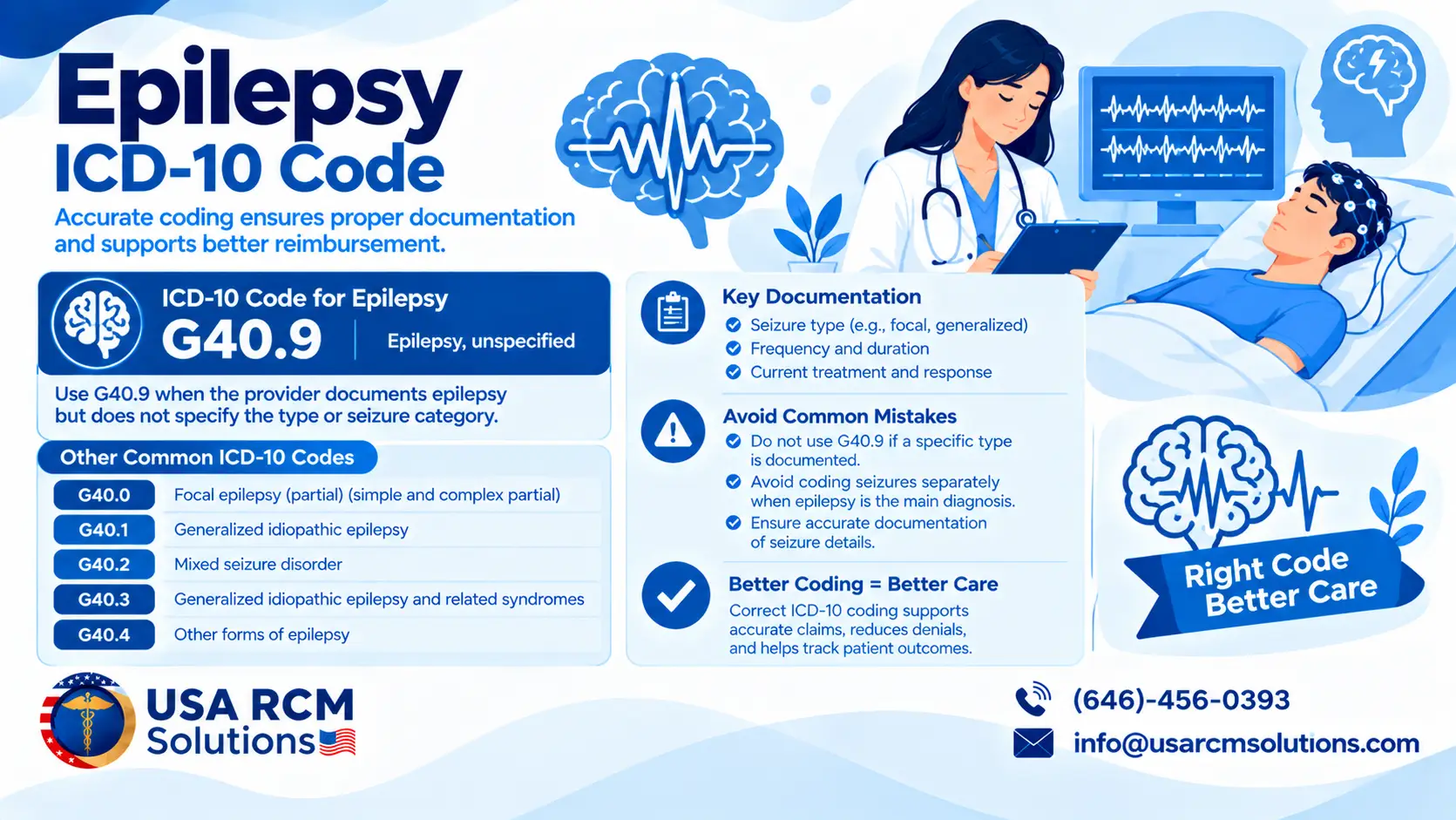
The ICD-10 code for epilepsy falls in the G40 range. G40 codes cover epilepsy and recurrent seizures. The most common default is G40.909. It means epilepsy, unspecified, not intractable, without status epilepticus.
Providers who write about seizure disorders also point to G40.909 in the index. Therefore, this code appears on many neurology and primary care claims.
How G40 Codes Are Built
Many G40 codes follow a simple pattern. The type comes first. Then one digit shows if the epilepsy is intractable. The last digit shows status epilepticus.
For example, G40.909 means unspecified type, not intractable, without status epilepticus. Likewise, G40.919 epilepsy ICD 10 coding means unspecified type, intractable, without status epilepticus.
Epilepsy ICD 10 Code List
The epilepsy icd 10 code list below shows the main G40 families. Descriptions are shortened, so confirm the final digits in the tabular list.
| Code | Short Description | Typical Use |
| G40.909 | Epilepsy, unspecified, not intractable, no status epilepticus | Epilepsy or seizure disorder with no detail |
| G40.919 | Epilepsy, unspecified, intractable, no status epilepticus | Treatment-resistant epilepsy, type not stated |
| G40.309 | Generalized idiopathic epilepsy, not intractable, no status epilepticus | Generalized epilepsy with no known cause |
| G40.209 | Symptomatic focal epilepsy, complex partial seizures, not intractable, no status epilepticus | Focal seizures with impaired awareness |
| G40.109 | Symptomatic focal epilepsy, simple partial seizures, not intractable, no status epilepticus | Focal seizures with preserved awareness |
| G40.A09 | Absence epileptic syndrome, not intractable, no status epilepticus | Absence seizures, including childhood absence |
| G40.B09 | Juvenile myoclonic epilepsy, not intractable, no status epilepticus | Teen and young adult myoclonic epilepsy |
| G41.9 | Status epilepticus, unspecified | Status epilepticus with no more detail |
Providers may use newer terms, such as focal impaired awareness. So check the index to map the wording to the right code.
Common ICD 10 Codes for Different Epilepsy Types
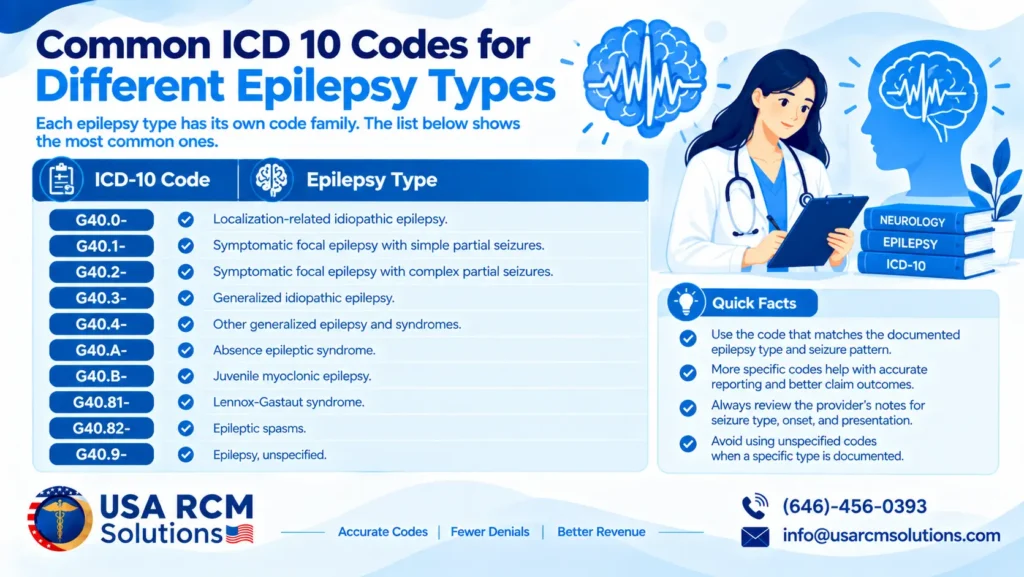
Each epilepsy type has its own code family. The list below shows the most common ones.
- G40.0-: localization-related idiopathic epilepsy.
- G40.1-: symptomatic focal epilepsy with simple partial seizures.
- G40.2-: symptomatic focal epilepsy with complex partial seizures.
- G40.3-: generalized idiopathic epilepsy.
- G40.4-: other generalized epilepsy and syndromes.
- G40.A-: absence epileptic syndrome.
- G40.B-: juvenile myoclonic epilepsy.
- G40.81-: Lennox-Gastaut syndrome.
- G40.82-: epileptic spasms.
- G40.9-: epilepsy, unspecified.
Symptomatic Epilepsy ICD 10
Symptomatic epilepsy ICD 10 coding often uses G40.1- or G40.2-. In this term, a known cause drives the seizures, such as injury or stroke. However, the provider must use that wording. Therefore, coders should not guess the type from imaging.
G40.309 Generalized Idiopathic Epilepsy Code
The G40.309 generalized idiopathic epilepsy code fits generalized epilepsy with no known cause. It also means not intractable and no status epilepticus. Providers often treat these patients with long-term medication. So the record should show type, control, and treatment.
Childhood Epilepsy ICD 10 Code
Childhood epilepsy ICD 10 code choices depend on the syndrome. Absence epilepsy in children uses G40.A-. Infantile spasms use G40.82-, which covers epileptic spasms. Lennox-Gastaut syndrome uses G40.81-. Febrile seizures use R56.0- instead of G40.
Children may outgrow some syndromes, so documentation should stay current. Pediatric neurologists also add developmental codes when they document them.
Intractable Epilepsy ICD 10 Code
Intractable codes apply when seizures resist treatment. ICD-10-CM treats several terms as intractable. These include pharmacoresistant, treatment resistant, refractory, and poorly controlled. Therefore, G40.919 may fit when the provider documents refractory epilepsy of unspecified type. Other intractable codes follow the same pattern, such as G40.319 for generalized idiopathic epilepsy.
Payers often need proof of failed medications before they approve advanced care. So clear intractable wording protects both patients and revenue.
Status Epilepticus: Epilepticus ICD 10
Searches for epilepticus icd 10 usually point to G41 codes. Status epilepticus is a medical emergency with prolonged or repeated seizures. When a patient has known epilepsy, G40 codes include a status epilepticus option. For example, G40.901 means epilepsy, unspecified, not intractable, with status epilepticus. Always review the Excludes notes before you use a G41 code.
How to Find an Epilepsy ICD 10 Code on Medical Coding Websites
Many coders start online, so a clear search routine helps. First, use trusted sites such as CMS and the National Center for Health Statistics. Next, try professional tools such as AAPC Codify or your encoder software. Finally, check free lookup sites, but verify every result.
- Search the index first. Type epilepsy, seizure disorder, or the documented syndrome.
- Open the tabular list. Read the full code description and notes.
- Check the later characters. Match intractability and status epilepticus.
- Read the Excludes notes. Confirm no conflicts with R56 or F44 codes.
- Confirm the year. Use the code set for the date of service.
- Cross-check the site. Compare third-party results with official files.
Third-party sites may lag behind updates. Therefore, official files should win every disagreement.
ICD 10 Coding Guidelines for Epilepsy
Clear rules guide this work. The tips below fit most neurology and primary care charts. Choosing the right epilepsy icd 10 code starts with provider documentation.
Core Coding Guidelines
- Code from provider documentation only.
- Use G40 codes for epilepsy and recurrent seizures.
- Use R56.9 for a single seizure without an epilepsy diagnosis.
- Report intractability when the provider uses a matching term.
- Report status epilepticus only when documented.
- Treat seizure disorder as epilepsy, as the index directs.
- Add Z79.899 for long-term drug therapy when documented.
- Use the code set effective on the date of service.
Step-by-Step Process for Coding Epilepsy
- Read the full note. Find the diagnosis, seizure type, and treatment plan.
- Confirm epilepsy or a single seizure. Choose G40 or R56 accordingly.
- Identify the type. Look for generalized, focal, absence, or a named syndrome.
- Check intractability. Look for refractory, pharmacoresistant, or poorly controlled.
- Check status epilepticus. Report it only when the provider documents it.
- Add supporting codes. Include long-term drug therapy when it applies.
- Review Excludes notes. Confirm no code pair conflicts.
- Submit and track. Watch for denials and payer questions.
An Illustrative Example: Generalized Epilepsy
Here is an illustrative example. A 15-year-old patient has generalized seizures with no known cause. The neurologist documents generalized idiopathic epilepsy, controlled on medication. No status epilepticus occurs. Therefore, the coder reports G40.309. Z79.899 can show long-term drug therapy.
An Illustrative Example: Refractory Focal Epilepsy
A second patient has focal seizures and has tried three medications. The provider documents refractory symptomatic epilepsy with complex partial seizures. No status epilepticus appears in the note. So the coder reports G40.219, which signals intractable epilepsy.
Why Accurate Coding Matters
Accurate codes protect patient records and payment. A vague code can invite payer questions. A wrong code can delay approvals. Therefore, small fixes bring real money back.
Prior Authorization in Medical Billing
Prior Authorization in Medical Billing means getting payer approval before a service. Epilepsy care often needs it. Video EEG monitoring, advanced imaging, some medications, and neurostimulation devices may all require approval. Payers read the diagnosis code closely. Therefore, a vague code can delay care.
An intractable code with clear notes shows why advanced care is necessary. Staff should also attach EEG results, medication history, and imaging reports. Rules vary by payer, so always check each policy.
An Illustrative Denial Case
Here is another illustrative case. A neurology office requested video EEG monitoring with G40.909. The payer denied it for lacking medical necessity. However, the provider’s notes already documented refractory epilepsy and three failed medications. So the team corrected the code to match the note and appealed. Then the payer approved the test.
Documentation Tips for Providers
Good coding begins with good notes. Share these tips with your clinical team.
- State epilepsy and the type, such as generalized or focal.
- Document whether seizures are intractable, refractory, or controlled.
- Record status epilepticus episodes clearly.
- List medications tried and their results.
- Note the cause, such as stroke or brain injury, when known.
A Virtual Medical Scribe can capture these details during the visit. Therefore, neurologists spend more time with patients.
Key Optimization Methods
The table below shows practical ways to improve epilepsy coding.
| Method | What It Does | Expected Result |
| Neurology EHR templates | Prompt for type, intractability, and status epilepticus | More specific codes |
| Prior Authorization in Medical Billing workflows | Gather EEG, imaging, and medication history before submission | Fewer authorization denials |
| Clinical documentation queries | Ask providers to clarify vague seizure terms | Accurate code selection |
| Claim scrubbing | Flags R56 and G40 conflicts | Cleaner claims |
| Coder education | Reviews annual G40 updates | Fewer coding errors |
| Denial trend review | Tracks rejections by code and payer | Targeted fixes |
Best Tools and Practices
Strong tools support strong habits. The table below shows what works well together.
| Tool or Practice | Purpose | Why It Helps |
| Encoder software | Guides code search and edits | Faster, more accurate selection |
| Official ICD-10-CM guidelines | Sets rules for code use | Reliable reference |
| EHR order sets for EEG and imaging | Link tests to diagnoses | Stronger necessity support |
| Payer policy lookup tools | Show authorization rules | Fewer surprises |
| Coding audits | Sample neurology claims | Finds patterns early |
| KPI dashboards | Track denial rate by code | Shows problem areas |
Common Mistakes With the Epilepsy ICD 10 Code
Even experienced teams repeat the same errors. Teams that already track patterns, such as ICD 10 for Diarrhea denials, can reuse the same review process. The table below shows the most common epilepsy errors and better options.
| Common Mistake | Why It Hurts | Better Approach |
| Using R56.9 when epilepsy is documented | Understates the diagnosis | Use the matching G40 code |
| Using G40.909 for every case | Loses type and intractability | Code the most specific documented detail |
| Ignoring intractable wording | Weakens necessity for advanced care | Capture refractory or pharmacoresistant terms |
| Missing status epilepticus detail | Hides severity | Report it when documented |
| Coding febrile seizures as epilepsy | Uses the wrong code family | Use R56.0- for febrile seizures |
| Skipping prior authorization checks | Triggers denials | Verify requirements before testing |
Support for Coding and Revenue Teams
Coding does not happen in isolation. Documentation, enrollment, billing, and follow-up all affect payment. Therefore, many practices look for outside help.
Full-Service Support for Coding and Revenue Teams
USA RCM Solutions helps practices manage coding and revenue tasks together. Its service range supports the full cycle. The list below shows the main offerings.
- Medical Billing & Coding Services: accurate claims built on correct diagnosis codes.
- Medical Credentialing Services: payer enrollment and provider onboarding.
- Accounts Receivable Services: steady follow-up on aging claims.
- Virtual Medical Scribe: documentation support that saves provider time.
- Denial Management Services: root cause review, appeals, and prevention.
- Healthcare Marketing Services: patient acquisition and online visibility.
These services support one another. For instance, richer notes improve diagnosis detail, and specific codes reduce denials. Denial Management Services also review neurology denials, so teams learn which G40 codes payers question. As a result, teams fix root problems instead of resubmitting the same claim.
How to Choose a Coding Partner
Choose a partner the way you would hire a key employee. Ask direct questions and expect clear answers.
- Coding credentials: Ask about certifications and ongoing education.
- Neurology experience: Confirm they understand authorization and EEG billing.
- Audit support: Check how they handle payer reviews and appeals.
- Reporting: Request sample dashboards and monthly reports.
- Compliance: Confirm HIPAA safeguards and staff training.
- Clear pricing: Understand fees, contract terms, and exit options.
Future Trends in Epilepsy Coding
Coding keeps changing because technology and payer rules keep changing. The table below highlights trends worth watching.
| Trend | What It Means | Likely Impact |
| AI-assisted coding | Software suggests codes from neurology notes | Faster coding with human review |
| Automated prior authorization | Systems submit requests electronically | Faster approvals |
| Remote EEG and telehealth neurology | Virtual visits need clear documentation | Consistent coding across settings |
| Wearable seizure monitoring | Devices feed data into the chart | Stronger clinical support |
| Predictive denial analytics | Models flag risky claims early | Fewer denials |
| Virtual documentation support | Remote scribes capture visit detail | Clearer clinical notes |
Technology helps, but coders still make the final call. Experts must review every suggested code. Therefore, the best teams blend smart tools with trained people.
Conclusion
So, what should you remember about the epilepsy icd 10 code? G40 codes cover epilepsy and recurrent seizures, and G40.909 is the common default. Type, intractability, and status epilepticus then refine the code. A single seizure without epilepsy usually uses R56.9.
Strong documentation drives every correct choice. Providers should record the epilepsy type, treatment history, and any status epilepticus. Meanwhile, billing teams should verify authorization rules before testing and track denials by code.
You can build this process in-house or add outside support. A partner like USA RCM Solutions can cover coding, billing, and follow-up together. Either way, start with a neurology claim audit this week. Then fix your top documentation gaps, and review progress each month.
FAQs
What is the epilepsy icd 10 code?
epilepsy icd 10 code fall in the G40 range of ICD-10-CM. The common default is G40.909, which means epilepsy, unspecified, not intractable, without status epilepticus. More specific codes exist for generalized, focal, absence, and other types.
What is the icd code 10 for seizure?
A single seizure without an epilepsy diagnosis often uses R56.9, unspecified convulsions. Febrile seizures use R56.0-, and post-traumatic seizures use R56.1. However, recurrent seizures documented as epilepsy or seizure disorder use G40 codes.
Which code applies to intractable epilepsy?
Intractable epilepsy uses G40 codes with a 1 in the intractable position. For example, G40.919 means epilepsy, unspecified, intractable, without status epilepticus. ICD-10-CM treats terms such as refractory, pharmacoresistant, and poorly controlled as intractable.
How do I code status epilepticus?
When the patient has a documented epilepsy type, use the G40 code that includes status epilepticus. For example, G40.901 covers unspecified epilepsy, not intractable, with status epilepticus. G41 codes cover status epilepticus more broadly, such as G41.9 for unspecified.