
The 88305 CPT code is one of the most billed codes in pathology. It describes a Level IV surgical pathology examination of a tissue specimen. Therefore, labs, dermatology clinics, and hospitals see it on thousands of claims every year. However, small mistakes with units, modifiers, or documentation still cause denials.
This guide explains what the code means and when to use it. You will also learn how to document it and submit it to payers. Because billing rules change, we will use simple steps and real examples.
What Is the 88305 CPT Code?
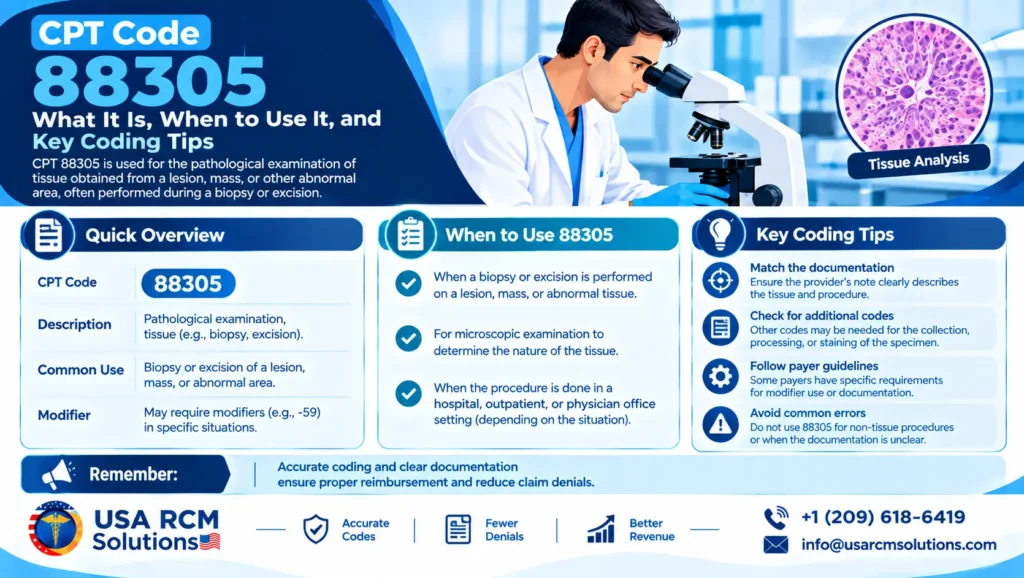
The 88305 CPT code reports a gross and microscopic examination of tissue. A pathologist looks at the specimen with the naked eye first. Then the pathologist studies prepared slides under a microscope. Finally, the pathologist signs a report with a diagnosis.
Pathology codes follow a six-level system, from 88300 to 88309. Each level matches the complexity of the specimen. So the 88305 pathology code sits in the middle of the range, at Level IV.
88305 CPT Code Description
The official 88305 CPT code description reads “Level IV, surgical pathology, gross and microscopic examination.” The AMA then lists example specimens under that level. For instance, breast biopsy, colon biopsy, and prostate needle biopsy all fall here.
That list matters because it guides coders. If the specimen appears on the Level IV list, the code usually fits. However, always check the current CPT book, because the list can change.
88305 CPT Code Definition in Plain Words
Here is a simple 88305 CPT Code definition. It pays for examining one separately identified tissue specimen at a moderate level of complexity. The lab or pathologist bills it once per specimen. Therefore, the code counts specimens, not slides.
Many coders also write the 88305 CPT code as cpt 88305 in notes and billing systems. The meaning stays the same. It always points to Level IV tissue examination.
What Does CPT Code 88305 Specifically Cover in Pathology?
The code covers the full surgical pathology examination process. It includes both the technical work and the professional work. The technical work happens in the lab. The professional work is the pathologist’s interpretation.
The service includes several steps. Staff accession the specimen and the pathologist describes it. Technicians then process, embed, cut, and stain the tissue. Finally, the pathologist reviews the slides and issues a report.
88305 Specimen Types
Common 88305 specimen types include many biopsies and small resections. The table below shows typical examples.
| Body System | Common Level IV Specimens |
| Digestive | Stomach, colon, and small bowel biopsies; colon polyps |
| Skin | Skin biopsies for rash, lesions, or suspected cancer |
| Breast | Breast biopsy and breast lumpectomy for non-tumor reasons |
| Urinary | Bladder biopsy and prostate needle biopsy |
| Reproductive | Cervix biopsy, endometrial curettings, and uterus specimens |
| Respiratory | Lung biopsy and bronchial biopsy |
| Lymphatic | Lymph node biopsy |
This table is a guide, not a full list. Always match the specimen to the current CPT descriptor.
What the Code Does Not Cover
The 88305 CPT code does not include special stains. It also excludes immunohistochemistry and molecular tests. Those services use separate codes. For example, the cpt code 88342 reports the first immunohistochemistry stain per specimen.
Similarly, cytology and fine needle aspirates use different codes. So do frozen sections and consultation services. Therefore, a lab can bill 88305 plus add-on tests when the documentation supports each one.
Common Scenarios Where CPT 88305 Is Appropriately Used
Real examples make the rules easier to follow. Here are the most common cases.
Skin biopsy for a rash. A dermatologist takes a punch biopsy from a patient’s thigh. The patient had a tick bite two weeks earlier and now has a spreading rash. The lab bills 88305 for the skin specimen.
The visit claim may use an insect bite code for the body site. The ICD-10 code for tick bite usually pairs a site-specific bite code with W57.XXXA. Your coder should confirm the exact codes in the current ICD-10-CM book.
Colon biopsies during colonoscopy. A gastroenterologist removes a polyp from the sigmoid colon. The gastroenterologist also takes two biopsies from the cecum. Each site goes in its own container, so the lab reports three units of 88305.
Prostate needle biopsy. Many urologists send cores in separate containers. Each container is a separate specimen. Therefore, the lab bills one unit per labeled container.
Breast core biopsy. A radiologist places a core needle in a suspicious area. The lab examines the tissue and reports atypia. The 88305 CPT code fits this specimen. The lab may add stains if the pathologist orders them.
How Many Times Can 88305 Be Billed?
You can bill 88305 once for each separately identified specimen. That rule matters more than the number of slides or fragments. So one container with five fragments from the same site counts as one unit.
Different sites count separately. For example, three labeled gastric biopsies from different areas count as three units. However, the lab must label each container clearly and the report must describe each one.
| Situation | Units of 88305 |
| One container, several fragments from one site | 1 |
| Three containers from three different sites | 3 |
| Same site split into two containers by the physician | Usually 1, per payer rules |
| Multiple levels cut on one block | 1 |
Medicare also publishes medically unlikely edits, which cap units per date of service. Check the current table before you submit a high-volume claim. Moreover, private payers may set their own limits.
Does CPT 88305 Need a Modifier?
Most of the time, no modifier is required. A lab doing both technical and professional work bills the code globally, without a modifier. That is the simplest case.
However, some situations call for modifiers. The table below shows the usual ones.
| Modifier | When It Applies |
| 26 | Pathologist bills only the professional interpretation |
| TC | Lab bills only the technical component |
| 59 or XS | Separate specimens flagged by a payer edit |
| GW | Service unrelated to a hospice patient’s terminal condition |
Split Billing With 26 and TC
Sometimes a hospital owns the lab, and an outside pathologist reads the slides. In that case, the hospital bills with the TC modifier. The pathologist bills the same code with modifier 26. Neither party bills the global service.
The GW Modifier and Hospice Patients
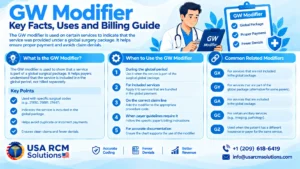
A GW modifier tells Medicare the service has no link to the hospice patient’s terminal illness. Consider a hospice patient with lung cancer who has a suspicious skin lesion removed. The skin biopsy does not relate to the lung cancer. Therefore, the lab or physician may use GW with the pathology claim. Documentation must support that choice.
Medical Necessity for Billing CPT 88305
Medical necessity means the test was reasonable and needed for the patient’s diagnosis or symptoms. Payers review it because tissue testing costs money. So every claim needs a diagnosis that supports the specimen.
The ordering physician usually provides the reason. For example, a gastroenterologist orders biopsies because of chronic diarrhea. A dermatologist orders a skin specimen because of a changing mole.
Strong medical necessity shows three things:
- A clear clinical problem or symptom.
- A diagnosis code that matches the problem.
- A specimen that fits the reason for testing.
Weak links cause denials. For instance, a routine screening code rarely supports an extra biopsy without an abnormal finding. Therefore, the requisition must give a real clinical indication.
Guidelines for Proper Medical Documentation for 88305 Billing
Good records protect both payment and compliance. Every claim should trace back to a signed order and a complete report.
Step-by-Step Documentation Process
- Capture the order. Get a signed requisition with the patient’s name, date of birth, and test.
- Record the clinical history. Include symptoms, prior diagnoses, and the reason for biopsy.
- Label every container. List the site, the side, and the specimen type.
- Write the gross description. Note size, color, and number of fragments.
- Document the microscopic findings. Describe what the pathologist saw.
- Sign the final report. Include the diagnosis and the date.
- Match the claim to the report. Count units from the labeled specimens.
Real Example of a Clean Report
Consider this report for a colon biopsy. “Specimen A: cecum biopsy, two tan fragments. Specimen B: sigmoid polyp, one fragment. Diagnosis A: chronic inflammation. Diagnosis B: tubular adenoma.” This report supports two units of the 88305 CPT code. Each specimen has its own site and diagnosis.
How to Submit Claims for CPT Code 88305 With Major Insurance Providers
The submission process looks similar across payers. Yet each plan has its own rules. So verify before you file.
Medicare
Medicare Part B accepts the claim on a CMS-1500 or an 837P file. The lab enters 88305 in Item 24D with any needed modifier. Item 24G shows the units, and Item 24E points to the diagnosis. Use only diagnosis codes that support the specimen.
Commercial Plans
Plans such as Aetna, UnitedHealthcare, Cigna, and Blue Cross Blue Shield follow similar steps. However, they may require in-network lab status. Some also require prior authorization for related procedures. A quick call to provider relations can save time.
Medicaid
Each state sets its own rules for CPT 88305 pathology billing. Some states limit units per day. Others require specific diagnosis pairings. Always read the state provider manual first.
| Payer | Key Point to Check |
| Medicare | MUE limits and place of service |
| Aetna | Network status and lab policy |
| UnitedHealthcare | Pathology reimbursement policy |
| Cigna | Lab network and unit limits |
| Blue Cross Blue Shield | Plan-specific policy by state |
| Medicaid | State manual and unit caps |
What Is the Difference Between CPT Codes 88304 and 88305?
The difference is complexity. Code 88304 is Level III, and the 88305 CPT code is Level IV. The CPT book lists example specimens for each level. Level IV specimens usually need more detailed review.
For example, a skin tag or a hernia sac typically falls under 88304. A breast biopsy or colon polyp usually falls under 88305. Therefore, the specimen type drives the code, not the pathologist’s effort on the day.
| Feature | 88304 | 88305 |
| Level | III | IV |
| Typical specimens | Skin tag, hernia sac, incidental appendix | Breast biopsy, colon polyp, prostate core |
| Complexity | Lower | Moderate |
| Reimbursement | Lower | Higher |
Coders should never upgrade a specimen to get more pay. Auditors compare the specimen description with the CPT list. So accurate coding protects the practice.
What Is the Difference Between CPT 88305 and 88307?
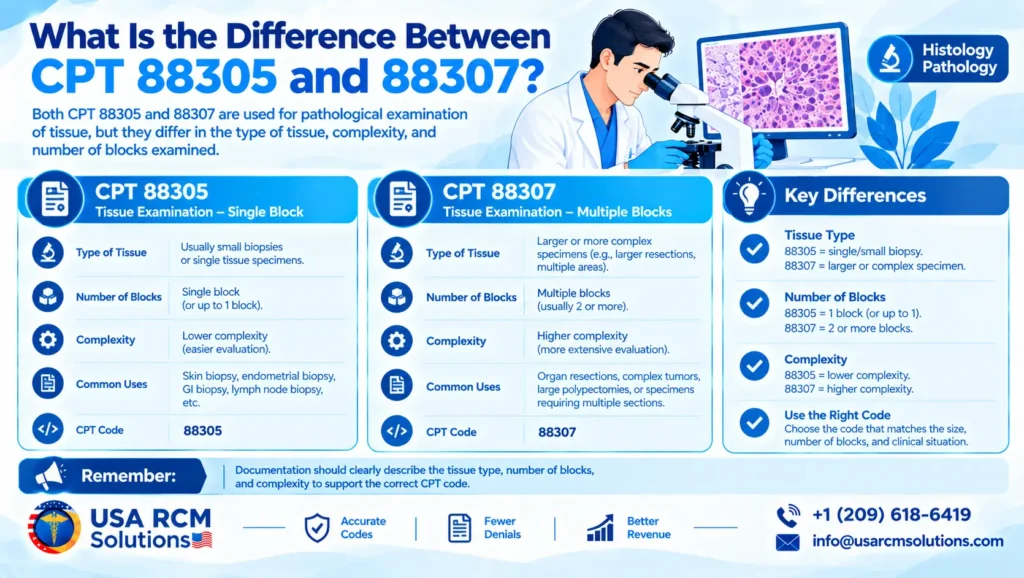
Code 88307 is Level V. It covers larger and more complex specimens. Typical examples include a nephrectomy, a mastectomy for tumor, or a segmental colon resection for cancer. Those cases need deeper study and more sampling.
In contrast, CPT 88305 covers biopsies and smaller specimens. The pathologist still does a full review, but the scope is narrower. Therefore, the reimbursement for 88307 is higher.
| Feature | 88305 | 88307 |
| Level | IV | V |
| Typical specimens | Biopsies, polyps, curettings | Resections for tumor, large organs |
| Work involved | Moderate | Higher |
| Common example | Prostate needle biopsy | Total nephrectomy |
A good rule is simple. If the surgeon removed a whole organ or a large tumor, check 88307 first. If the surgeon took a biopsy, check 88305.
Common Mistakes
Most denials trace back to a few repeat errors. Fixing them early protects revenue.
| Mistake | Why It Causes Problems | How to Fix It |
| Billing by slide count | Units follow specimens, not slides | Count labeled containers |
| Using 88305 for 88304 specimens | Auditors flag upcoding | Match the CPT specimen list |
| Missing diagnosis support | Payer sees no medical necessity | Require a clear clinical history |
| Wrong use of modifier 59 | Payers question unbundling | Use 59 or XS only with documentation |
| Billing add-on stains without orders | No order means no payment | Keep signed orders for every stain |
| Missing TC or 26 in split billing | Two parties bill the global code | Confirm who owns the lab |
A denial for any of these reasons needs a root-cause fix. Do not resubmit the same claim unchanged. Instead, correct the problem and file again.
Key Optimization Methods
Clean processes help labs keep denial rates low. These methods work well for pathology billing.
| Optimization Method | What It Does | Expected Benefit |
| Specimen-to-unit audit | Compares labeled containers to billed units | Fewer unit errors |
| Diagnosis review at intake | Checks the requisition for medical necessity | Fewer necessity denials |
| Payer policy tracker | Stores rules for each plan | Faster, cleaner submissions |
| Claim scrubbing rules | Flags missing modifiers and bad pairings | Higher first-pass acceptance |
| Denial trend reports | Shows repeat errors by client or payer | Targeted education |
Start with the unit audit, because unit mistakes are the easiest to prevent. Then add policy tracking and scrubbing rules.
Best Tools and Practices
The right tools reduce manual work. Pair them with steady habits.
| Tool or Practice | Purpose | Tip |
| Laboratory information system | Tracks specimens and orders | Link it to your billing system |
| Claim scrubber | Catches edit conflicts | Update edits each quarter |
| CPT and NCCI references | Confirm current rules | Use the current-year books |
| Client requisition templates | Capture history and diagnosis | Make key fields mandatory |
| Monthly coding audits | Find patterns early | Review ten claims per coder |
Education matters too. CPT changes every year, and payers update policies often. So schedule short training sessions each quarter.
Future Trends
Pathology billing keeps evolving. Labs that prepare now will adapt faster.
| Trend | What to Expect | How to Prepare |
| Digital pathology | More remote slide reviews | Clarify who bills TC and 26 |
| AI-assisted diagnosis | Faster reads with human sign-off | Keep documentation clear |
| Stricter payer audits | More reviews of unit counts | Strengthen specimen labeling |
| Molecular add-on testing | More stains and genetic tests | Track orders for every add-on |
| Price transparency rules | Public rates for common codes | Review fee schedules yearly |
Technology will help, but it will not replace human judgment. A coder still must match each specimen to the right level.
How USA RCM Solutions Can Help
Pathology billing takes skill and time, and the 88305 CPT code is no exception. USA RCM Solutions supports labs and practices with experienced teams. The team writes clear reports, uses real examples, and follows step-by-step workflows.
The company offers Medical Billing & Coding Services for accurate claim submission. Its Denial Management Services help find the root cause behind repeat 88305 denials. In addition, the team files strong appeals with proper records.
Providers also use Medical Credentialing Services to enroll with payers faster. Meanwhile, Accounts Receivable Services keep unpaid claims from aging past filing limits.
Documentation quality matters here too. A Virtual Medical Scribe can capture clinical history during the visit. As a result, requisitions support medical necessity from the start.
Finally, growth matters as much as collections. Healthcare Marketing Services help practices attract new referrals and build local trust. Together, these services strengthen the revenue cycle from order to payment.
Conclusion
The 88305 CPT code reports a Level IV surgical pathology examination. It covers many common biopsies and small specimens. Therefore, correct use keeps pathology claims clean and payments steady.
Remember the core rules. Bill one unit per separately identified specimen. Match the specimen to the CPT list. Use modifiers like 26, TC, or GW only when the situation fits. Then document medical necessity in plain words.
Know the difference between 88304, 88305, and 88307. Add stains such as the cpt code 88342 only when orders support them. Check each payer’s rules before you submit. With these habits, your lab can cut denials and protect revenue.
FAQs
Can a dermatology practice bill 88305 for slides read in its own office?
Yes, but only when the practice meets several conditions. The office needs a valid CLIA certificate for histology work. The reading physician must also be qualified, and the group must follow in-office ancillary rules. State laws and payer contracts may add limits, so confirm them before you start billing
Why can two payers reimburse 88305 so differently?
Each payer sets its own fee schedule and contract rates. Medicare pays based on the physician fee schedule and your locality. Commercial plans often negotiate rates with each lab, so amounts vary widely. Therefore, review your contracts and compare paid amounts every year.
Can I use 88305 for a fine needle aspiration or cytology sample?
No, cytology and fine needle aspirates use different codes. Surgical pathology codes apply to tissue examined as a block or biopsy. Cytology codes apply to cell samples smeared or prepared from fluid. So check the specimen type and the lab method before you pick the code.
How long does a lab have to file a claim for 88305?
Timely filing limits depend on the payer. Medicare Part B generally allows 12 months from the date of service. Many commercial plans allow only 90 to 180 days. Because limits differ, track each payer’s deadline and file claims as early as possible.