
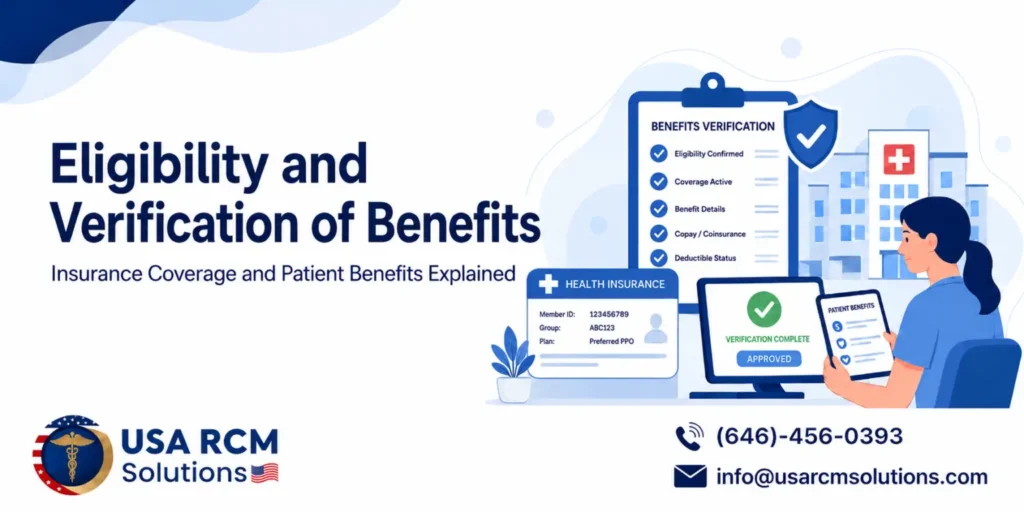
Eligibility and verification of benefits in medical billing means checking whether a patient has active insurance and what that insurance will cover for a specific service. It helps the billing team know if the patient can receive covered care under the payer’s rules.
This step should happen before the appointment, procedure, test, or treatment whenever possible. It protects the provider from avoidable denials and helps the patient understand their expected cost.
Eligibility Verification vs Benefits Verification
The table below explains the difference in a simple way.
| Point of Difference | Eligibility Verification | Benefits Verification |
|---|---|---|
| Main purpose | Confirms if the insurance plan is active | Confirms what the plan covers |
| Main question | Does the patient have active coverage? | Will this service be covered? |
| Checked details | Member ID, group number, policy status, effective date | Copay, deductible, coinsurance, visit limits, prior authorization |
| Timing | Before the visit or date of service | Before the visit, procedure, test, or treatment |
| Risk if skipped | Claim may deny for inactive coverage | Claim may deny for non-covered service or missing authorization |
| Revenue impact | Helps avoid basic coverage denials | Helps prevent payment delays and patient billing disputes |
Eligibility and Verification of Benefits in Medical Billing
The eligibility verification process should be completed before the patient visit whenever possible. This gives the billing team time to fix errors, request missing details, and avoid claim problems later.
A standard workflow also helps staff follow the same process for every patient.
Step 1: Collect Accurate Patient and Insurance Information
The process starts with collecting correct patient and policy details. Even a small mistake in this step can cause a claim rejection.
The billing team should collect and confirm:
- Patient full name
- Date of birth
- Insurance company name
- Member ID
- Group number
- Subscriber name
- Subscriber date of birth
- Patient relationship to subscriber
- Primary and secondary insurance details
- Copy of insurance card, front and back
If the patient is covered under a spouse, parent, or employer plan, the subscriber details must match the payer’s records. Incorrect subscriber information can delay verification and claim processing.
Step 2: Check Active Coverage for the Date of Service
Next, the billing team confirms whether the patient’s insurance is active for the expected date of service.
This step is important because insurance coverage can change at any time. A patient may have a valid card, but the plan may be inactive, terminated, or replaced by a new policy.
The team should verify:
- Policy status
- Effective date
- Termination date, if any
- Date of service coverage
- Plan type
- Patient eligibility status
Coverage should be checked as close to the appointment date as possible. For high-cost services, same-day eligibility verification is often safer.
Step 3: Verify Plan Type and Network Status
After confirming active coverage, the billing team should review the patient’s plan type and network status.
Common plan types include:
- HMO
- PPO
- EPO
- POS
- Medicare
- Medicaid
- Commercial insurance
Network status matters because in-network and out-of-network benefits can be very different. A patient may have coverage, but the provider may not be contracted with that payer network.
This can affect reimbursement, patient responsibility, and claim approval. It can also lead to patient complaints if the cost is much higher than expected.
Step 4: Confirm Primary and Secondary Insurance
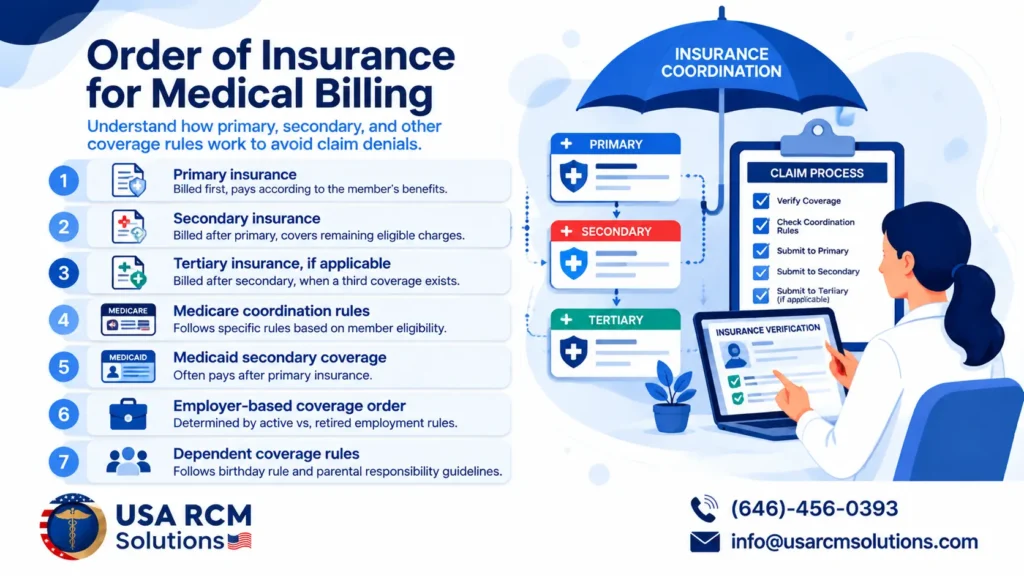
Many patients have more than one insurance plan. In these cases, the billing team must confirm the correct billing order before claim submission.
This is called coordination of benefits.
The team should identify:
- Primary insurance
- Secondary insurance
- Tertiary insurance, if applicable
- Medicare coordination rules
- Medicaid secondary coverage
- Employer-based coverage order
- Dependent coverage rules
If the wrong payer is billed first, the claim may be denied or delayed. Correct coordination of benefits helps avoid unnecessary AR follow-up and rebilling.
Step 5: Document the Payer Response
Every verification call, portal check, or clearinghouse response should be documented clearly.
The billing team should record:
- Verification date
- Payer name
- Representative name or reference number
- Portal confirmation number, if available
- Coverage status
- Benefit details
- Prior authorization requirement
- Referral requirement
- Patient responsibility
- Notes about limitations or exclusions
Steps for Verification of Benefits in Medical Billing
The next step is to confirm whether the insurance plan covers the exact service the provider plans to perform.
For example, the plan may cover a regular office visit but may have different rules for therapy, imaging, surgery, lab testing, or durable medical equipment.
This step helps prevent denials for non-covered services.
Some insurance plans limit how many times a patient can receive a service within a year or benefit period.
This is common for:
- Physical therapy
- Occupational therapy
- Chiropractic care
- Behavioral health
- Specialist visits
- Home health services
- Diagnostic testing
The billing team should confirm how many visits are allowed, how many have already been used, and how many remain. If this step is missed, the claim may deny after the allowed limit is reached.
How USA RCM Solutions Helps Providers Improve Eligibility and VOB Workflow
USA RCM Solutions helps providers improve their eligibility and VOB workflow by making the front-end billing process more accurate, consistent, and claim-ready. The team verifies patient coverage, benefit details, payer rules, and financial responsibility before claims move forward.
This helps providers catch problems early, such as inactive coverage, wrong insurance details, missing prior authorization, referral requirements, non-covered services, or incorrect patient responsibility. When these issues are found before the visit or before billing, the practice can avoid preventable denials and payment delays.
Conclusion
Eligibility and verification of benefits in medical billing helps providers prevent avoidable denials before the claim is submitted. When billing teams confirm coverage, benefits, patient responsibility, prior authorization rules, CPT details, ICD-10 support, and documentation requirements, claims become cleaner and reimbursement becomes faster. A strong verification process protects revenue, improves patient communication, and reduces billing rework across the full revenue cycle.