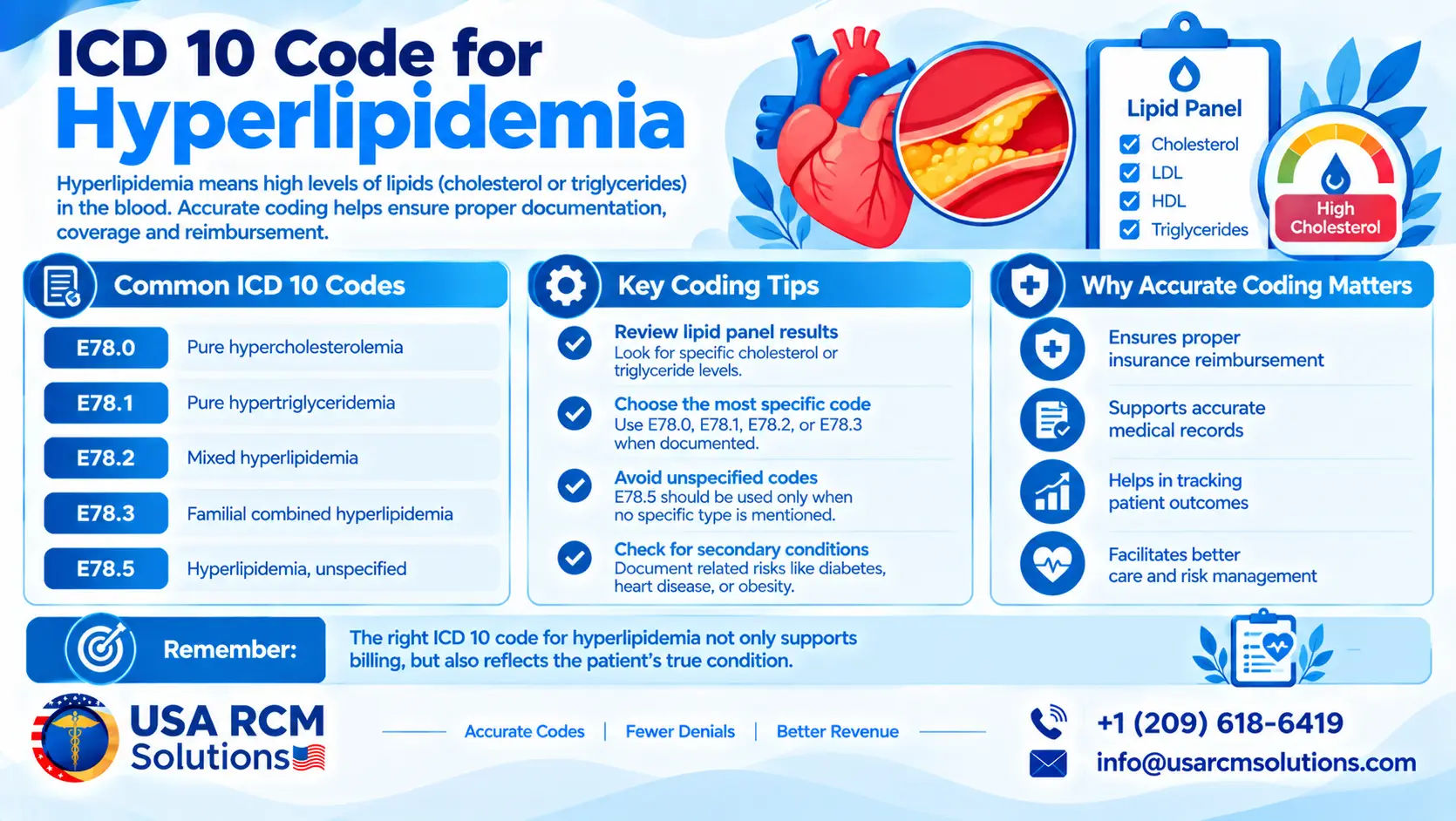
The icd 10 code hyperlipidemia claims use most often is E78.5, which means hyperlipidemia, unspecified. Providers choose it when they document high blood fats without naming a type. However, ICD-10-CM offers more specific options for cholesterol, triglycerides, and inherited disorders. The right choice affects accuracy and payment. This guide explains each option in plain words.
High cholesterol is common, so these claims reach billing teams daily. Therefore, small coding errors add up fast. You will find tables, real examples, and a step-by-step process below. So let us begin with the basics.
ICD 10 Code Hyperlipidemia: What Is the ICD 10 Code for Hyperlipidemia?
Hyperlipidemia means high levels of fats in the blood. These fats include cholesterol and triglycerides. In ICD-10-CM, these conditions fall into category E78. That category covers disorders of lipoprotein metabolism and other lipidemias.
So what is the ICD 10 code for hyperlipidemia? The answer depends on the documentation. If the provider writes only hyperlipidemia, E78.5 applies. A named type points to a more specific code instead.
Some coders type hyperlip icd 10 as shorthand. Others search icd code 10 for hyperlipidemia. All of these searches lead to category E78.
E78.5: ICD 10 Code Hyperlipidemia Unspecified
E78.5 is the ICD 10 Code Hyperlipidemia unspecified. It fits when the note says hyperlipidemia with no type. Current listings mark E78.5 as a billable code. So it is complete as written.
The ICD 10 Code Hyperlipidemia works well for early visits. However, payers and quality programs prefer detail when the provider knows it. Therefore, update the code once the type is clear.
Hyperlipidemia ICD 10 Code List
The hyperlipidemia ICD 10 code list below shows the main E78 options.
| Code | Description | When to Use |
| E78.00 | Pure hypercholesterolemia, unspecified | High cholesterol without high triglycerides |
| E78.010 | Homozygous familial hypercholesterolemia | Provider documents the homozygous type |
| E78.011 | Heterozygous familial hypercholesterolemia | Provider documents the heterozygous type |
| E78.019 | Familial hypercholesterolemia, unspecified | Familial type with no further detail |
| E78.1 | Pure hyperglyceridemia | High triglycerides alone |
| E78.2 | Mixed hyperlipidemia | High cholesterol and high triglycerides |
| E78.3 | Hyperchylomicronemia | Provider documents hyperchylomicronemia |
| E78.41 | Elevated lipoprotein(a) | Provider documents high Lp(a) |
| E78.49 | Other hyperlipidemia | Other specified types, such as familial combined |
| E78.5 | Hyperlipidemia, unspecified | Hyperlipidemia with no type |
| E78.9 | Disorder of lipoprotein metabolism, unspecified | Lipid disorder with no more detail |
The familial codes changed recently. Current listings show E78.01 split into homozygous, heterozygous, and unspecified codes. So confirm the current-year code set before you submit.
Dyslipidemia ICD 10 Code
The dyslipidemia ICD 10 code is usually E78.5. Dyslipidemia means abnormal blood lipid levels. As far as I know, the index points dyslipidemia to E78.5. However, a documented type should still drive the code.
High Cholesterol ICD 10 Code
The high cholesterol ICD 10 code is usually E78.00. That code means pure hypercholesterolemia, unspecified. Use it when the provider documents high cholesterol and no high triglycerides. If both are high, use E78.2 instead.
What Is the Correct ICD-10 Code for Essential Hyperlipidemia?
Essential hyperlipidemia is an older phrase. Providers sometimes use it for high blood fats with no clear cause. In ICD-10-CM, the word essential is a nonessential modifier. Therefore, it does not change the code.
In most cases, essential hyperlipidemia maps to E78.5. Essential hypercholesterolemia maps to E78.00. Confirm both in your encoder, because index wording can change. Never choose a code from the word essential alone.
Explanation of ICD-10 Codes for Mixed Hyperlipidemia
Mixed hyperlipidemia means both cholesterol and triglycerides run high. The code is E78.2. Its inclusion terms cover combined hyperlipidemia NOS and elevated cholesterol with elevated triglycerides. So the mixed hyperlipidemia icd 10 code covers several phrasings.
Do not report E78.00 and E78.1 together for the same patient. E78.2 already describes the combination. Therefore, use the single combination code.
Familial combined hyperlipidemia is different. It uses E78.49, which also covers other specified hyperlipidemias. E78.2 carries an Excludes1 note for the familial combined type. So never report both together.
An Illustrative Example: Mixed Hyperlipidemia
Here is an illustrative example. A patient has an LDL of 168 mg/dL and triglycerides of 310 mg/dL. The provider documents mixed hyperlipidemia and prescribes a statin. Therefore, the coder reports E78.2. Z79.899 can show long-term drug therapy.
Hypercholesterolemia ICD 10: E78.00 and Familial Types
Hypercholesterolemia icd 10 coding starts with E78.00. It means pure hypercholesterolemia, unspecified. The index also sends essential, primary, and pure hypercholesterolemia to this family. However, high triglycerides change the answer to E78.2.
Familial Hypercholesterolemia ICD 10
Familial hypercholesterolemia is an inherited condition. It causes very high LDL from a young age. The familial hypercholesterolemia icd 10 family is E78.01-. Current listings split it into homozygous, heterozygous, and unspecified codes. So the provider should name the type when known.
Never assume a familial type from lab values or family history alone. Family history without the condition uses a separate family history code.
How to Accurately Document Hyperlipidemia for ICD-10 Billing
Good coding begins with good notes. Providers should support every chronic condition they report. Many practices use the MEAT method: monitor, evaluate, assess, and treat.
- State the exact type, such as mixed hyperlipidemia or pure hypercholesterolemia.
- Record lab values and dates, including LDL, HDL, and triglycerides.
- Name the treatment, such as the statin and dose.
- Note lifestyle advice, such as diet and exercise.
- Document related conditions, such as diabetes or kidney disease.
- State the plan and the follow-up interval.
- Avoid writing history of when the condition is still active.
A Virtual Medical Scribe can capture these details during the visit. Therefore, providers can focus on the patient.
Hyperlipidemia itself rarely causes symptoms. If the patient reports tiredness, the ICD 10 Code for Fatigue is R53.83. Report it only when the provider documents it.
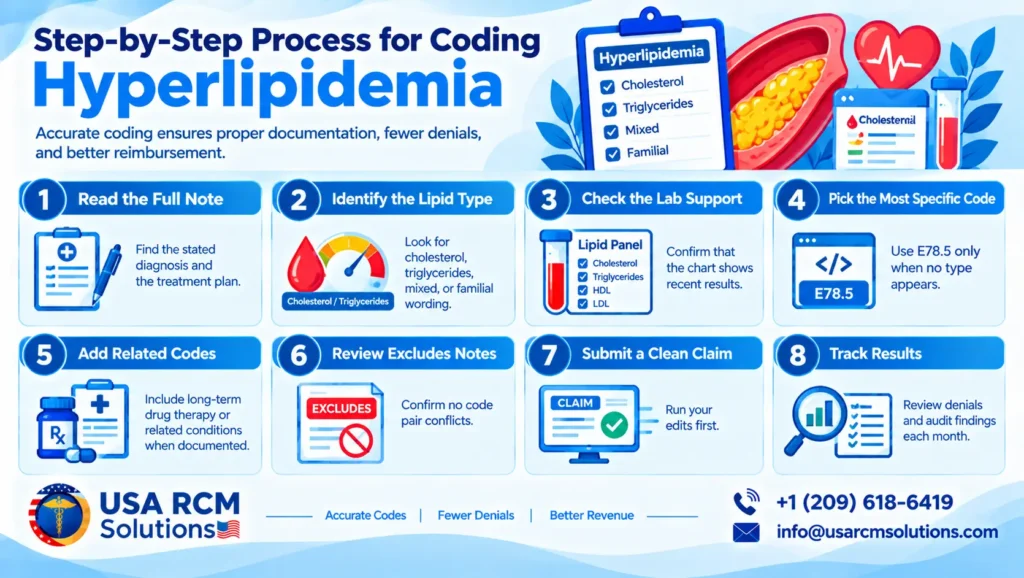
Step-by-Step Process for Coding Hyperlipidemia
- Read the full note. Find the stated diagnosis and the treatment plan.
- Identify the lipid type. Look for cholesterol, triglycerides, mixed, or familial wording.
- Check the lab support. Confirm that the chart shows recent results.
- Pick the most specific code. Use E78.5 only when no type appears.
- Add related codes. Include long-term drug therapy or related conditions when documented.
- Review Excludes notes. Confirm no code pair conflicts.
- Submit a clean claim. Run your edits first.
- Track results. Review denials and audit findings each month.
An Illustrative Example: Unspecified Hyperlipidemia
A second patient takes atorvastatin each day. The provider writes hyperlipidemia and continues the medicine. No type or labs appear in the note. So the coder reports E78.5 and Z79.899. The team then asks providers to name the type at future visits.
An Illustrative Specificity Case
Here is another illustrative case. A clinic coded E78.5 for nearly every lipid patient. However, an internal audit found notes that named pure hypercholesterolemia. So the team trained providers to state the type and updated the EHR template. Then coding specificity improved.
Common Errors in ICD-10 Coding for Hypercholesterolemia
Even experienced teams repeat the same errors. Specificity matters in every specialty. For example, the ICD-10 Code for Tick Bite depends on the injury site and encounter type. Lipid coding works the same way. The table below shows the most common errors and better options.
| Common Mistake | Why It Hurts | Better Approach |
| Using E78.5 when a type is documented | Loses specificity | Code the documented type |
| Reporting E78.00 and E78.1 together | Duplicates a combination | Use E78.2 |
| Using E78.00 when triglycerides are also high | Understates the condition | Use E78.2 when both are documented |
| Using E78.01 without a sixth character | Leaves the code incomplete | Add the homozygous, heterozygous, or unspecified character |
| Coding a familial type from family history alone | Lacks provider support | Wait for provider documentation |
| Writing history of for an active, treated condition | Hides current care | Report the active code |
| Coding from lab values alone | Fails audit review | Code from provider documentation |
Improving Hyperlipidemia Claims
Strong processes beat last-minute fixes. The two tables below show what works well.
Key Optimization Methods
| Method | What It Does | Expected Result |
| Type prompts in the EHR | Ask providers to select the lipid type | Fewer unspecified codes |
| MEAT-based documentation reviews | Check each chronic condition for support | Stronger audit defense |
| Compliant clinical queries | Ask for type and familial status | More accurate codes |
| Annual code update training | Reviews E78 changes each October | Fewer outdated codes |
| Claim scrubbing | Flags incomplete or conflicting E78 codes | Cleaner claims |
| Denial trend review | Tracks rejections by code and payer | Targeted fixes |
Best Tools and Practices
| Tool or Practice | Purpose | Why It Helps |
| Encoder software | Guides code search and edits | Faster, more accurate selection |
| Official ICD-10-CM guidelines | Sets rules for code use | Reliable reference |
| EHR lipid templates | Prompt for type, labs, and treatment | Complete notes |
| Lab interfaces | Bring lipid results into the chart | Stronger clinical support |
| Coding audits | Sample chronic condition claims | Finds patterns early |
| KPI dashboards | Track specificity and denial rates | Shows problem areas |
Support for Coding and Revenue Teams
Coding does not happen in isolation. Documentation, enrollment, billing, and follow-up all affect payment. Therefore, many practices look for outside help.
Full-Service Support for Coding and Revenue Teams
USA RCM Solutions helps practices manage coding and revenue tasks together. Its service range supports the full cycle. The list below shows the main offerings.
- Medical Billing & Coding Services: accurate claims built on correct diagnosis codes.
- Medical Credentialing Services: payer enrollment and provider onboarding.
- Accounts Receivable Services: steady follow-up on aging claims.
- Virtual Medical Scribe: documentation support that saves provider time.
- Denial Management Services: root cause review, appeals, and prevention.
- Healthcare Marketing Services: patient acquisition and online visibility.
These services support one another. For instance, richer notes improve diagnosis detail, and specific codes reduce denials. Strong Medical Billing & Coding keeps chronic condition claims clean from the start. Meanwhile, payers pay only enrolled providers, so Medical Credentialing Services protect every claim. As a result, teams fix root problems instead of resubmitting the same claim.
How to Choose a Coding Partner
Choose a partner the way you would hire a key employee. Ask direct questions and expect clear answers.
- Coding credentials: Ask about certifications and ongoing education.
- Chronic care experience: Confirm they understand primary care and cardiology billing.
- Audit support: Check how they handle payer reviews and appeals.
- Reporting: Request sample dashboards and monthly reports.
- Compliance: Confirm HIPAA safeguards and staff training.
- Clear pricing: Understand fees, contract terms, and exit options.
Future Trends in Lipid Coding
Coding keeps changing because technology and payer rules keep changing. The table below highlights trends worth watching.
| Trend | What It Means | Likely Impact |
| AI-assisted coding | Software suggests codes from clinical notes | Faster coding with human review |
| Genetic testing growth | More patients receive familial diagnoses | Higher need for specific codes |
| Quality measure tracking | Payers link lipid care to outcomes | Greater focus on accurate documentation |
| Automated lab data feeds | Results flow into the chart | Stronger clinical support |
| Predictive denial analytics | Models flag risky claims early | Fewer denials |
| Virtual documentation support | Remote scribes capture visit detail | Clearer clinical notes |
Technology helps, but coders still make the final call. Experts must review every suggested code. Therefore, the best teams blend smart tools with trained people.
Conclusion
So, what should you remember about the ICD 10 Code Hyperlipidemia needs? E78.5 covers hyperlipidemia with no type. E78.00 covers pure hypercholesterolemia, and E78.2 covers mixed hyperlipidemia. Familial types use the E78.01- family, and other specified types use E78.49.
Strong documentation drives every correct choice. Providers should name the lipid type, record lab values, and state the treatment plan. Meanwhile, coders should update unspecified codes once the type becomes clear.
You can build this process in-house or add outside support. A partner like USA RCM Solutions can cover coding, billing, and follow-up together. Either way, start with a chronic condition audit this week. Then fix your top documentation gaps, and review progress each month.
FAQs
Does hyperlipidemia affect HCC risk adjustment or quality measures?
As far as I know, the common hyperlipidemia codes do not map to an HCC in the main CMS models. However, they still matter for quality programs. Measures such as statin therapy for patients with cardiovascular disease or diabetes often use lipid diagnoses and medication data. So accurate coding supports both care reporting and payer reviews.
Which CPT code and diagnosis should I use for a lipid panel?
A lipid panel commonly uses CPT 80061. The diagnosis explains why the test was needed. Use the lipid code, such as E78.5 or E78.2, for a patient with a known condition. Use Z13.220 for screening when no diagnosis or symptoms exist. Payers also set frequency limits, and Medicare commonly limits screening panels to once every five years.
What code should I use for a family history of high cholesterol?
Use a family history code when the patient does not have the condition. Z83.42 covers a family history of familial hypercholesterolemia. Z83.438 covers a family history of other disorders of lipoprotein metabolism and other lipidemias. These codes explain risk and testing, but they do not replace a diagnosis code.
How do I code statin side effects or statin intolerance?
Code the documented reaction first, such as drug-induced myopathy. Then add T46.6X5A to show the adverse effect of an antihyperlipidemic drug, when the provider documents it. Some lipid organizations suggest Z88.8 for statin intolerance. However, payer and coding policy varies, so confirm your local rules. The provider’s note must clearly link the reaction to the drug.