Generalized weakness icd 10 coding usually points to R53.1, which means weakness. The code also covers asthenia NOS. Coders use it when a provider documents overall weakness without a cause. However, M62.81 and other codes can also apply. So this guide explains when each one fits.
Weakness is a common complaint in clinics and emergency rooms. Therefore, billing teams see this code every week. You will find tables, real examples, and a step-by-step process below. So let us start with the code itself.
What Is the ICD-10 Code for Generalized Weakness?
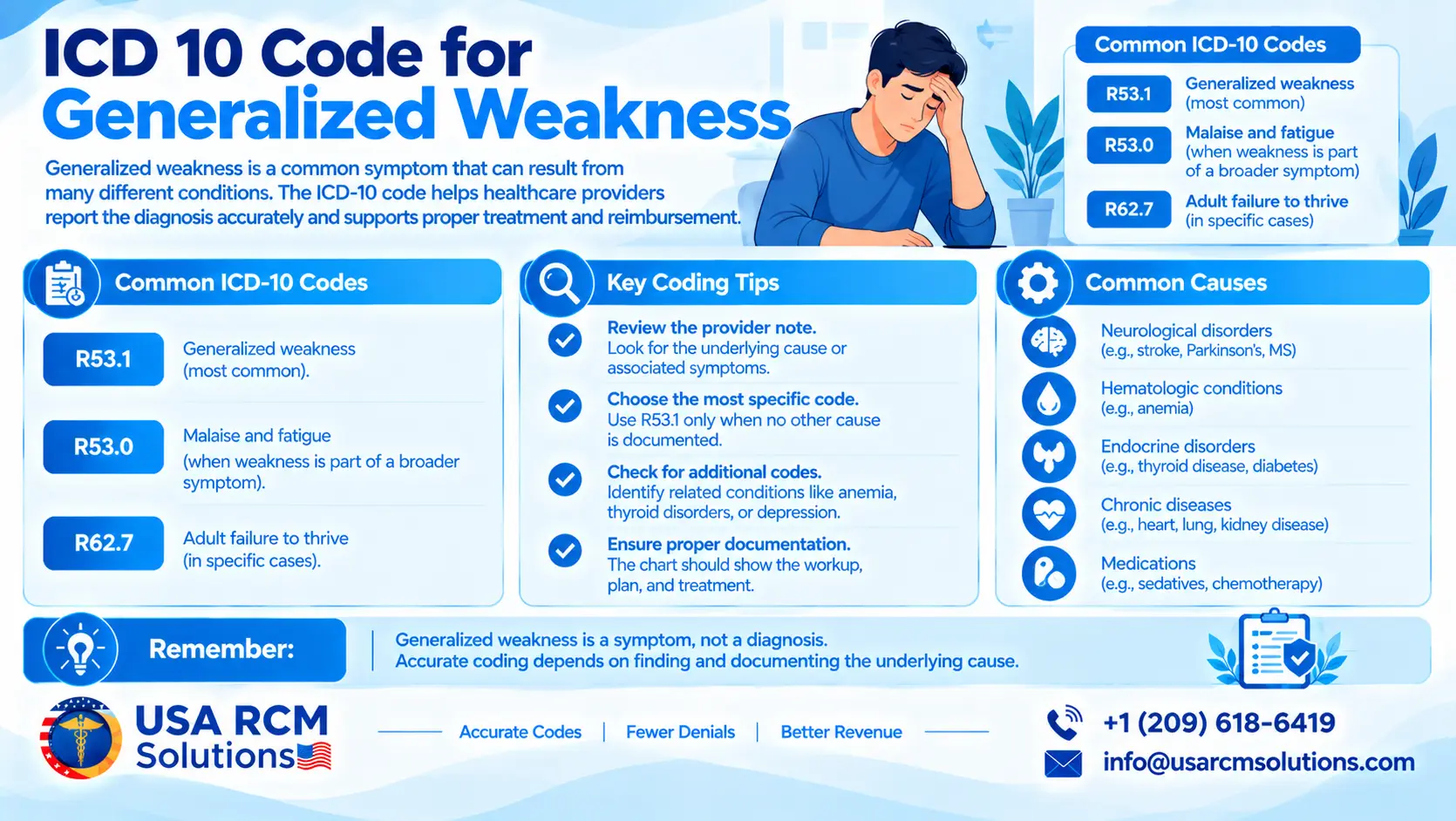
The ICD-10 code for generalized weakness is R53.1. Current listings mark it as a billable code. The index sends weak, weakening, and weakness (generalized) to this code. So the icd 10 code for generalized weakness matches the basic weakness icd 10 code.
Searches for weakness icd 10, Generalized Weakness ICD 10, and asthenia icd 10 all lead here. Some people also type icd 10 code for weakness generalized or simply R53.1.
R53.1 ICD 10 Description
The R53.1 ICD 10 description is simply weakness. It also includes asthenia NOS. ICD-10-CM code R53.1 sits in the symptoms and signs chapter. Therefore, it describes a symptom, not a final disease.
General Weakness Medical Term
Doctors use several terms for this problem. Asthenia means a general lack of strength. Debility and malaise are related words. However, myasthenia gravis is a separate disease with its own code. Therefore, coders should not treat these words as interchangeable.
What Does the Medical Billing Code for Generalized Weakness Mean?
A medical billing code for generalized weakness tells the payer why the patient came in. R53.1 says the provider documented overall weakness. It does not name a cause. Payers read it as a starting point for a workup.
On a claim, R53.1 links to the services the practice performed. Examples include office visits and labs, such as a CBC, a thyroid test, and a metabolic panel. The diagnosis supports why those tests were necessary. However, the code alone does not prove medical necessity for advanced testing.
What Is the Difference Between R53.1 and M62.81?
R53.1 and M62.81 look similar, but they differ. Overall weakness or asthenia NOS belongs to R53.1. Muscle weakness, generalized belongs to M62.81. M62.81 sits in the musculoskeletal chapter, and R53.1 sits in the symptoms chapter. An Excludes1 note blocks the two codes from appearing together.
| Feature | R53.1 | M62.81 |
| Name | Weakness | Muscle weakness (generalized) |
| Chapter | Symptoms and signs | Musculoskeletal system |
| Typical wording | Weakness, asthenia, generalized weakness | Generalized muscle weakness |
| Often seen in | Primary care, urgent care, and hospital visits | Therapy and musculoskeletal care |
| Report together? | No | No, because of the Excludes1 note |
So choose the code that matches the provider’s words. Weakness of the whole body points to R53.1. Generalized muscle weakness points to M62.81. If the wording is unclear, ask the provider. Muscle weakness ICD 10 searches usually lead to M62.81.
Leg Muscle Weakness ICD-10
Leg muscle weakness ICD-10 coding differs from generalized weakness. M62.81 means generalized, so it does not fit weakness in one leg. As far as I know, localized weakness often uses R29.898 or a cause-specific code, such as monoplegia of the lower limb. Check the index and the provider’s note.
What Is the ICD-10 Code for Weakness in Other Situations?
The ICD-10 code for weakness depends on the type. Overall weakness uses R53.1. Age-related weakness uses R54, and an Excludes1 note bars R54 from R53.1. The table below shows the most common options.
| Code | Description | When to Use |
| R53.1 | Weakness | Generalized weakness or asthenia NOS |
| M62.81 | Muscle weakness (generalized) | Generalized muscle weakness |
| R54 | Age-related physical debility | Senile weakness or frailty in older adults |
| M62.84 | Sarcopenia | Provider documents sarcopenia |
| R53.81 | Other malaise | Malaise or debility NOS |
| R53.83 | Other fatigue | Fatigue or tiredness |
| R29.810 | Facial weakness | Facial droop or weakness |
| G81.9- | Hemiplegia, unspecified | One-sided paralysis or severe weakness |
| G45.9 | Transient cerebral ischemic attack, unspecified | Provider documents a TIA |
Common Causes of Sudden Onset Generalized Body Weakness
Sudden weakness has many causes. Some are minor, but others are emergencies. Providers sort through them with history, exams, and tests.
- Infections, such as flu, COVID-19, or a urinary tract infection.
- Dehydration or low blood volume.
- Low potassium, low sodium, or other electrolyte problems.
- Anemia or sudden blood loss.
- Low blood sugar.
- Medication side effects.
- Heart problems, such as arrhythmia or heart failure.
- Stroke or TIA.
- Nerve disorders, such as Guillain-Barré syndrome.
- Thyroid or adrenal problems.
Weakness can also follow medication use. For example, a patient treated under ICD 10 Code Hyperlipidemia rules may take a statin. The provider must document any link to the drug before coders add adverse effect codes.
Tick-borne infections can also cause weakness. Coders then use the infection code, and the ICD-10 Code for Tick Bite may add detail. Again, the provider must document the link.
TIA Symptoms and Weakness
TIA symptoms and weakness often appear together. A transient ischemic attack causes sudden symptoms that fade, often within minutes to hours. Typical signs include one-sided weakness, facial droop, speech trouble, and vision loss. Therefore, sudden weakness on one side needs emergency care, not routine coding. This guide supports billers, and it does not replace medical advice.
Call emergency services right away for any of these signs.
- Weakness on one side of the body.
- Facial droop or trouble speaking.
- Sudden confusion or vision loss.
- Chest pain or trouble breathing.
- Severe headache with weakness.
The ICD 10 code for TIA is G45.9 when the type is unspecified. Searches for icd 10 tia lead to the G45 family. Once a provider documents TIA, G45.9 replaces R53.1 for that episode. After recovery, Z86.73 may show a history of TIA without lasting deficits.
Explaining Medical Coding for Generalized Muscle Weakness to Patients
Patients often see codes on bills and portals. Many feel worried when a code looks serious. Clear words ease that worry.
- A code is a label that helps insurers process the claim.
- A symptom code does not mean a final diagnosis.
- The code can change after tests give answers.
- Different providers may choose different codes for the same visit.
- Patients can ask the practice to review a code they do not understand.
Here is a simple script that staff can use.
“Your visit code means weakness. It tells your insurance why you came in. After your tests, the provider may update it.”
For M62.81, staff can say this instead.
“This code means generalized muscle weakness. It often appears on therapy visits.”
Use plain words and avoid jargon. Then ask the patient to repeat the main point in their own words. So the patient leaves with a clear, calm understanding.
Generalized Weakness ICD 10 Coding Guidelines
Clear rules guide this work. The tips below fit most primary care and specialty charts.
Core Coding Guidelines
- Code from provider documentation only.
- Use R53.1 for generalized weakness or asthenia NOS.
- Do not report R53.1 with M62.81, R54, or M62.84.
- Code a confirmed cause instead of the symptom.
- In outpatient care, code symptoms for suspected conditions.
- Use the code set effective on the date of service.
Documentation Tips for Providers
Good coding begins with good notes. Share this checklist with your clinical team.
- Onset, such as sudden or gradual.
- Distribution, such as whole body, one side, or one limb.
- Severity and effect on daily activities.
- Associated symptoms, such as fever, pain, or dizziness.
- Tests ordered and the reason for each.
- Assessment and plan, including follow-up.
A Virtual Medical Scribe can capture these details during the visit. Therefore, providers spend more time with patients.
Step-by-Step Process for Coding Weakness
- Read the full note. Find the stated symptom and the reason for the visit.
- Check the distribution. Decide if the weakness is generalized, localized, or one-sided.
- Check for a confirmed cause. Look for infection, anemia, stroke, or another diagnosis.
- Check for age-related wording. Look for senile or age-related weakness.
- Pick the most specific code. Use R53.1 only when no cause or type appears.
- Review Excludes notes. Confirm no code pair conflicts.
- Link the services. Match labs and visits to the diagnosis.
- Submit and track. Watch for denials and payer questions.
An Illustrative Example: Weakness With Normal Labs
Here is an illustrative example. A patient reports three days of overall weakness. The provider orders basic labs, and all results return normal. Therefore, the coder reports R53.1 for the visit and the labs. If the provider later finds a cause, the confirmed diagnosis replaces the symptom.
An Illustrative Example: Therapy Visit
A second patient leaves the hospital after a long illness. The therapist documents generalized muscle weakness and sets strength goals. So the coder reports M62.81 for the therapy claims. The note should also show measurable functional limits.
An Illustrative Denial Case
Here is another illustrative case. A clinic billed a nerve study with R53.1 alone. The payer denied it for weak medical necessity. However, the note described progressive leg weakness and numbness. So the provider clarified the findings through a compliant query. The team then coded the documented findings, and the payer approved the test.
Key Optimization Methods
The table below shows practical ways to improve weakness coding.
| Method | What It Does | Expected Result |
| Weakness documentation templates | Prompt for onset, distribution, and severity | Better specificity |
| Compliant clinical queries | Ask providers to clarify generalized vs. localized weakness | Accurate code choice |
| Workup tracking | Links labs and follow-up to the symptom | Stronger medical necessity |
| Claim scrubbing | Flags R53.1 and M62.81 conflicts | Cleaner claims |
| Patient-friendly code explanations | Give plain-language summaries | Fewer billing questions |
| Denial trend review | Tracks rejections by code and payer | Targeted fixes |
Best Tools and Practices
Strong tools support strong habits. The table below shows what works well together.
| Tool or Practice | Purpose | Why It Helps |
| Encoder software | Guides code search and edits | Faster, more accurate selection |
| Official ICD-10-CM guidelines | Sets rules for code use | Reliable reference |
| EHR weakness templates | Prompt for cause, duration, and distribution | Complete notes |
| Payer policy lookup tools | Show covered diagnoses and limits | Fewer surprises |
| Patient portal explanations | Translate codes into plain words | Fewer calls and disputes |
| Coding audits | Sample symptom-code claims | Finds patterns early |
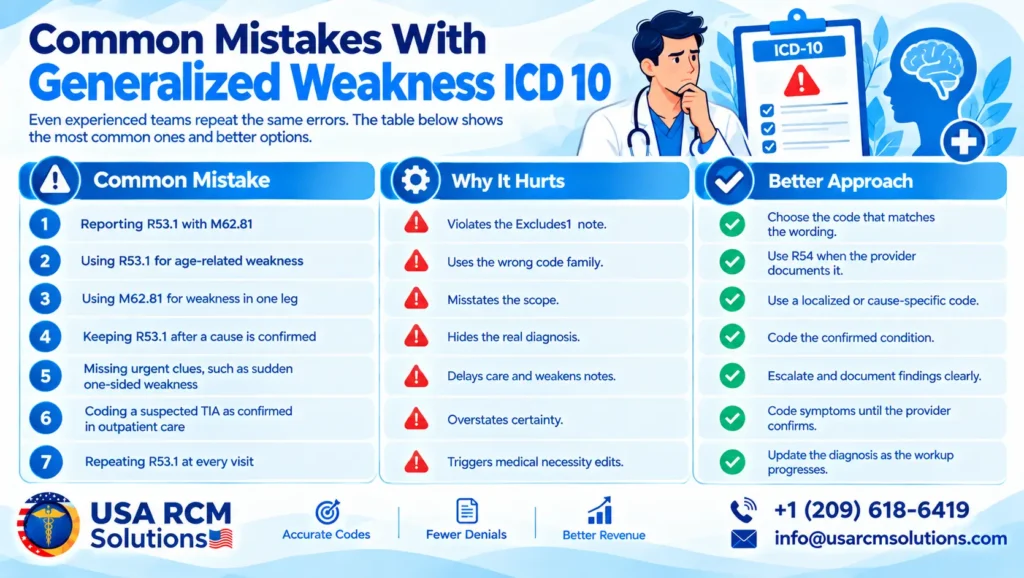
Common Mistakes With Generalized Weakness ICD 10
Even experienced teams repeat the same errors. The table below shows the most common ones and better options.
| Common Mistake | Why It Hurts | Better Approach |
| Reporting R53.1 with M62.81 | Violates the Excludes1 note | Choose the code that matches the wording |
| Using R53.1 for age-related weakness | Uses the wrong code family | Use R54 when the provider documents it |
| Using M62.81 for weakness in one leg | Misstates the scope | Use a localized or cause-specific code |
| Keeping R53.1 after a cause is confirmed | Hides the real diagnosis | Code the confirmed condition |
| Missing urgent clues, such as sudden one-sided weakness | Delays care and weakens notes | Escalate and document findings clearly |
| Coding a suspected TIA as confirmed in outpatient care | Overstates certainty | Code symptoms until the provider confirms |
| Repeating R53.1 at every visit | Triggers medical necessity edits | Update the diagnosis as the workup progresses |
Support for Coding and Revenue Teams
Coding does not happen in isolation. Documentation, enrollment, billing, and follow-up all affect payment. Therefore, many practices look for outside help.
Full-Service Support for Coding and Revenue Teams
USA RCM Solutions helps practices manage coding and revenue tasks together. Its service range supports the full cycle. The list below shows the main offerings.
- Medical Billing & Coding Services: accurate claims built on correct diagnosis codes.
- Medical Credentialing Services: payer enrollment and provider onboarding.
- Accounts Receivable Services: steady follow-up on aging claims.
- Virtual Medical Scribe: documentation support that saves provider time.
Denial Management Services: root cause review, appeals, and prevention.- Healthcare Marketing Services: patient acquisition and online visibility.
These services support one another. For instance, richer notes improve diagnosis detail, and specific codes reduce denials. Accounts Receivable Services also chase claims that stall on symptom-code edits. Meanwhile, Medical Credentialing Services protect payment, because payers pay only enrolled providers. As a result, teams fix root problems instead of resubmitting the same claim.
How to Choose a Coding Partner
Choose a partner the way you would hire a key employee. Ask direct questions and expect clear answers.
- Coding credentials: Ask about certifications and ongoing education.
- Specialty experience: Confirm they understand primary care and therapy billing.
- Audit support: Check how they handle payer reviews and appeals.
- Reporting: Request sample dashboards and monthly reports.
- Compliance: Confirm HIPAA safeguards and staff training.
- Clear pricing: Understand fees, contract terms, and exit options.
Future Trends in Weakness Coding
Coding keeps changing because technology and payer rules keep changing. The table below highlights trends worth watching.
| Trend | What It Means | Likely Impact |
| AI-assisted coding | Software suggests codes from clinical notes | Faster coding with human review |
| Automated stroke screening alerts | Systems flag urgent weakness symptoms | Faster care and better notes |
| Telehealth triage | Virtual visits capture weakness history | Higher need for clear documentation |
| Remote patient monitoring | Devices track activity and strength trends | Stronger clinical support |
| Predictive denial analytics | Models flag risky claims early | Fewer denials |
| Virtual documentation support | Remote scribes capture visit detail | Clearer clinical notes |
Technology helps, but coders still make the final call. Experts must review every suggested code. Therefore, the best teams blend smart tools with trained people.
Conclusion
So, what should you remember about generalized weakness icd 10 coding? R53.1 covers weakness and asthenia NOS. M62.81 covers generalized muscle weakness, and an Excludes1 note keeps the two apart. Age-related weakness uses R54, and a documented TIA uses G45.9.
Strong documentation drives every correct choice. Providers should record onset, distribution, and the workup plan. Meanwhile, coders should replace the symptom code once a cause is confirmed.
You can build this process in-house or add outside support. A partner like USA RCM Solutions can cover coding, billing, and follow-up together. Either way, start with a claim audit this week. Then fix your top documentation gaps, and review progress each month.
FAQs
Will insurance pay for physical therapy when the diagnosis is R53.1?
Coverage varies by payer. Therapy claims usually need a treating diagnosis, such as M62.81, plus documented functional limits. A plan of care with measurable goals also strengthens the claim. So the therapist’s note should show why skilled therapy is necessary.
How do I code weakness that remains after a stroke?
Do not use R53.1 for lasting deficits from a past stroke. Use the I69 codes for sequelae of cerebrovascular disease instead. These codes name the deficit, such as hemiplegia, and the side affected. The provider’s note should state the deficit and the affected side clearly.
Does generalized weakness justify a hospital admission?
Symptom codes alone rarely settle admission status. Payers review the full picture, including vital signs, lab results, and the care plan. Inpatient stays with a symptom principal diagnosis group into a symptom-based DRG, which often pays less. Medicare also expects a reasonable stay across two midnights for most inpatient admissions. So the record should explain why the patient needed hospital-level care.
How do I code weakness after COVID-19?
Code the specific symptom or condition the provider documents. Add U09.9 when the provider links it to a post-COVID-19 condition. The code is an additional code, so it never stands alone. Therefore, the note must state the connection to the prior infection.