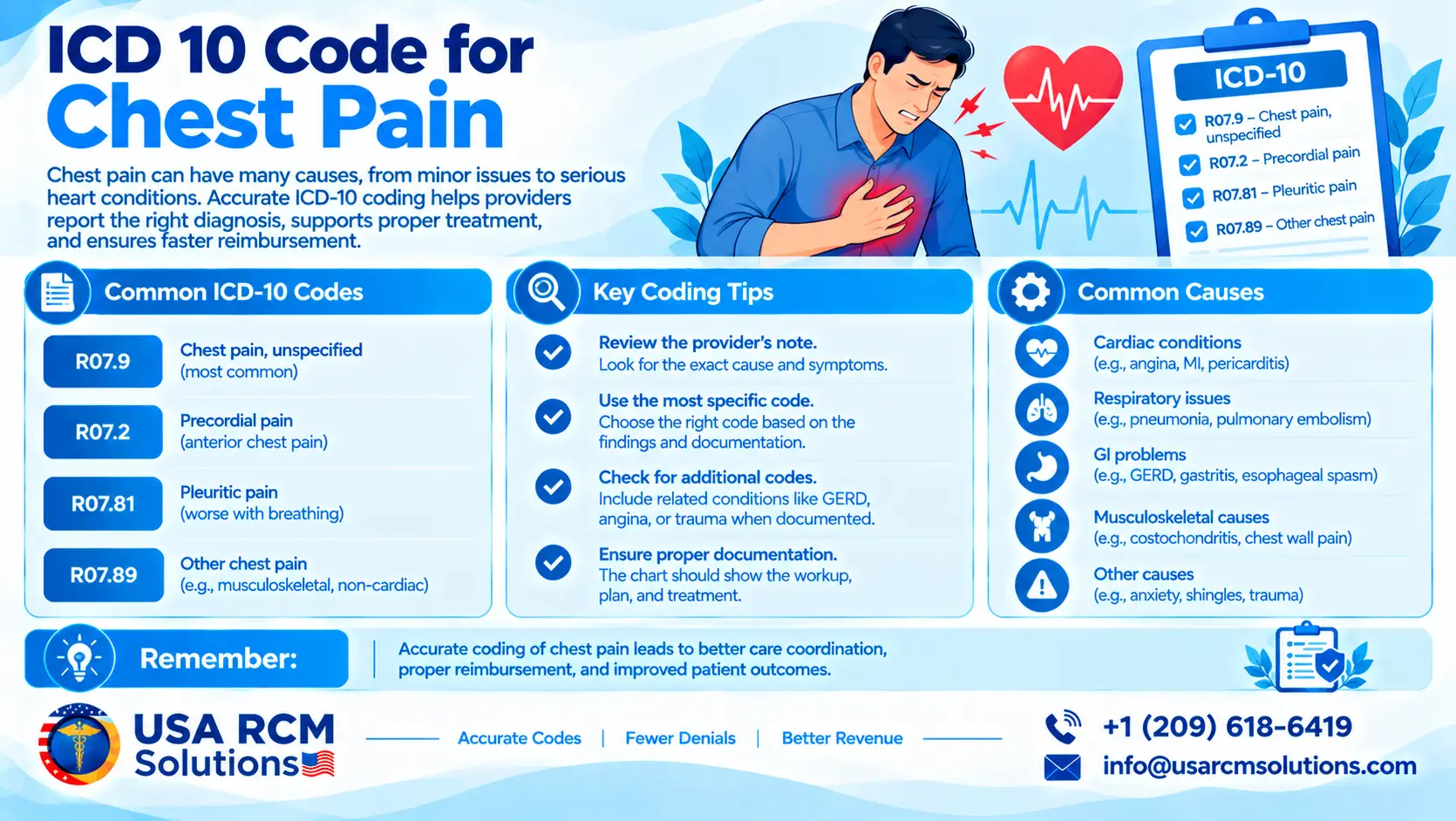
The icd 10 code for chest pain helps healthcare providers document symptoms and submit accurate insurance claims. Chest pain can result from muscle strain, inflammation, digestive problems, or serious heart conditions. Therefore, medical coders must review clinical documentation before selecting the appropriate code.
The correct code depends on the pain’s location, characteristics, and confirmed diagnosis. However, providers should not assume a cardiac condition without supporting documentation. Accurate coding also helps reduce claim denials and supports consistent medical records.
This guide explains chest pain ICD-10 codes, documentation requirements, coding examples, and common mistakes. It also covers atypical pain, radiating pain, rib pain, and related symptoms. These practical steps can help billing teams improve coding accuracy and reimbursement workflows.
What Is the ICD 10 Code for Chest Pain?
The most appropriate icd 10 code for chest pain depends on the documented clinical circumstances. When the provider documents chest pain without further details, R07.9 is generally appropriate.
R07.9 represents unspecified chest pain under the ICD-10-CM classification. However, more specific documentation may support another code within the R07 category.
Common ICD 10 Code for Chest Pain
The following table summarizes frequently used chest pain codes. Always verify the current code description and applicable guidelines before submitting a claim.
| ICD-10-CM code | Description | Typical use |
| R07.9 | Chest pain, unspecified | Chest pain without additional documented specificity |
| R07.89 | Other chest pain | Other specified chest pain not classified elsewhere |
| R07.2 | Precordial pain | Pain documented in the precordial region |
| R07.1 | Chest pain on breathing | Pain associated with breathing |
| R07.0 | Pain in throat | Pain documented in the throat |
| R07.81 | Pleurodynia | Pain associated with the chest wall or pleurodynia documentation |
| R07.82 | Intercostal pain | Pain documented between the ribs |
| R07.89 | Other chest pain | Certain specified chest pain presentations |
Important coding note: R07.9 is a symptom code, not a diagnosis of heart disease. Select a more specific code when the medical record supports it.
Code descriptions and code-set instructions can change. Check the current official ICD-10-CM files before finalizing claims.
What Is the ICD 10 Code for Unspecified Chest Pain?
The ICD 10 code for unspecified chest pain is R07.9. Coders generally use this code when the provider documents chest pain without specifying its type or location.
For example, a patient visits a clinic because of intermittent chest discomfort. The provider records chest pain but does not identify its cause or location. In this situation, R07.9 may be appropriate.
However, unspecified coding should not replace available clinical details. Review the complete record before assigning the code.
When Should You Use R07.9?
Use R07.9 when documentation supports chest pain but lacks additional specificity. The provider does not need to establish a final cause for every symptom code.
Nevertheless, coders should distinguish unspecified pain from a documented, specific presentation. For example, documented precordial pain may support R07.2 instead.
Consider these situations:
- The provider documents chest pain without further description.
- The examination records chest pain, but the cause remains undetermined.
- The available documentation does not identify a more specific chest pain type.
Do not select R07.9 automatically when the record provides greater detail. Instead, follow the documentation and applicable coding guidelines.
How to Choose the Correct ICD 10 Code for Chest Pain
Selecting the correct chest pain ICD 10 code requires a structured review. Coders should consider the provider’s diagnosis, symptom description, and applicable ICD-10-CM instructions.
Step 1: Review the Provider’s Documentation
Read the assessment, examination findings, and relevant clinical notes. Identify the exact term used to describe the patient’s pain.
Look for descriptions such as sharp, dull, burning, pleuritic, or precordial. These terms may help identify a more specific code when supported by the documentation.
Step 2: Identify the Location and Characteristics
Determine whether the provider documents chest wall pain, intercostal pain, or another specified presentation. Do not infer a diagnosis from the patient’s symptoms alone.
For example, pain between the ribs may support an intercostal pain code. However, the final selection depends on the provider’s wording and the official code set.
Step 3: Check for an Established Diagnosis
Review whether the provider identified a cause, such as costochondritis or angina. If a definitive diagnosis explains the symptom, follow applicable coding rules.
Do not automatically code both the diagnosis and chest pain. Additional symptom coding depends on whether the symptom is integral, separately reportable, or otherwise required.
Step 4: Verify the Code and Instructions
Search the Alphabetic Index first, then confirm the result in the Tabular List. Review inclusion terms, Excludes notes, and other instructions.
Also check whether the code requires greater specificity. Never rely only on a search snippet or an old coding reference.
Step 5: Confirm Claim Requirements
Check payer policies, medical necessity, and applicable reporting requirements. Ensure that the diagnosis supports the services billed.
When documentation is unclear, follow your organization’s compliant provider-query process. Never change a clinical diagnosis solely to obtain reimbursement.
What Is the ICD-10 Code for Atypical Chest Pain?
The appropriate code for atypical chest pain often depends on the provider’s exact documentation. R07.89, representing other chest pain, may be appropriate when the provider documents atypical chest pain and the official classification supports that selection.
However, coders should verify the Alphabetic Index and Tabular List before assigning the code. The word “atypical” does not automatically establish a particular heart condition.
Atypical Chest Pain Coding Example
A patient reports brief chest discomfort that does not follow a typical angina pattern. The provider documents atypical chest pain without confirming a specific underlying cause.
The coder reviews the index and tabular instructions before selecting the appropriate symptom code. If R07.89 is supported by the current classification, it may be reported.
Conversely, a confirmed diagnosis may require a different code. Follow the documented assessment rather than assuming that atypical pain means coronary artery disease.
Chest Discomfort ICD 10: Which Code Applies?
The correct chest discomfort ICD 10 code depends on how the provider describes the symptom. When the provider documents unspecified chest discomfort as chest pain, R07.9 may be appropriate.
Other chest pain, R07.89, may apply when documentation supports a specified presentation classified there. The term “discomfort” alone does not establish a unique code in every case.
Chest Discomfort Versus Chest Pain
Patients may describe pressure, tightness, heaviness, burning, or aching. Providers should document the symptoms clearly and distinguish them from any confirmed diagnosis.
Coders should not translate vague wording into a more specific condition without support. When the record lacks clarity, a provider query may help resolve the ambiguity.
For example, a patient reports chest pressure during exercise. If the provider confirms angina, the applicable angina code may take priority under the relevant coding rules.
Left Side Chest Pain ICD-10
The correct code for left side chest pain ICD-10 depends on the documented location and nature of the symptom. ICD-10-CM does not provide a separate code for every possible chest pain location.
When the provider documents left-sided chest pain without further specificity, R07.9 may be appropriate. However, a more specific documented condition may support another code.
Example: Left-Sided Chest Pain
A patient reports pain on the left side of the chest after lifting heavy boxes. The provider documents localized chest pain but does not confirm a muscle injury.
The coder should review the complete assessment before choosing a code. Do not assume that left-sided pain indicates a heart condition or muscle strain.
If the provider confirms a specific musculoskeletal diagnosis, code according to that diagnosis and applicable instructions.
Acute Chest Pain ICD 10: Coding Considerations
The phrase acute chest pain ICD 10 describes a symptom presentation rather than one universally applicable code. R07.9 may apply when the provider documents acute chest pain without further specificity.
However, the word “acute” alone does not determine the final code. Review the documented diagnosis, associated symptoms, and current classification.
Acute Chest Pain Example
A patient arrives at an emergency department with sudden chest pain. The clinician evaluates the patient, but the cause remains undetermined.
The appropriate symptom code depends on the final documentation. If no more specific description exists, R07.9 may be suitable.
If testing establishes a diagnosis, the coder must follow applicable guidelines for that condition. Emergency treatment does not automatically make every chest pain claim a cardiac diagnosis.
Clinical safety note: New, severe, or unexplained chest pain requires prompt medical assessment. Call emergency services for possible heart attack symptoms, especially with shortness of breath, sweating, faintness, or pain spreading to the arm or jaw.
ICD 10 Code for Pleuritic Chest Pain
The icd 10 code for pleuritic chest pain depends on the provider’s documented diagnosis and the official coding index. R07.1 represents chest pain on breathing and may apply when the documentation supports that description.
Pleuritic pain often worsens during deep breathing, coughing, or sneezing. However, this symptom can occur with several conditions, including pleural inflammation and pulmonary disorders.
Pleuritic Pain Versus a Confirmed Condition
Consider a patient who reports sharp pain when taking a deep breath. The clinician documents chest pain on breathing without establishing an underlying cause.
R07.1 may be appropriate when supported by the documentation. If the provider diagnoses another condition, the coder should review its specific coding instructions.
Never assume that pleuritic pain automatically confirms pleurisy. Code the documented condition, not an inferred diagnosis.
ICD 10 Rib Pain and Costochondritis ICD 10
Rib pain and costochondritis can produce similar symptoms, but they are not interchangeable diagnoses. Therefore, coders must distinguish a documented symptom from a confirmed condition.
ICD 10 Rib Pain
The appropriate icd 10 rib pain code depends on the exact location and clinical description. Intercostal pain may be coded R07.82 when the provider documents pain between the ribs.
Other rib-related presentations may require different codes. For example, a confirmed rib fracture requires an appropriate injury code rather than a generic chest pain code.
Example: A patient experiences pain between the ribs after exercise. The provider documents intercostal pain without diagnosing an injury. R07.82 may be appropriate if the documentation supports it.
Costochondritis ICD 10
The costochondritis ICD 10 code is generally M94.0, which covers chondrocostal junction syndrome, including costochondritis.
Costochondritis involves inflammation affecting the cartilage connecting the ribs and breastbone. Patients may experience tenderness that increases with movement, coughing, or pressure.
Consider a patient with reproducible chest wall tenderness. The clinician diagnoses costochondritis after evaluating the symptoms. The coder should report M94.0 when supported by the record.
Do not automatically assign costochondritis because pressing the chest reproduces pain. The provider must establish the diagnosis.
ICD 10 Code for Chest Pain Radiating to Left Arm
The icd 10 code for chest pain radiating to left arm depends on the provider’s documented assessment. Radiation into the arm does not establish a separate universal chest pain code.
When the provider documents chest pain without a confirmed cause, an appropriate symptom code may apply. However, confirmed angina or another cardiac diagnosis may change the coding approach.
Coding Example: Chest Pain With Arm Radiation
A patient reports chest pressure that spreads into the left arm. The clinician evaluates the patient for potentially serious cardiac causes.
If the evaluation does not establish a diagnosis, code the documented symptoms according to current guidelines. Do not assign angina or a heart attack code without provider documentation.
Chest pain with arm radiation can indicate a medical emergency. Clinical assessment must take priority over coding decisions.
ICD 10 Code for Chest Pain Radiating to Back
The icd 10 code for chest pain radiating to back depends on the documented condition. Radiation to the back is a clinical detail, not a standalone diagnosis.
For unspecified chest pain, R07.9 may remain appropriate. If the provider documents a specific underlying condition, use the applicable code and follow reporting instructions.
Example: Chest Pain With Back Radiation
A patient reports sudden chest pain that spreads toward the back. The clinician investigates possible cardiovascular and other serious causes.
The coder should review the final assessment and documented findings. Never infer a specific vascular, cardiac, or spinal condition from radiation alone.
Sudden, severe chest or back pain requires urgent assessment, particularly when accompanied by weakness, fainting, or breathing difficulty.
Shortness of Breath ICD-10 and Chest Pain
Shortness of breath may occur alongside chest pain, but each symptom requires careful documentation. The shortness of breath ICD-10 code is generally R06.02 for shortness of breath.
Whether both chest pain and shortness of breath should be reported depends on the circumstances. Follow applicable coding guidelines and payer requirements.
Example: Chest Pain With Breathing Difficulty
A patient visits the emergency department with chest pain and difficulty breathing. The provider documents both symptoms but has not established a cause.
The coder reviews the record and determines whether R07.9 and R06.02 are reportable. Additional diagnoses may become relevant after the clinical evaluation.
Do not assume that shortness of breath automatically indicates heart failure. Likewise, do not omit a separately reportable symptom without reviewing the coding rules.
ICD 10 Code for Chest Pain Angina
The ICD 10 code for chest pain angina depends on the specific angina diagnosis documented by the provider. Angina is not interchangeable with unspecified chest pain.
For example, I20.9 represents angina pectoris, unspecified. More specific angina types may require other codes within the I20 category.
Chest Pain Versus Angina
Chest pain is a symptom, while angina is a clinical diagnosis involving myocardial ischemia. A patient may experience chest pain without having angina.
If the provider confirms angina, review the appropriate code family and any applicable reporting instructions. Do not assign I20.9 solely because a patient describes pressure or tightness.
Similarly, confirmed acute coronary syndrome or myocardial infarction requires coding based on the documented diagnosis. Accurate coding depends on clinical evidence and provider assessment.
How to Look Up ICD 10 Codes for Symptoms
Looking up symptoms correctly helps reduce errors and improves claim consistency. Follow a repeatable process rather than selecting the first search result.
Step-by-Step Coding Process
- Identify the documented term. Start with the exact symptom or diagnosis recorded by the provider.
- Search the Alphabetic Index. Locate the main term and follow relevant subentries.
- Confirm the Tabular List. Check the full code description and required instructions.
- Review exclusions and notes. Identify conditions that cannot be coded together or require additional codes.
- Check current-year guidance. Confirm the code remains valid for the applicable date of service.
- Review claim requirements. Verify medical necessity, payer rules, and reporting requirements.
- Document the decision. Keep an audit trail when required by organizational policy.
Can I Find ICD 10 Codes for Chest Pain on Popular Medical Coding Platforms?
Yes, many established coding platforms provide searchable ICD-10-CM indexes and code descriptions. However, their features, update schedules, and access requirements differ.
| Platform or resource | Main purpose | Recommended practice |
| CDC ICD-10-CM files | Official US code-set resources | Confirm current code descriptions and annual updates |
| CMS resources | Coding and Medicare guidance | Review applicable official guidance and policies |
| AAPC Codify | Coding lookup and reference tools | Check code details and relevant guidance |
| Find-A-Code | Medical coding reference | Verify codes against authoritative sources |
| Encoder software | Coding workflow and claim support | Confirm annual updates and organizational configuration |
| Payer policy portals | Coverage and billing requirements | Review policies relevant to the specific claim |
Paid platforms may offer additional guidance, cross-references, and workflow features. Nevertheless, no platform replaces the official classification or the provider’s documentation.
Best Tools and Practices
| Tool or practice | Benefit | Recommended use |
| Official ICD-10-CM files | Authoritative code-set reference | Verify codes and instructions |
| Updated coding encoder | Faster code searches | Confirm annual updates |
| Documentation checklist | Consistent chart reviews | Use before claim submission |
| Claim-edit software | Identifies potential billing issues | Review flagged claims before release |
| Internal audit reports | Reveals recurring errors | Target staff training |
| Provider query process | Clarifies incomplete documentation | Follow compliant organizational procedures |
Key Optimization Methods for Chest Pain Coding
Healthcare organizations can improve coding accuracy through consistent documentation, regular audits, and staff training. These methods also help identify preventable claim errors.
| Optimization method | How it helps | Practical example |
| Documentation review | Identifies missing clinical details | Check whether the provider specifies pain location |
| Code verification | Reduces incorrect code assignments | Confirm R07.9 against the current Tabular List |
| Provider education | Improves diagnostic documentation | Train providers to distinguish symptoms from diagnoses |
| Claim audits | Detects recurring errors | Review a sample of chest pain claims monthly |
| Denial analysis | Identifies reimbursement problems | Track denials involving unsupported diagnoses |
| Staff training | Promotes consistent coding practices | Review challenging cases during team meetings |
Real-World Optimization Example
A billing team notices repeated denials involving unspecified chest pain. The team reviews the affected records and identifies incomplete clinical documentation.
Next, the organization introduces a documentation checklist and targeted staff training. The team then monitors subsequent claims for improvements.
This approach addresses the underlying process rather than changing codes without clinical support. Regular audits also help identify whether the improvements continue over time.
Common Mistakes When Assigning Chest Pain Codes
Even experienced coders can make mistakes when records contain vague symptoms or conflicting information. Identifying these problems helps improve compliance and reduce rework.
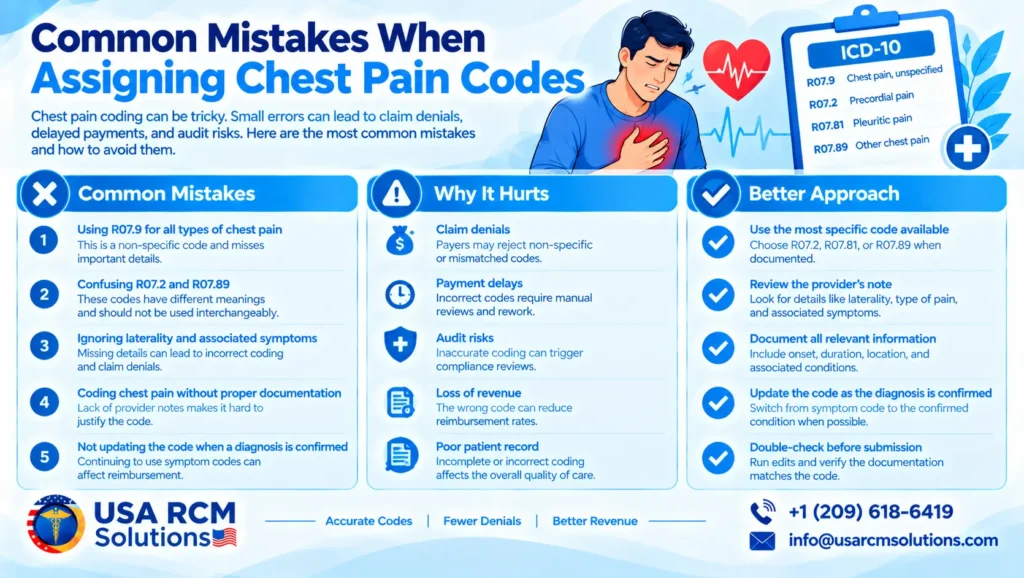
| Common mistake | Why it matters | Better approach |
| Using R07.9 automatically | May overlook documented specificity | Review the full clinical record |
| Assuming chest pain means angina | Creates unsupported diagnoses | Code only established conditions |
| Confusing rib pain with costochondritis | These represent different clinical concepts | Follow the provider’s diagnosis |
| Ignoring exclusion notes | Can result in incompatible coding | Review Tabular List instructions |
| Using outdated code references | May produce invalid or inaccurate claims | Check the applicable annual code set |
| Coding every symptom automatically | May create unnecessary reporting | Apply official symptom-coding rules |
| Changing a code for payment | Risks inaccurate claims | Follow documentation and compliance requirements |
| Ignoring payer policies | May cause avoidable claim delays | Check applicable coverage and billing rules |
Additional Coding Considerations
Coders should also distinguish symptom coding from injury coding. A documented rib fracture, for example, requires an appropriate injury code.
Likewise, a confirmed cardiac diagnosis may change the reporting approach. Review the circumstances and apply the relevant official instructions.
Unrelated coding topics require separate research. For example, ICD 10 Code Hyperlipidemia belongs to a different diagnostic category. Similarly, the ICD-10 Code for Tick Bite follows injury and external-cause coding rules.
Neither code should be assigned merely because the patient presents with chest pain. Each diagnosis must have appropriate documentation and clinical support.
Future Trends in Chest Pain Coding
Medical coding continues to evolve as healthcare organizations adopt new technology and strengthen compliance programs. The following trends may influence coding workflows and quality monitoring.
| Future trend | Potential benefit | Important consideration |
| AI-assisted coding | Speeds up preliminary code suggestions | Human review remains necessary |
| Automated documentation checks | Flags missing clinical details | Alerts must follow applicable coding rules |
| Electronic health record integration | Reduces duplicate data entry | Incorrect source data can still cause errors |
| Real-time claim edits | Identifies problems before submission | Edits require regular maintenance |
| Advanced audit analytics | Reveals recurring coding patterns | Findings need qualified interpretation |
| Continuous staff education | Supports accurate coding decisions | Training must reflect current guidance |
The Role of Human Review
Automation can identify potential code matches, but it cannot always interpret clinical context correctly. Therefore, qualified professionals should verify suggestions against documentation and official guidelines.
Healthcare teams should also monitor software updates and review audit findings. A balanced approach combines technology, clinical documentation, and professional judgment.
How Chest Pain Coding Affects Medical Billing
Accurate diagnosis coding supports clean claims and appropriate reimbursement. Incorrect coding can lead to denials, delayed payments, or additional administrative work.
The icd 10 code for chest pain should reflect the documented clinical presentation and applicable coding instructions. Billing teams must also confirm that the reported services meet payer requirements.
Relationship Between Coding and Accounts Receivable
Coding errors can affect Accounts Receivable (A/R) when insurers reject claims or request additional information. Staff may then need to investigate denials, correct errors, and resubmit eligible claims.
A structured workflow can reduce unnecessary delays:
- Review the provider’s documentation before coding.
- Validate diagnosis codes against current references.
- Check claim edits and payer requirements.
- Submit the claim with accurate supporting information.
- Review denials and identify their underlying causes.
- Track outstanding balances and follow up appropriately.
This process supports stronger revenue cycle management. It also helps organizations identify recurring issues before they affect more claims.
How USA RCM Solutions Supports Healthcare Practices
USA RCM Solutions provides Medical Billing & Coding Services to support accurate claim preparation and billing workflows.
Medical Credentialing Services help practices manage provider enrollment requirements with health plans.
Accounts Receivable Services support follow-up on outstanding claims and unresolved balances.
Denial Management Services help teams investigate rejected claims and address preventable billing problems.
Medical Scribe Services support clinical documentation workflows, helping providers maintain organized medical records.
Virtual Medical Scribe solutions can also help practices manage documentation demands during patient encounters.
Healthcare Marketing Services support practices seeking to strengthen their online presence and reach potential patients.
These services address different parts of healthcare operations. Practices should select support based on their workflow, compliance needs, and business goals.
Conclusion
Accurate chest pain coding begins with clear documentation and careful code verification. Although R07.9 commonly represents unspecified chest pain, other codes may apply when the record supports greater specificity.
Coders should review the provider’s assessment, consult the Alphabetic Index, and confirm selections in the Tabular List. They must also follow current ICD-10-CM guidelines and applicable payer requirements.
A reliable coding process reduces avoidable errors and supports efficient claim management. Regular audits, updated reference tools, and ongoing staff education can further improve results.
FAQs
Can chest pain be coded before the final diagnosis is established?
Yes, symptom coding may be appropriate when the provider documents chest pain and has not established its cause. The correct code depends on the available documentation and applicable reporting rules. Outpatient settings generally do not permit coding uncertain diagnoses as confirmed conditions. Follow the specific guidelines for the care setting and claim.
Does insurance always cover an evaluation for chest pain?
Coverage depends on the patient’s plan, medical necessity, services performed, and applicable policy requirements. A diagnosis code alone does not guarantee payment. Insurers may request clinical records or additional information before processing a claim. Practices should verify benefits and follow relevant payer policies.
What should a coder do when two parts of the medical record conflict?
The coder should review the relevant documentation and follow organizational procedures for resolving discrepancies. If the conflict affects code assignment, a compliant provider query may be necessary. Coders should not independently choose a diagnosis based on personal assumptions. Keep supporting documentation according to organizational policy.
How can a practice measure chest pain coding quality?
A practice can track coding accuracy, denial rates, claim correction frequency, and audit findings. Reviewing these measures over time helps identify recurring problems. Teams should also evaluate documentation completeness and staff training needs. Use the results to improve workflows rather than encouraging unsupported code specificity.