
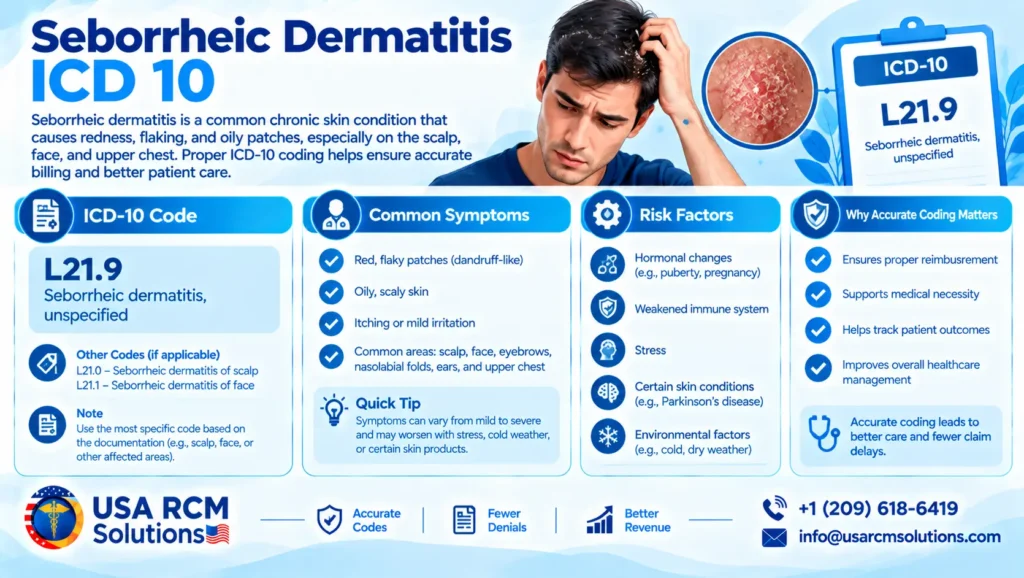
Choosing the right seborrheic dermatitis ICD 10 code sounds simple, but many claims still go wrong. The condition looks like a common rash, and so coders often pick the wrong category. However, a small error can trigger a denial or a records request. Therefore, this guide explains each code, its use, and its documentation needs.
You will learn how the L21 family works and when each code applies. You will also see how it differs from eczema and contact dermatitis. Because coding rules change, we use plain steps and real examples.
What Exactly Is Seborrheic Dermatitis?
Seborrheic dermatitis is a common, long-lasting skin condition. It causes red, flaky, and sometimes greasy patches. The rash often appears where skin makes more oil. That includes the scalp, face, ears, and upper chest.
The condition comes and goes. Stress, cold weather, and illness can trigger flares. In addition, a yeast called Malassezia lives on the skin and may play a role. Doctors do not fully understand every cause.
What Is Another Name for Seborrheic Dermatitis?
Several names describe the same condition. Mild scalp cases often get called dandruff. In babies, doctors call it cradle cap. Some clinicians also write seborrheic eczema, which matters for coding.
The term seborrheic eczema ICD-10 code often confuses coders. The ICD-10-CM index sends both terms to the same L21 category. So the name on the chart does not change the code family.
Common Symptoms
Patients usually report a few clear signs. Doctors also look for them during the exam.
- Red or pink patches with yellow or white scales.
- Itching, burning, or mild soreness.
- Flaking on the scalp or eyebrows.
- Redness along the nose folds.
Because itching is common, many providers also think about pruritus ICD 10 coding. However, itching alone does not need its own code when it is part of the diagnosis.
What Is the Seborrheic Dermatitis ICD 10 Code?
The seborrheic dermatitis ICD 10 category is L21. That category sits in Chapter 12 of ICD-10-CM, which covers skin and subcutaneous tissue. The category splits into four billable codes. Each code needs a clear match in the provider note.
This section answers the seborrheic dermatitis ICD 10 question in both common spellings. The ICD 10 code for seborrheic dermatitis is L21.9 when the provider gives no more detail. The ICD-10 code for seborrheic dermatitis can also be L21.0, L21.1, or L21.8. The note decides.
Specific ICD-10 Codes for Seborrheic Dermatitis
The table below lists every billable code in the L21 family.
| ICD-10 Code | Description | When to Use It |
| L21.0 | Seborrhea capitis | Dandruff or cradle cap on the scalp |
| L21.1 | Seborrheic infantile dermatitis | Infant rash in seborrheic pattern |
| L21.8 | Other seborrheic dermatitis | Specified type not listed elsewhere |
| L21.9 | Seborrheic dermatitis, unspecified | No site or type in the note |
Always verify codes against the current ICD-10-CM book. Code sets update each October, so check the latest edition.
ICD 10 Code for Seborrheic Dermatitis Unspecified
The ICD-10 code L21.9 is the default choice. Providers use it when the note says “seborrheic dermatitis” with no extra detail. It is also the most common seborrheic dermatitis diagnosis code on claims.
The L21.9 diagnosis code works well for routine visits. Seborrheic dermatitis ICD 10 reports often use it. However, payers like specific codes. So encourage providers to document the site and type whenever they can.
What Is the ICD-10 Code for Other Seborrheic Dermatitis?
The answer is L21.8. This code covers other specified forms. For example, a provider may document a clear variant, such as a blepharitis-related pattern. The note must name that form.
Do not use L21.8 as a catch-all. It requires a specified type in the record. Otherwise, the unspecified code is the safer choice.
ICD 10 Code for Seborrheic Dermatitis of Face
Many patients ask about the ICD 10 code for seborrheic dermatitis of face. This seborrheic dermatitis ICD 10 question deserves a clear answer. ICD-10-CM has no separate face code. Therefore, a coder usually reports L21.9 or L21.8, based on the note.
A facial seborrheic dermatitis code follows the same rule. The site stays in the documentation, but the code does not change. So write the location clearly, such as “nasolabial folds and eyebrows.”
Scalp Seborrheic Dermatitis ICD-10
Scalp cases have their own option. L21.0, seborrhea capitis, covers dandruff and cradle cap. Some payers expect it for scalp-only disease.
A scalp seborrheic dermatitis ICD-10 choice depends on the exact wording. If the provider writes “dandruff,” L21.0 fits. If the note says “seborrheic dermatitis of the scalp,” many coders use L21.9. However, they should check payer policy.
Seborrheic Dermatitis vs Atopic Dermatitis: ICD 10 Differences
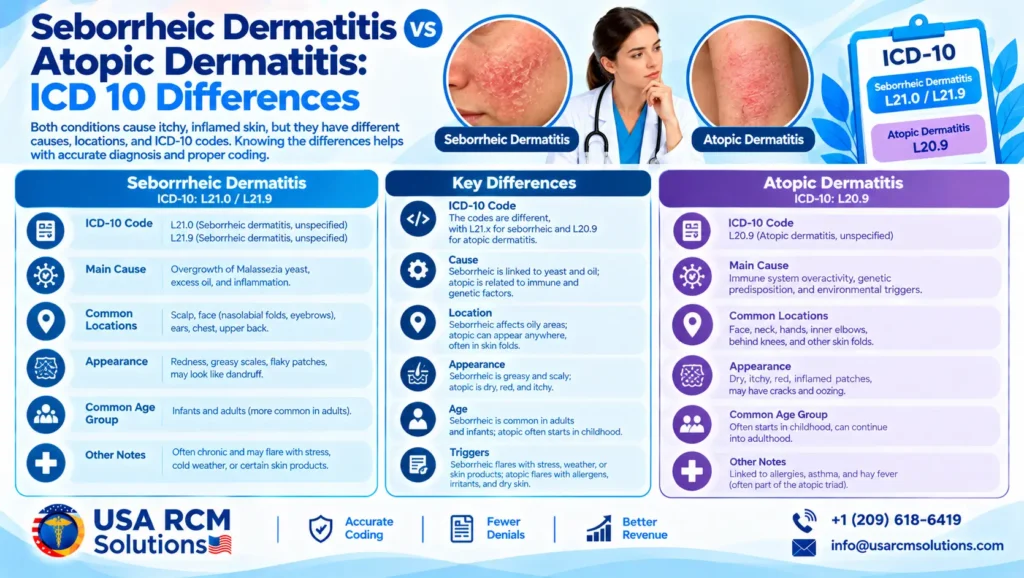
These two conditions look alike, and so patients and coders mix them up. The seborrheic dermatitis ICD 10 family differs from the atopic family. However, they differ in cause, location, and code. The table below shows the main points.
| Feature | Seborrheic Dermatitis | Atopic Dermatitis |
| Main cause | Oil glands and yeast reaction | Skin barrier defect and immune factors |
| Typical sites | Scalp, face, ears, chest | Elbow and knee folds, hands, neck |
| Scale type | Greasy, yellow or white | Dry, rough, and cracked |
| Itch level | Mild to moderate | Often severe |
| Start in life | Infants and adults | Usually early childhood |
| ICD-10 family | L21 | L20 |
Atopic Dermatitis ICD 10
The atopic dermatitis ICD 10 family is L20. Code L20.9 covers unspecified atopic dermatitis. Code L20.89 covers other forms. Code L20.82 covers flexural eczema.
Never swap L20 and L21 codes. They describe different diseases. Moreover, treatment plans and payer rules differ, so a wrong code can cause mismatched claims.
Eczema ICD 10 and ICD 10 Code for Eczema
The term eczema is broad. Because of that, eczema ICD 10 coding needs care. The index sends unspecified eczema to L30.9, which means dermatitis, unspecified.
So the ICD 10 code for eczema depends on the type. Atopic eczema uses L20. Nummular eczema uses L30.0. Dyshidrotic eczema uses L30.1. Seborrheic eczema uses L21.
Contact Dermatitis ICD 10
The contact dermatitis ICD 10 codes sit in L23 through L25. L23 covers allergic contact dermatitis. L24 covers irritant contact dermatitis. L25.9 covers unspecified contact dermatitis.
These codes often need a cause. For instance, L23.2 covers allergic reactions to cosmetics. Therefore, ask the provider to name the trigger when they know it.
Rash ICD 10 and ICD 10 Code for Skin Rash
Sometimes a provider cannot name a diagnosis yet. In that case, rash ICD 10 coding uses R21. This code means rash and other nonspecific skin eruption. It is also the usual ICD 10 code for skin rash when no diagnosis exists.
However, R21 is a symptom code. Once the provider confirms seborrheic dermatitis, report L21.9 or a more specific code instead. Do not report both together for the same visit unless the provider documents a clear reason.
Pruritus ICD 10
Itching has its own code. Pruritus ICD 10 coding uses L29.9 for unspecified pruritus. Code L29.8 covers other pruritus.
Itching is normal with seborrheic dermatitis. So coders should not add L29.9 when the provider already diagnosed the condition. A symptom that belongs to the disease does not need a second code.
Real Examples of Seborrheic Dermatitis ICD 10 Coding
Examples make the rules clear. Here are three common cases.
Case 1: Unspecified diagnosis. A 45-year-old man has red, flaky skin near his nose. The provider writes “seborrheic dermatitis” and prescribes a topical antifungal. The coder reports L21.9.
Case 2: Infant cradle cap. A mother brings in her two-month-old with thick scalp scales. The provider documents cradle cap. The coder reports L21.0 or L21.1, based on the note and payer policy.
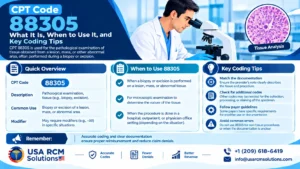
Case 3: Biopsy for unclear rash. A patient has a stubborn rash that does not respond to treatment. The dermatologist takes a skin biopsy. The pathology lab bills the 88305 CPT code for the tissue examination. The biopsy result shows seborrheic dermatitis, so the claim uses L21.9 or L21.8.
Step-by-Step Process to Apply Seborrheic Dermatitis ICD 10 Codes
Follow these steps for every encounter.
- Read the provider note. Look for the exact diagnosis words.
- Confirm the diagnosis. Do not code from a “rule out” statement in an outpatient note.
- Check the site and type. Note the scalp, face, or infant status.
- Choose the closest code. Use L21.0, L21.1, L21.8, or L21.9.
- Check for excluded conditions. Make sure the rash is not atopic or contact dermatitis.
- Link the code to the service. Point each procedure or visit to the right diagnosis.
- Review before submission. Scrub the claim for errors.
Guidelines for Documentation and Medical Necessity
Good notes protect your payment. A payer reviewer needs to see why the visit was needed. So the record should include a few key items.
- The location and appearance of the rash.
- The duration and symptoms.
- Treatments tried and the response.
- The provider’s final diagnosis.
Medical necessity gets stronger with clear history. For instance, a note that says “failed over-the-counter shampoo after four weeks” supports a prescription visit.
Prior Authorization in Medical Billing for Dermatology
Most routine seborrheic dermatitis care does not need approval. Topical creams and shampoos rarely need it. However, some prescription products and procedures may.
Understanding prior authorization in medical billing helps your team avoid surprises. Check the payer portal before you order a costly drug or special treatment. Then record the approval number in the chart. As a result, you reduce rework and delays.
Common Mistakes
Most denials follow a few repeat errors. The table below shows them with fixes.
| Mistake | Why It Causes Problems | How to Fix It |
| Using L21.9 when the note names a type | Payer sees a vague code | Use a more specific code when documented |
| Coding eczema as L21 | Different disease family | Match the type in the note to the family |
| Billing R21 with L21.9 | Symptom plus diagnosis is redundant | Drop the symptom code |
| Adding pruritus L29.9 | Itch is part of the disease | Skip it when the disease is coded |
| Confusing L21 with seborrheic keratosis | Seborrheic keratosis uses L82 | Read the note word by word |
| Missing site detail | Reviewers cannot confirm the case | Ask for the location in the note |
Seborrheic keratosis deserves a special warning. It sounds similar, but it is a benign growth. Its codes live in L82, not L21.
Key Optimization Methods
Strong workflows help practices keep clean claims. These methods work well.
| Optimization Method | What It Does | Expected Benefit |
| Provider documentation templates | Prompts for site and type | More specific codes |
| Code lookup shortcuts in the EHR | Lists L21 options for quick choice | Faster, safer selection |
| Pre-bill claim scrubbing | Flags mismatched diagnosis and service | Higher first-pass rates |
| Payer policy tracker | Stores rules for each plan | Fewer surprise denials |
| Monthly coding audits | Finds repeat errors early | Targeted coder training |
Start with documentation templates, because they fix problems at the source. Then add scrubbing and audit steps.
Best Tools and Practices
The right tools save time and reduce guesswork. Pair them with steady habits.
| Tool or Practice | Purpose | Tip |
| Current ICD-10-CM codebook | Confirm code details | Replace it every October |
| Encoder software | Guides code choice | Verify every suggestion |
| Claim scrubber | Catches edit conflicts | Update edits each quarter |
| Dermatology note templates | Standardize records | Keep fields short and clear |
| Quarterly coder training | Refresh rules | Review recent denials together |
Future Trends
Coding keeps evolving. Dermatology practices should watch these shifts.
| Trend | What to Expect | How to Prepare |
| AI-assisted coding | Faster code suggestions | Keep human review in place |
| Teledermatology growth | More virtual rash visits | Confirm payer telehealth rules |
| Stricter specificity rules | Fewer payments for unspecified codes | Push providers for detail |
| Annual code updates | New or changed skin codes | Review every October release |
| Value-based dermatology | Quality reporting ties to payment | Track outcomes in the chart |
Technology will help, but it will not replace judgment. Coders still need to read the note and understand the case.
How USA RCM Solutions Can Help
Dermatology coding takes skill and steady attention, and seborrheic dermatitis ICD 10 rules are no exception. USA RCM Solutions supports practices with experienced teams. The team writes clear notes, uses real examples, and follows step-by-step workflows.
The company offers Medical Billing & Coding Services for accurate claim submission. Its Denial Management Services help find the root cause behind repeat denials. In addition, the team appeals denied claims with strong records.
Providers also use Medical Credentialing Services to enroll with payers faster. Meanwhile, Accounts Receivable Services keep unpaid claims from aging past filing limits.
Documentation quality matters here too. A Virtual Medical Scribe can capture site and type details during the visit. As a result, notes support a specific seborrheic dermatitis ICD 10 code from the start.
Finally, growth matters as much as collections. Healthcare Marketing Services help practices attract new patients and build local trust. Together, these services strengthen the revenue cycle from visit to payment.
Conclusion
The seborrheic dermatitis ICD 10 category is L21. It includes L21.0, L21.1, L21.8, and L21.9. Therefore, the right choice depends on the provider’s documentation.
Remember the core points. Use L21.9 when the note gives no detail. Use L21.0 for scalp dandruff or cradle cap. Use L21.8 only when the note names a specific form. Then keep seborrheic dermatitis separate from atopic dermatitis, contact dermatitis, and general eczema.
Good habits also protect revenue. Document the site and the treatment history. Check payer rules before you bill. With these steps, your practice can cut denials and keep claims clean.
FAQs
Can a patient have seborrheic dermatitis and psoriasis at the same time?
Yes, some patients have features of both conditions. Doctors sometimes call the overlap sebopsoriasis. The provider must document each diagnosis clearly. Then the coder reports each one separately. Psoriasis uses the L40 family, so never replace one family with the other.
Does Medicare cover treatment for seborrheic dermatitis?
Medicare Part B usually covers medically necessary office visits with a provider. Part D plans may cover prescription creams and shampoos, but they vary by plan formulary. Over-the-counter products are generally not covered. Therefore, patients should check their plan before filling a prescription.
How often can providers bill follow-up visits for seborrheic dermatitis?
Payers allow follow-up visits when the record shows a clear need. Examples include a poor treatment response or a new flare. Routine visits without a change in care may face review. So the note should explain why the patient returned and what the provider changed.
Is seborrheic dermatitis a chronic condition for coding purposes?
ICD-10-CM does not add a separate “chronic” label to the L21 codes. The provider can still describe the disease as chronic or recurrent in the note. That detail helps support medical necessity for repeat visits. However, it does not change the code you report.