
CPT 93306 is one of the most common cardiology codes. It reports a complete transthoracic echocardiogram with spectral and color flow Doppler. Therefore, cardiology offices, hospitals, and imaging centers bill it every day. However, small errors with modifiers, add-on codes, or diagnoses still cause denials.
This guide explains what the code covers and how payers reimburse it. You will also learn how to prepare for the test and what happens during it. Because billing rules change, we use plain steps and real examples.
What Is CPT Code 93306?
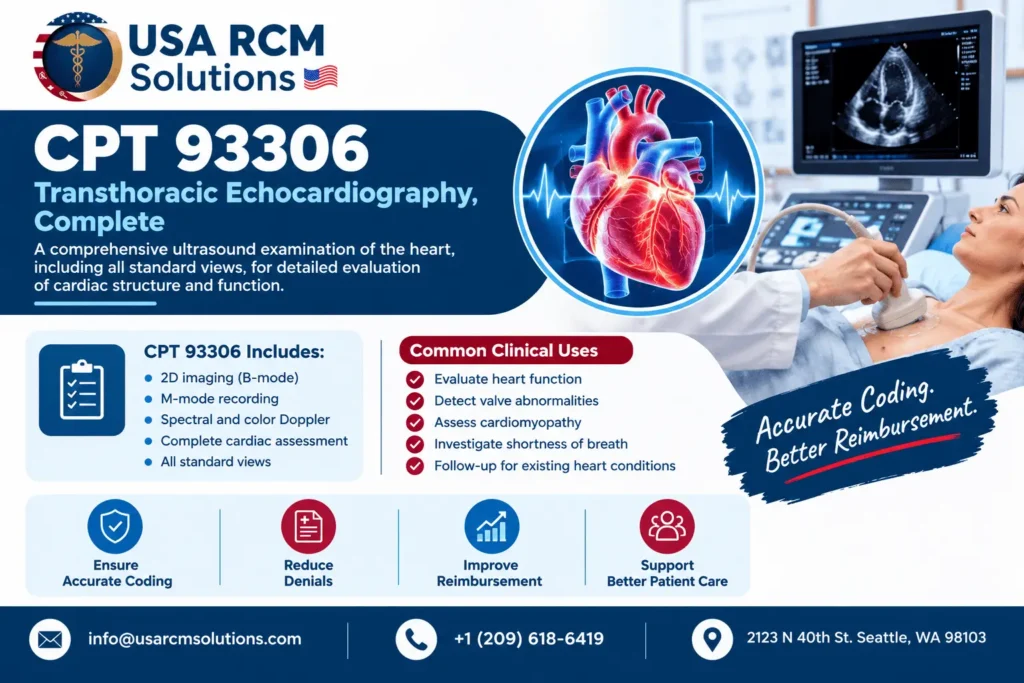
Many readers ask, “what is CPT code 93306?” It is a procedure code from the Medicine section of the CPT book. It describes a complete transthoracic echocardiogram, often shortened to TTE with Doppler. The test uses sound waves to create moving pictures of the heart.
Staff often call it the echo CPT 93306 code for a full heart study. The code groups three pieces into one service. Those pieces are 2D imaging, spectral Doppler, and color flow Doppler.
93306 CPT Code Description
The official CPT code 93306 description reads: “Echocardiography, transthoracic, real-time with image documentation (2D), includes M-mode recording, when performed, complete, with spectral Doppler echocardiography, and with color flow Doppler echocardiography.” That wording is long, but it carries clear rules. The study must be complete. It must also include both Doppler types.
So the 93306 CPT code description tells you what the provider must document. A missing piece can turn the claim into a different code.
Transthoracic Echo CPT Code Basics
The transthoracic echo CPT code family sits in the range 93303 to 93308. Each code fits a different study type. The table below shows the main options.
| CPT Code | Description | Typical Use |
| 93306 | Complete TTE with spectral and color Doppler | Full heart evaluation |
| 93307 | Complete TTE, 2D only, no Doppler | Structure without flow data |
| 93308 | Limited or follow-up TTE, 2D | Focused recheck |
| 93320 | Add-on, spectral Doppler, complete | With 93307 only |
| 93325 | Add-on, color flow Doppler | With 93307 or 93308 |
Always check the current CPT book. Code descriptors and rules can change each year.
What Is a Complete Transthoracic Echocardiogram?
A complete transthoracic echocardiogram looks at the whole heart from outside the chest. The sonographer places a probe on the chest wall. Sound waves bounce off heart tissue and form images on a screen.
“Complete” has a specific meaning in CPT. The study must review all major parts of the heart. That includes the chambers, valves, great vessels, and the sac around the heart. It also requires a full look at blood flow.
What Makes It “Transthoracic”?
The word transthoracic means “through the chest.” In contrast, a transesophageal study places the probe in the esophagus. That test uses different codes. So the route of the probe matters for coding.
Core Imaging Methods
A full study combines several methods. Each one adds a different type of information.
- 2D echocardiogram: shows the heart’s shape and motion in real time.
- M-mode: records fine motion along a single line.
- Spectral Doppler: measures the speed of blood flow.
- Color Doppler imaging: shows flow direction with color overlays.
Together, these methods create a full cardiac ultrasound. They also support a clear heart function assessment.
What Procedures Are Covered Under CPT 93306?
CPT 93306 covers the complete echocardiogram procedure with both Doppler types. It also includes M-mode recording when the lab performs it. The service bundles imaging, flow measurement, and the physician’s interpretation.
Here is what the study usually reviews.
| Area Reviewed | What the Team Looks For |
| Left ventricular function | Size, wall motion, and ejection fraction |
| Right ventricle | Size and pumping strength |
| Heart valves | Narrowing or leaking |
| Atria | Size and clots, when visible |
| Aorta and great vessels | Diameter and flow |
| Pericardium | Fluid around the heart |
| Pulmonary pressures | Estimated from Doppler flow |
This list shows the value of Doppler echocardiography. It turns a picture into a cardiac structure evaluation plus a flow study.
What the Code Does Not Include
CPT 93306 already includes spectral and color flow Doppler. Therefore, you should not bill add-on codes 93320 or 93325 with it. Doing so creates a bundling error.
The code also excludes contrast agents, stress testing, and 3D imaging. Those services have their own codes. For instance, a stress echo uses the 93350 family. A contrast study uses a separate add-on code.
Real Examples of When CPT 93306 Fits
Examples make the rules clear. Here are three common cases.
Case 1:
New murmur. A 58-year-old man has a new heart murmur at a checkup. His doctor orders a complete echo. The lab reports a mild leaking mitral valve. So the claim uses CPT 93306 with the murmur diagnosis.
Case 2:
Heart failure follow-up. A 70-year-old woman has known heart failure. Her symptoms worsen, so her cardiologist orders a full study. The echo shows reduced left ventricular function. So the lab bills 93306 because the complete study supports treatment changes.
Case 3:
Lung disease with heart strain. A patient arrives with a COPD exacerbation ICD 10 diagnosis, J44.1. The doctor suspects strain on the right side of the heart. A full echo estimates pulmonary pressures. The lab bills the study with the supporting diagnosis. The chart explains why the test was needed.
What Diagnosis Covers CPT 93306?
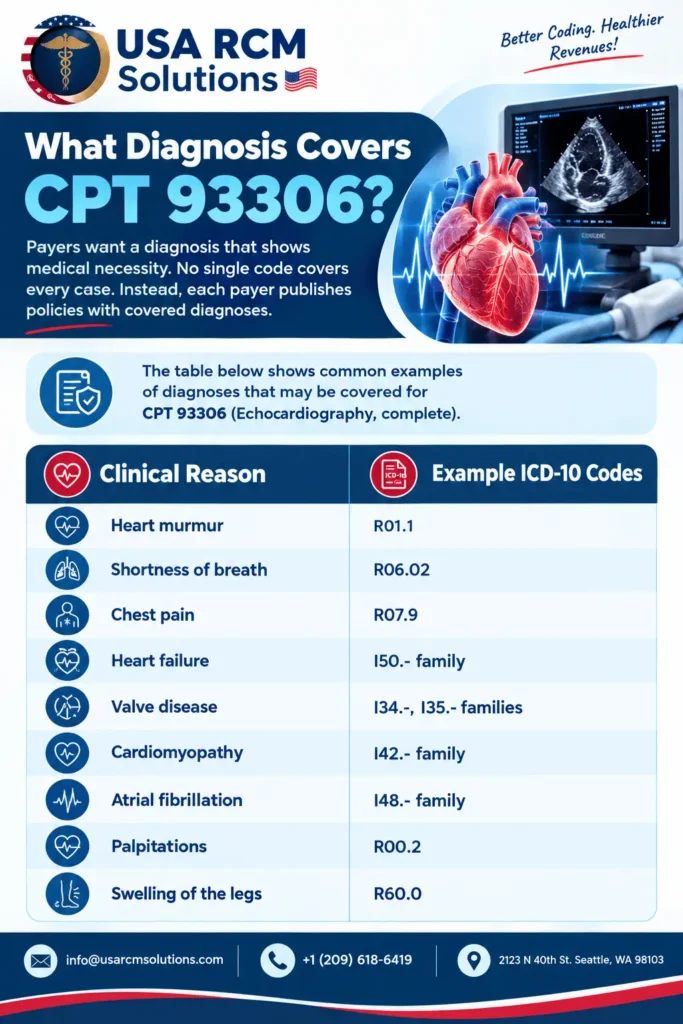
Payers want a diagnosis that shows medical necessity. No single code covers every case. Instead, each payer publishes policies with covered diagnoses. The table below shows common examples.
| Clinical Reason | Example ICD-10 Codes |
| Heart murmur | R01.1 |
| Shortness of breath | R06.02 |
| Chest pain | R07.9 |
| Heart failure | I50.- family |
| Valve disease | I34.-, I35.- families |
| Cardiomyopathy | I42.- family |
| Atrial fibrillation | I48.- family |
| Palpitations | R00.2 |
| Swelling of the legs | R60.0 |
Always check the payer’s local policy. Some plans accept symptom codes, but others prefer confirmed diagnoses. Moreover, routine screening echoes in healthy patients are often not covered.
How to Support Medical Necessity
Strong support has three parts. First, the chart must show a clear symptom or finding. Next, the order must state the reason for the echo. Finally, the result must affect care.
A note like “echo for dyspnea and leg swelling” supports the claim well. A note that says only “echo” does not.
Does CPT 93306 Require Authorization?
It depends on the payer. Original Medicare does not usually require prior approval for an outpatient echo. However, many commercial plans and Medicare Advantage plans do.
Large plans often use outside managers for imaging approvals. Examples include eviCore, Carelon, and Evolent. These groups apply their own clinical criteria. So the ordering office should check the portal before scheduling.
| Payer Type | Authorization Trend | Key Tip |
| Original Medicare | Usually not required | Document medical necessity |
| Medicare Advantage | Often required | Check the plan portal |
| Commercial plans | Often required | Confirm the imaging manager |
| Medicaid | Varies by state | Read the state manual |
Missing approvals lead to denials that are hard to overturn. So build authorization checks into your scheduling workflow. Then record the approval number in the chart and on the claim.
How Do Insurance Companies Typically Reimburse CPT 93306?
Payers reimburse CPT 93306 under fee schedules. Medicare uses the physician fee schedule, which splits payment into two parts. The technical component covers equipment, supplies, and the sonographer. Meanwhile, the professional component covers the physician’s interpretation.
Commercial plans follow similar logic but negotiate their own rates. Therefore, payment varies by contract, region, and place of service.
Global, TC, and 26 Billing
The way you bill depends on who owns the equipment and who reads the study.
| Billing Style | Modifier | Who Bills |
| Global | None | Office that owns the machine and reads the study |
| Technical only | TC | Facility or imaging center |
| Professional only | 26 | Cardiologist who interprets the study |
In a hospital setting, the facility bills the technical piece. The cardiologist bills the professional piece with modifier 26. In a private office, the practice often bills globally. So confirm who owns what before you submit.
Factors That Affect Payment
Several factors move the final payment. They include the site of service, geographic area, and payer contract. In addition, multiple procedure reductions can apply when a lab performs several tests in one day. So review each remittance for accuracy.
How to Prepare for a Comprehensive Heart Ultrasound
Preparation is simple for most patients. A standard transthoracic study needs little planning.
- Follow the office instructions. Most patients do not need to fast.
- Take medicines as directed. Do not stop any drug unless the doctor says so.
- Wear comfortable clothing. A two-piece outfit makes changing easier.
- Bring your medication list. Include any supplements.
- Arrive a few minutes early. Paperwork and check-in take time.
- Skip body lotion on the chest. It can affect probe contact.
- Ask questions beforehand. Clear answers reduce anxiety.
Patients who need special preparation will hear that from the office. For instance, a stress test uses different rules.
What to Expect During a Full Cardiac Echo Procedure
The echocardiogram procedure is painless and uses no radiation. Most visits take 30 to 60 minutes. Here is how it usually goes.
- Check-in. Staff confirm your name, order, and insurance.
- Preparation. You remove clothing above the waist and put on a gown.
- Positioning. You lie on your left side on an exam table.
- Sensors. The sonographer places small ECG pads on your chest.
- Scanning. The sonographer applies warm gel and moves the probe across your chest.
- Doppler sounds. You may hear whooshing noises. That is the sound of blood flow.
- Breathing cues. The sonographer may ask you to hold your breath briefly.
- Finish. Staff wipe off the gel, and you get dressed.
A cardiologist then reviews the images and writes the report. Results often arrive within a few days.
Echocardiogram Medical Billing: Step-by-Step Process
Follow these steps for each claim.
- Verify eligibility. Confirm coverage before the visit.
- Check authorization rules. Get approval when the payer requires it.
- Review the order. Make sure it lists a clear reason.
- Confirm the study type. Match the report to 93306, 93307, or 93308.
- Select diagnosis codes. Link each code to the test.
- Add modifiers. Use TC or 26 when billing a split.
- Scrub the claim. Check for add-on conflicts and missing data.
- Submit and track. Follow up on any denial fast.
Common Mistakes
Most denials trace back to a few repeat errors. The table below shows them with fixes.
| Mistake | Why It Causes Problems | How to Fix It |
| Billing 93320 or 93325 with 93306 | Doppler is already included | Remove the add-on codes |
| Missing Doppler documentation | Report does not support the code | Require both Doppler types in the report |
| Skipping authorization | Plan denies for no approval | Add a portal check before scheduling |
| Weak diagnosis support | Payer sees no necessity | Link a clear symptom or finding |
| Wrong modifier use | Two parties bill the global service | Confirm TC and 26 roles |
| Limited study billed as complete | Auditors flag upcoding | Match the code to the study |
A denial for any of these reasons needs a root-cause fix. Do not resubmit the same claim unchanged. Instead, correct the problem and file again.
Key Optimization Methods
Strong processes keep denial rates low. These methods work well in cardiology billing.
| Optimization Method | What It Does | Expected Benefit |
| Authorization tracking | Logs approvals for every order | Fewer no-approval denials |
| Report templates | Prompts for Doppler and chamber findings | Stronger code support |
| Diagnosis review at scheduling | Checks payer-covered codes | Fewer necessity denials |
| Pre-bill claim scrubbing | Flags add-on code conflicts | Higher first-pass rates |
| Denial trend reports | Shows repeat errors by payer | Targeted training |
Start with report templates, because they fix problems at the source. Then add tracking and scrubbing steps.
Best Tools and Practices
The right tools help teams bill CPT 93306 with fewer errors. Pair them with steady habits.
| Tool or Practice | Purpose | Tip |
| Current CPT codebook | Confirm code descriptors | Replace it every year |
| Payer portals | Check approvals and policies | Save screenshots of approvals |
| Claim scrubber | Catches bundling conflicts | Update edits each quarter |
| Cardiology reporting software | Structures echo reports | Make Doppler fields mandatory |
| Quarterly training | Refresh rules | Review recent denials together |
Credentialing in Medical Billing for Cardiology Practices
Payers pay only providers they have enrolled. Therefore, credentialing in medical billing deserves attention for every cardiologist and imaging site. A missing or expired enrollment can block payment for months.
Practices should track each provider’s payer status. They should also track license dates and facility links. Renewals take time, so start early. As a result, claims for echo services flow smoothly.
Future Trends
Cardiac imaging keeps evolving. Teams should watch these shifts.
| Trend | What to Expect | How to Prepare |
|---|---|---|
| AI-assisted echo reads | Faster image analysis and measurements | Keep physician sign-off in place |
| Handheld ultrasound | More point-of-care cardiac scans | Learn which codes apply |
| Tighter authorization rules | More plans require approval | Build checks into scheduling |
| Remote reading | Cardiologists review studies off site | Clarify TC and 26 roles |
| Value-based payment | Quality measures tied to pay | Track outcomes in the chart |
Technology will help, but it will not replace judgment. Coders still need to match each study to the right code.
How USA RCM Solutions Can Help
Cardiology billing takes skill and steady attention. USA RCM Solutions supports practices with experienced teams. The team writes clear notes, uses real examples, and follows step-by-step workflows.
The company offers Medical Billing & Coding Services for accurate claim submission. Its Denial Management Services help find the root cause behind repeat denials. In addition, the team appeals denied claims with strong records.
Providers also use Medical Credentialing Services to enroll with payers faster. Meanwhile, Accounts Receivable Services keep unpaid claims from aging past filing limits.
Documentation quality matters here too. A Virtual Medical Scribe can capture symptoms and orders during the visit. As a result, notes support the study from the start.
Finally, growth matters as much as collections. Healthcare Marketing Services help practices attract new patients and build local trust. Together, these services strengthen the revenue cycle from order to payment.
Conclusion
CPT 93306 reports a complete transthoracic echocardiogram with spectral and color flow Doppler. It bundles imaging, flow measurement, and interpretation into one service. Therefore, correct use keeps cardiology claims clean and payments steady.
Remember the core points. Do not bill add-on Doppler codes with this study. Use TC and 26 only for split billing. Check authorization rules before scheduling. Then support every claim with a clear diagnosis and a complete report.
Good habits protect revenue. Document the reason for the test and the findings. Confirm payer rules before you bill. With these steps, your practice can cut denials and keep claims clean.
FAQs
How often can a patient have an echocardiogram?
Payers do not set one fixed limit for every patient. Most expect a clear reason for each repeat study. Examples include new symptoms, a change in treatment, or a monitoring schedule for valve disease. So the chart should explain why the new test could change care.
What is the difference between a TTE and a TEE?
A TTE places the probe on the chest wall. By contrast, a TEE passes a probe down the esophagus for a closer view of the heart. Doctors use TEE when chest images are unclear or they need extra detail. The two tests use different codes, and TEE usually needs sedation.
Can a sonographer bill for an echocardiogram on their own?
No, sonographers do not bill Medicare for the study. The practice or facility bills the technical component. Meanwhile, the cardiologist bills the interpretation. Sonographers often hold credentials such as RDCS, and payers may expect them for accredited labs.
Does an echo lab need accreditation to receive payment?
Accreditation is not always required, but many payers prefer it. Programs such as IAC accreditation show that the lab meets quality standards. Some commercial plans may link better contract terms to it. So check each payer’s policy and your own contract before you decide.