
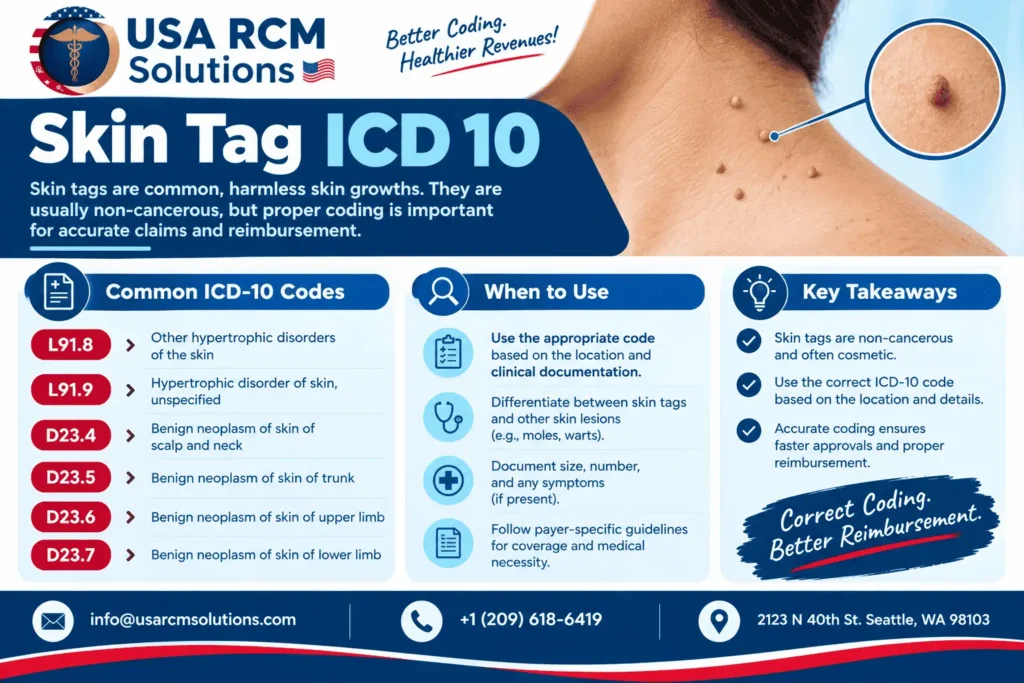
Skin tag ICD 10 coding starts with L91.8, the code for other hypertrophic skin disorders. That is the short answer. However, body location changes the code, and so does the provider’s wording. A neck tag and an anal tag do not share one code. Therefore, a fast lookup can send you to the wrong chapter.
Here is why this matters. Skin tags look minor, but payers still check every claim line. A wrong diagnosis code can deny the removal procedure. Billers then lose time on rework, and practices wait longer for payment.
This guide covers each code, the matching CPT codes, and the billing steps. You will also see real examples, common mistakes, and official resources.
Skin Tag ICD 10 Code at a Glance
Most coders want the answer first. So here is the quick view. The index points hypertrophied skin tags to L91.8. However, anal and vulvar tags follow different entries.
| Skin Tag Location | Diagnosis Code | Description |
| Neck, armpit, groin, or trunk | L91.8 | Other hypertrophic disorders of the skin |
| Anal or residual hemorrhoidal tag | K64.4 | Residual hemorrhoidal skin tags |
| Vulvar or perineal tag | N90.89 | Other specified noninflammatory disorders of vulva and perineum |
| Hypertrophic skin disorder, unspecified | L91.9 | Hypertrophic disorder of the skin, unspecified |
Code sets update each year. So confirm every code against the current set before you bill.
What Is the ICD 10 Code for Skin Tags?
The ICD 10 code for skin tags is L91.8. Its official title is “Other hypertrophic disorders of the skin.” Coders can report it on a claim because it is billable. Its parent category, L91, is only a header, so you cannot bill it alone.
Many people search for the icd 10 for skin tag and expect one exact match. However, L91.8 is an “other” code. It covers several overgrowth conditions, and skin tags are one of them. Therefore, the index entry for “Tag” matters more than the code title.
What Is the ICD-10 Code for Benign Skin Tags?
Skin tags are benign growths. So the ICD-10 code for benign skin tags is also L91.8. You do not need a separate “benign” code.
Some coders reach for D23.9, which means benign neoplasm of skin, unspecified. However, that code fits only when the provider documents a benign neoplasm. If the note says “skin tag,” follow the index and use L91.8.
How Do I Look Up the Skin Tag ICD 10 Code?
A repeatable lookup process prevents most errors. Follow these steps each time.
- Read the exact wording. Look for “skin tag,” “acrochordon,” or “fibroepithelial polyp.”
- Open the Alphabetic Index. Search the main term “Tag.”
- Follow the location sub-term. Choose skin, anus, vulva, or perineal as the note states.
- Check the Tabular List. Read the notes and Excludes instructions under the code.
- Confirm billable status. Make sure the code is valid on the date of service.
- Link the diagnosis to the procedure. Match it to the CPT code on the claim.
Here is a real example. A provider writes, “Three acrochordons on the right neck, removed by snipping.” The coder searches “Tag,” then “skin.” The index lands on L91.8. The coder links L91.8 to CPT 11200 and sends the claim.
ICD-10 Classification for Acrochordons
Acrochordon ICD-10 coding uses the same code, L91.8. The code sits in Chapter 12, Diseases of the Skin and Subcutaneous Tissue. Within that chapter, category L91 covers hypertrophic disorders of the skin.
| Code | Description | Billable? |
| L91 | Hypertrophic disorders of skin | No (header only) |
| L91.0 | Hypertrophic scar | Yes |
| L91.8 | Other hypertrophic disorders of the skin | Yes |
| L91.9 | Hypertrophic disorder of the skin, unspecified | Yes |
Several clinical terms map to L91.8. These include soft fibroma, soft papilloma, and fibroepithelial polyp. So the fibroepithelial polyp ICD-10 answer for a skin lesion is L91.8. However, a polyp inside an organ can follow that organ’s code. Check the index before you assume.
Many coders also search for the L91.8 diagnosis code by its title. That works, but the index path is safer. It protects you when the note uses an unusual term.
What Is a Medical Term for a Skin Tag?
The medical term for a skin tag is acrochordon. Providers also write soft fibroma, soft papilloma, or fibroepithelial polyp. CPT uses the phrase “fibrocutaneous tags.”
Therefore, coders should learn all of these names. A chart may use any one of them. Each one points to the same skin tag diagnosis code when the lesion sits on the skin.
What Is the ICD-9 Code for Skin Tags?
The United States replaced ICD-9-CM with ICD-10-CM on October 1, 2015. Before that date, the index placed skin tags under 701.9. That code meant unspecified hypertrophic and atrophic conditions of the skin.
Crosswalk tools now list 701.8 as the approximate match for L91.8. So old and new codes do not map one to one. Use ICD-9 only to read historical records, and never on a current claim.
What Is the ICD-10 Code for Multiple Skin Tags?
ICD-10 has no special code for multiple skin tags. L91.8 covers one tag or fifty. However, the count still matters for billing.
The CPT code depends on how many lesions the provider removes. So the note should state the number and the body areas. This detail protects both the diagnosis and the procedure line.
External Hemorrhoids ICD 10 and K64.4
Anal skin tags need a different code. Searches for external hemorrhoids icd 10 often lead to K64.4. That code means residual hemorrhoidal skin tags. Its inclusion terms list “external hemorrhoids, NOS” and “skin tags of anus.”
You may also see k64 4 typed without the period. The code is the same. It is billable and belongs to the digestive chapter, not the skin chapter.
Be careful with related codes:
- K64.5: Perianal venous thrombosis, used for a thrombosed external hemorrhoid.
- K64.0 to K64.3: Internal hemorrhoids, selected by degree.
- O22.4 and O87.2: Pregnancy and childbirth hemorrhoid codes, which K64.4 excludes.
So a pregnant patient with hemorrhoidal tags needs a different code choice. Always read the Excludes notes first.
Vulvar Skin Tag ICD 10: A Different Path
The vulvar skin tag icd 10 answer differs from the neck. The index entry “Tag, vulva” points to N90.89. The perineal tag entry points there too. N90.89 means other specified noninflammatory disorders of vulva and perineum.
Therefore, L91.8 is not the default for this site. The provider should document the exact location and any symptoms. Irritation or bleeding adds useful detail. Confirm the index entry in the current code set before you submit.
What Is the Difference Between a Skin Tag and a Wart?
Skin tags and warts look alike to many patients. However, they have different causes and different codes.
| Feature | Skin Tag | Wart |
| Cause | Skin friction and overgrowth | Human papillomavirus (HPV) |
| Texture | Soft, smooth, often on a stalk | Rough, firm, sometimes with dark dots |
| Contagious? | No | Yes |
| Diagnosis code | L91.8 | B07.- for viral warts |
| Anogenital version | K64.4 or N90.89 by site | A63.0 for anogenital warts |
| Removal CPT | 11200, 11201 | 17110 for up to 14 lesions |
The provider’s diagnosis decides the code. So a coder should never swap one for the other. If the note says “wart,” use the viral wart family. If it says “skin tag,” stay with the tag entries.
Common ICD-10 Codes for Skin Tags and Related Conditions
Providers often document more than one condition in a visit. This table helps you sort the options.
| Code | Description | Use It When |
| L91.8 | Other hypertrophic disorders of the skin | Skin tag or acrochordon on skin |
| L91.9 | Hypertrophic disorder of the skin, unspecified | Note is vague about the disorder |
| L91.0 | Hypertrophic scar | Provider documents a raised scar |
| K64.4 | Residual hemorrhoidal skin tags | Anal tag or external hemorrhoid, NOS |
| K64.5 | Perianal venous thrombosis | Thrombosed external hemorrhoid |
| N90.89 | Other specified noninflammatory disorders of vulva and perineum | Vulvar or perineal tag |
| D23.9 | Benign neoplasm of skin, unspecified | Provider documents a benign neoplasm |
| B07.9 | Viral wart, unspecified | Provider documents a wart |
Where Can I Find a List of ICD 10 Codes Including Skin Tags?
Always verify codes against official sources. Third-party lists sometimes lag behind updates. These sources stay reliable:
- CDC and NCHS: They publish the ICD-10-CM files and official guidelines.
- CMS: It posts annual code tables and update notices.
- AAPC and AMA: They offer coding references and CPT guidance.
- Encoder software: It searches the index and checks edits.
- Payer portals: They list coverage rules for skin tag removal ICD-10 pairings.
New code sets take effect each October. Today is October 27, 2026, so the fiscal year 2027 set is already active. Check the current tables before every submission.
CPT Code for Skin Tag Removal
The diagnosis code explains why the patient needed care. The CPT code explains what the provider did. So both must match.
The cpt code for skin tag removal is 11200. It covers up to and including 15 lesions. Code 11201 is an add-on for each additional 10 lesions, or part of 10. You cannot report 11201 alone.
| Lesions Removed | CPT Codes to Report |
| 1 to 15 | 11200 |
| 16 to 25 | 11200 + 11201 x 1 |
| 26 to 35 | 11200 + 11201 x 2 |
| 36 to 45 | 11200 + 11201 x 3 |
Any method counts for skin tag removal CPT billing. Snipping, ligation, electrosurgery, and cryotherapy all qualify. Local anesthesia is bundled into the procedure, so do not bill it separately.
However, not every lesion is a skin tag. If the provider excises a different benign lesion, other CPT codes apply. Those fall in the 11400 series. So the note must name the lesion clearly.
Understanding the Billing Process for Skin Tag Claims
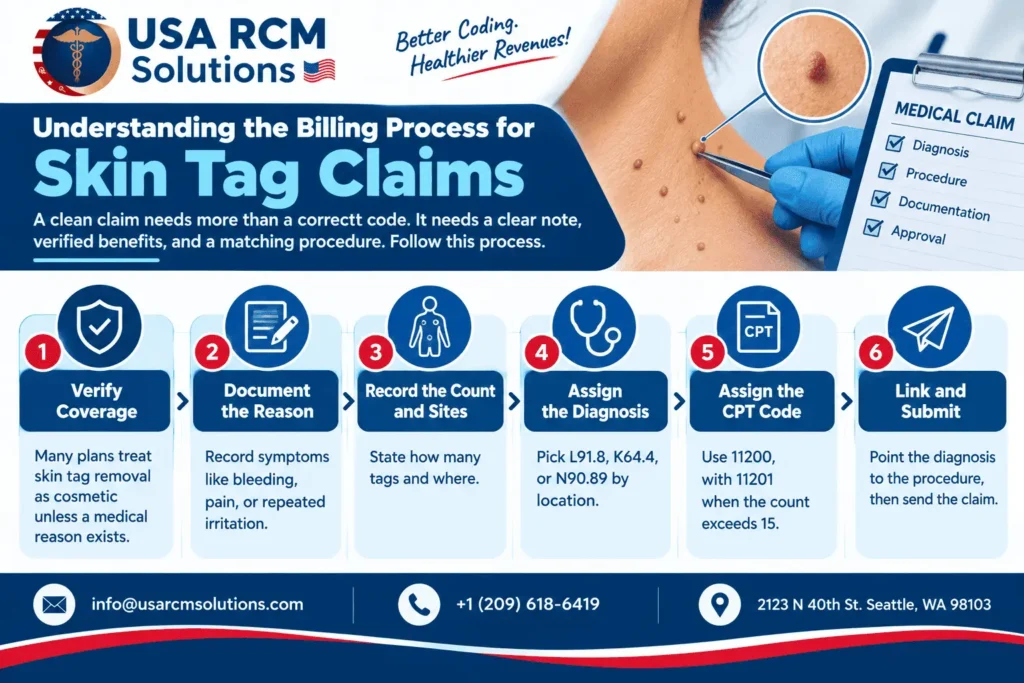
A clean claim needs more than a correct code. It needs a clear note, verified benefits, and a matching procedure. Follow this process.
- Verify coverage. Many plans treat skin tag removal as cosmetic unless a medical reason exists.
- Document the reason. Record symptoms like bleeding, pain, or repeated irritation.
- Record the count and sites. State how many tags and where.
- Assign the diagnosis. Pick L91.8, K64.4, or N90.89 by location.
- Assign the CPT code. Use 11200, with 11201 when the count exceeds 15.
- Link and submit. Point the diagnosis to the procedure, then send the claim.
Consider a real example. A 52-year-old patient has 22 tags on the neck and armpit. Her clothing rubs them, and several bleed. The provider documents the bleeding and removes all 22 by snipping.
The coder reports L91.8 as the diagnosis. The procedure lines are 11200 and one unit of 11201. The note supports medical need, so the payer can review the claim fairly.
Key Optimization Methods
| Method | What It Means | Benefit |
| Document symptoms | Record bleeding, pain, or irritation | Stronger medical necessity |
| Code by location | Match the code to the body site | Fewer diagnosis mismatches |
| Count every lesion | Note the exact number removed | Correct 11201 units |
| Check benefits early | Confirm cosmetic exclusions before the visit | Fewer patient disputes |
| Audit monthly | Review a sample of minor procedure claims | Spot patterns early |
Best Tools and Practices
| Tool or Practice | Purpose | Tip |
| Encoder software | Searches the index and validates codes | Update it every October |
| Claim scrubber | Flags diagnosis and CPT mismatches | Review edits daily |
| EHR templates | Prompt for lesion count and location | Keep fields short |
| Payer policy library | Stores cosmetic and coverage rules | Review it each quarter |
| Credentialing in Medical Billing checks | Confirms providers are enrolled with each payer | Track renewal dates |
Future Trends
| Trend | What to Expect | Action |
| AI-assisted coding | Software suggests codes from notes | Keep human review in place |
| Teledermatology growth | More remote skin visits | Confirm payer telehealth rules |
| Stricter cosmetic edits | Payers question minor procedures | Document medical need clearly |
| Real-time eligibility tools | Instant benefit checks at scheduling | Adopt them early |
| Ambient note capture | Voice tools build the chart during visits | Review output for accuracy |
Common Mistakes
| Mistake | Why It Hurts | Fix |
| Using L91.8 for an anal tag | Wrong chapter and payer rejection | Use K64.4 for anal tags |
| Using L91.8 for a vulvar tag | Misses the index entry | Check the vulva entry |
| Reporting 11201 alone | Add-on codes need a primary code | Pair it with 11200 |
| Skipping the lesion count | Units become unverifiable | State the number in the note |
| Coding a wart as a skin tag | Diagnosis does not match the lesion | Use the provider’s exact term |
| Coding a symptom beside a confirmed cause | Creates a redundant line | Code the cause only |
The last mistake appears across specialties. For example, Blurred Vision ICD 10 coding uses H53.8 only when no cause is confirmed. Skin coding follows the same logic.
How USA RCM Solutions Supports Dermatology and Primary Care Practices
Minor procedures create steady revenue, but small errors drain it. USA RCM Solutions helps practices protect that revenue.
The team offers Medical Billing & Coding Services for diagnosis and procedure claims.
Practices also use its Medical Credentialing Services to join payer networks faster.
Cash flow improves with its Accounts Receivable Services.
When claims fail, Denial Management Services helps recover lost revenue.
A Virtual Medical Scribe can capture lesion counts and symptoms during the visit.
Finally, Healthcare Marketing Services help practices reach new patients.
Credentialing in Medical Billing matters here because payers pay only enrolled providers. So clean enrollment supports every Skin Tag ICD 10 claim.
Conclusion
Skin tag ICD 10 coding starts with L91.8 for most skin sites. Anal tags move to K64.4, and vulvar tags follow the N90.89 index entry. There is no special code for multiple tags, so the CPT count carries that detail.
Pair the diagnosis with CPT 11200, and add 11201 when the count passes 15. Document symptoms, count, and location every time. Then verify benefits early and update your code set each October.
With these habits, your skin tag claims can move through payers with fewer delays.
FAQs
Does insurance cover skin tag removal?
Coverage depends on the payer and the reason for removal. Many plans treat removal as cosmetic and deny it. Medicare generally follows this approach unless the record shows medical need. Notes about bleeding, pain, infection, or repeated irritation strengthen the claim.
What happens to the code if the provider sends a tag to pathology?
The pathology report can change the final diagnosis. If the lab confirms a benign tag, L91.8 usually stays. If it finds a different lesion, the coder uses the code for that finding. Therefore, coders should wait for the final report when the provider orders one.
Can I bill an office visit on the same day as skin tag removal?
Sometimes, yes. The visit must include a significant, separately identifiable service beyond the removal itself. In that case, the E/M code usually needs modifier 25. Without that extra work, payers treat the visit as part of the procedure.
What is the global period for CPT 11200?
CPT 11200 carries a 0-day global period. That means the payment covers the procedure and routine care on that day. Code 11201 is an add-on, so it follows its parent code. If the patient returns for new tags later, the provider can bill a new service with proper documentation.