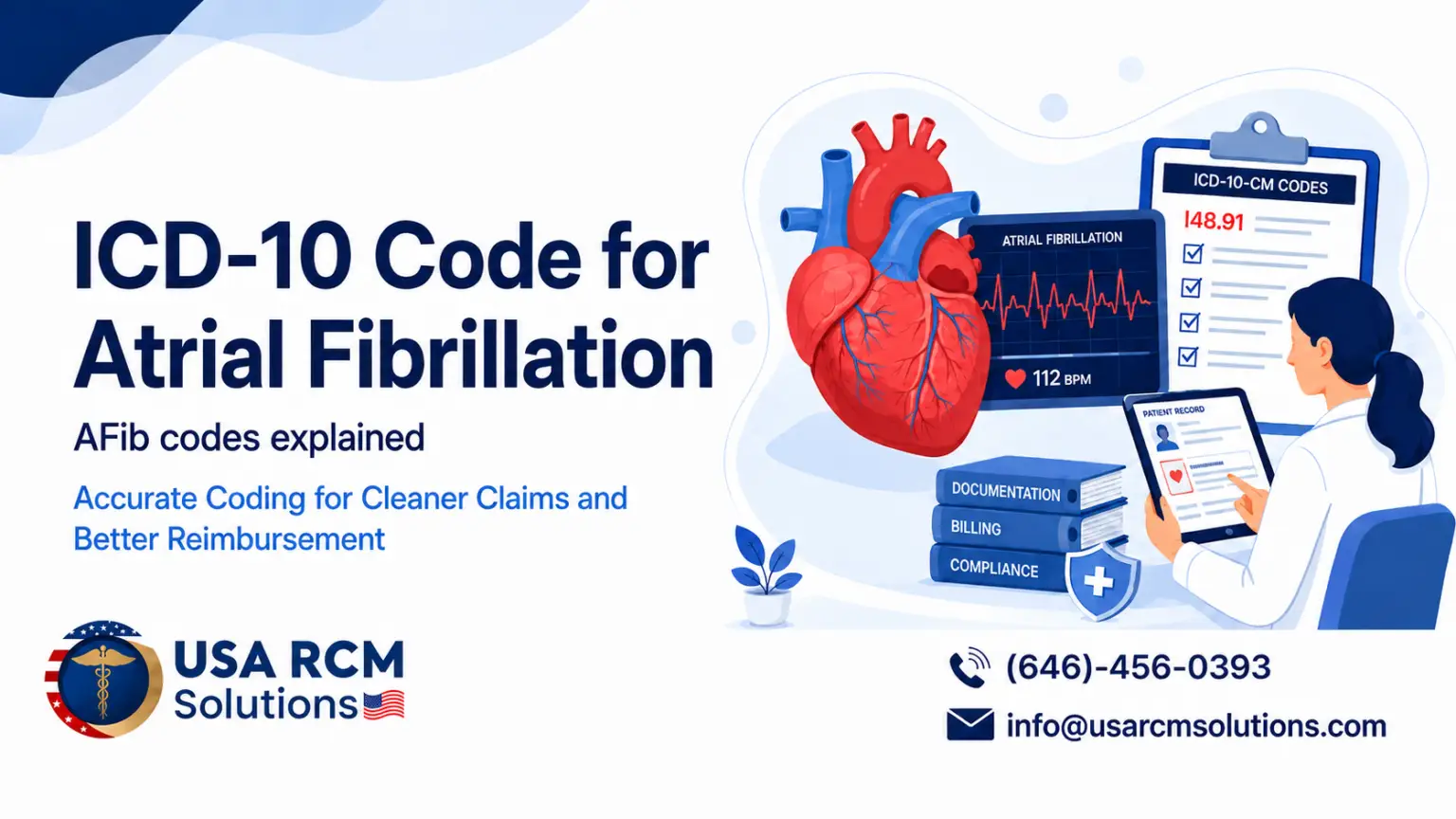
Choosing the correct ICD 10 code for atrial fibrillation helps healthcare organizations submit clean claims, avoid denials, and receive appropriate reimbursement. Errors in selecting AFib codes can create billing delays, compliance issues, and inaccurate medical records.
For medical billing teams, understanding AFib classification, documentation requirements, and code specificity is important for maintaining coding accuracy. This guide explains commonly used Atrial Fibrillation ICD-10 Codes, including chronic, paroxysmal, persistent, permanent, unspecified, and atrial fibrillation with rapid ventricular response (RVR).
What Is Atrial Fibrillation (AFib)?
Atrial fibrillation is an irregular and often rapid heart rhythm caused by abnormal electrical signals in the upper chambers of the heart. During AFib, the atria do not contract in a normal rhythm, which can affect blood flow and increase the risk of complications.
Common types of atrial fibrillation include:
- Paroxysmal atrial fibrillation: Episodes that begin and stop on their own.
- Persistent atrial fibrillation: AFib that continues and usually requires medical intervention to restore normal rhythm.
- Longstanding persistent atrial fibrillation: Persistent AFib lasting for an extended period, typically more than 12 months.
- Permanent atrial fibrillation: AFib where the decision has been made not to restore normal rhythm.
- Chronic atrial fibrillation: Long-term AFib documented as an ongoing condition.
Common ICD-10 Codes Used for Atrial Fibrillation
Medical coders should select the most specific diagnosis code supported by the patient’s medical record. The following table provides a quick reference for commonly used AFib codes.
| Type of Atrial Fibrillation | ICD-10-CM Code | Description |
| Paroxysmal atrial fibrillation | I48.0 | AFib that occurs in episodes and may stop spontaneously |
| Longstanding persistent atrial fibrillation | I48.11 | Persistent AFib that has continued for more than 12 months |
| Other persistent atrial fibrillation | I48.19 | Persistent AFib that does not meet another specified category |
| Chronic atrial fibrillation, unspecified | I48.20 | Used when chronic AFib is documented without further specificity |
| Permanent atrial fibrillation | I48.21 | AFib accepted as permanent when rhythm restoration is no longer pursued |
| Unspecified atrial fibrillation | I48.91 | Used when the provider documents AFib without identifying a specific type |
When determining the dx code for atrial fibrillation, coders should rely on the provider’s documented diagnosis rather than making assumptions based only on symptoms, medications, or treatment history.
Using a specific code when documentation supports it can improve ICD-10 coding accuracy and reduce unnecessary payer questions. In contrast, routinely reporting an unspecified code may create compliance concerns when the medical record clearly identifies a more specific Atrial Fibrillation ICD-10 Codes type.
Specific Atrial Fibrillation ICD-10 Codes Explained
Selecting the correct AFib code requires a clear understanding of the type of atrial fibrillation documented by the provider. Each category under the I48 code family represents a different clinical condition, and accurate selection helps support proper billing, coding compliance, and reimbursement.
Chronic Atrial Fibrillation ICD 10 Code
The chronic Atrial Fibrillation ICD-10 Codes is generally used when the provider documents AFib as a long-term or ongoing condition.
For chronic atrial fibrillation, commonly reported ICD-10-CM codes include:
| Condition | ICD-10-CM Code |
| Chronic atrial fibrillation | I48.20 |
| Permanent atrial fibrillation | I48.21 |
Accurate documentation should clarify whether the patient has ongoing AFib, persistent AFib, or permanent AFib. This prevents incorrect code assignment and reduces the risk of claim denials.
ICD 10 Code for Paroxysmal Atrial Fibrillation
The ICD 10 code for paroxysmal atrial fibrillation is:
I48.0: Paroxysmal atrial fibrillation
Paroxysmal AFib refers to episodes of irregular heart rhythm that begin suddenly and may return to normal without long-term intervention. Providers should clearly document that the AFib is paroxysmal to support the correct diagnosis code.
Common documentation elements include:
- Confirmation of paroxysmal AFib
- Episode frequency or history when clinically relevant
- Supporting diagnostic findings
- Treatment plan related to AFib management
ICD 10 Persistent Atrial Fibrillation Codes
Persistent atrial fibrillation requires specific coding based on the provider’s documentation.
Common ICD-10-CM codes include:
| Condition | ICD-10-CM Code |
| Longstanding persistent atrial fibrillation | I48.11 |
| Other persistent atrial fibrillation | I48.19 |
The ICD 10 code for longstanding persistent atrial fibrillation should be assigned when the provider documents that the condition has continued for an extended period.
ICD 10 Permanent Atrial Fibrillation Code
The ICD 10 permanent atrial fibrillation code is:
I48.21: Permanent atrial fibrillation
Permanent AFib indicates that the healthcare provider and patient have accepted the condition as a continuing rhythm disorder, and attempts to restore normal rhythm are no longer being pursued.
Atrial Fibrillation Unspecified ICD 10 Code
The atrial fibrillation unspecified ICD 10 code is:
I48.91: Unspecified atrial fibrillation
This code is used when the provider documents atrial fibrillation but does not specify the type.
ICD 10 Code for Atrial Fibrillation With RVR
Atrial fibrillation with rapid ventricular response (RVR) requires careful documentation because it describes a specific clinical presentation where the heart rate is significantly elevated due to abnormal electrical activity. Accurate coding depends on whether the provider documents AFib with RVR and supports the diagnosis through clinical findings.
For medical billing teams, correct identification of Atrial Fibrillation ICD-10 Codes with RVR helps ensure that claims accurately represent the patient’s condition and prevents coding errors that may affect reimbursement.
Rapid Atrial Fibrillation ICD 10 Coding Considerations
When reviewing rapid atrial fibrillation ICD 10 coding, medical billers should confirm that the provider specifically documents the presence of rapid ventricular response.
The ICD-10-CM classification does not provide a separate standalone code specifically named “AFib with RVR.” Instead, coding generally requires reporting the appropriate atrial fibrillation code based on the documented AFib type.
Examples include:
| Documented Condition | Possible ICD-10-CM Code |
| Atrial fibrillation with RVR, type not specified | I48.91 |
| Paroxysmal AFib with RVR | I48.0 |
| Persistent AFib with RVR | Appropriate persistent AFib code based on documentation |
Documentation Requirements for Accurate AFib Coding
Accurate Atrial Fibrillation ICD-10 Codes depends on complete and specific provider documentation. Medical coders cannot assign the most appropriate ICD-10 code without clear clinical information that supports the diagnosis.
For healthcare providers and billing teams, improving documentation quality is one of the most effective ways to prevent coding errors, reduce claim issues, and support proper reimbursement.
Provider Documentation Elements Required for Coding
To select the correct AFib ICD 10 code, the medical record should include enough detail about the patient’s condition. Important documentation elements include:
| Documentation Element | Why It Matters |
| Type of atrial fibrillation | Determines the correct ICD-10 code category |
| Acute or chronic status | Helps differentiate temporary conditions from ongoing AFib |
| Presence of RVR | Supports accurate coding when rapid ventricular response is documented |
| Clinical findings | Provides support for medical necessity |
| Related cardiac conditions | May affect treatment and overall coding accuracy |
| Treatment plan | Helps confirm the documented diagnosis |
How USA RCM Solutions Helps With Accurate AFib Billing and Coding
Atrial fibrillation coding requires attention to detail because different Atrial Fibrillation ICD-10 Codes types require different levels of specificity. USA RCM Solutions helps review coding processes to ensure diagnosis codes align with provider documentation.
Our approach helps healthcare organizations:
- Verify accurate ICD-10 code selection
- Reduce incorrect diagnosis reporting
- Improve coding compliance
- Identify potential documentation gaps
- Support accurate claim preparation
By reviewing coding details before claim submission, providers can reduce avoidable errors and improve the overall efficiency of their revenue cycle.
Conclusion :
Accurate atrial fibrillation coding is essential for maintaining compliant medical billing practices and achieving proper reimbursement. Selecting the correct ICD 10 code for atrial fibrillation requires detailed provider documentation, understanding of AFib classifications, and careful review of coding guidelines.
From paroxysmal and persistent AFib to permanent, chronic, and unspecified atrial fibrillation, each diagnosis requires appropriate code selection based on documented clinical information. Incorrect coding, incomplete documentation, and unnecessary use of unspecified codes can contribute to claim denials and reimbursement challenges.