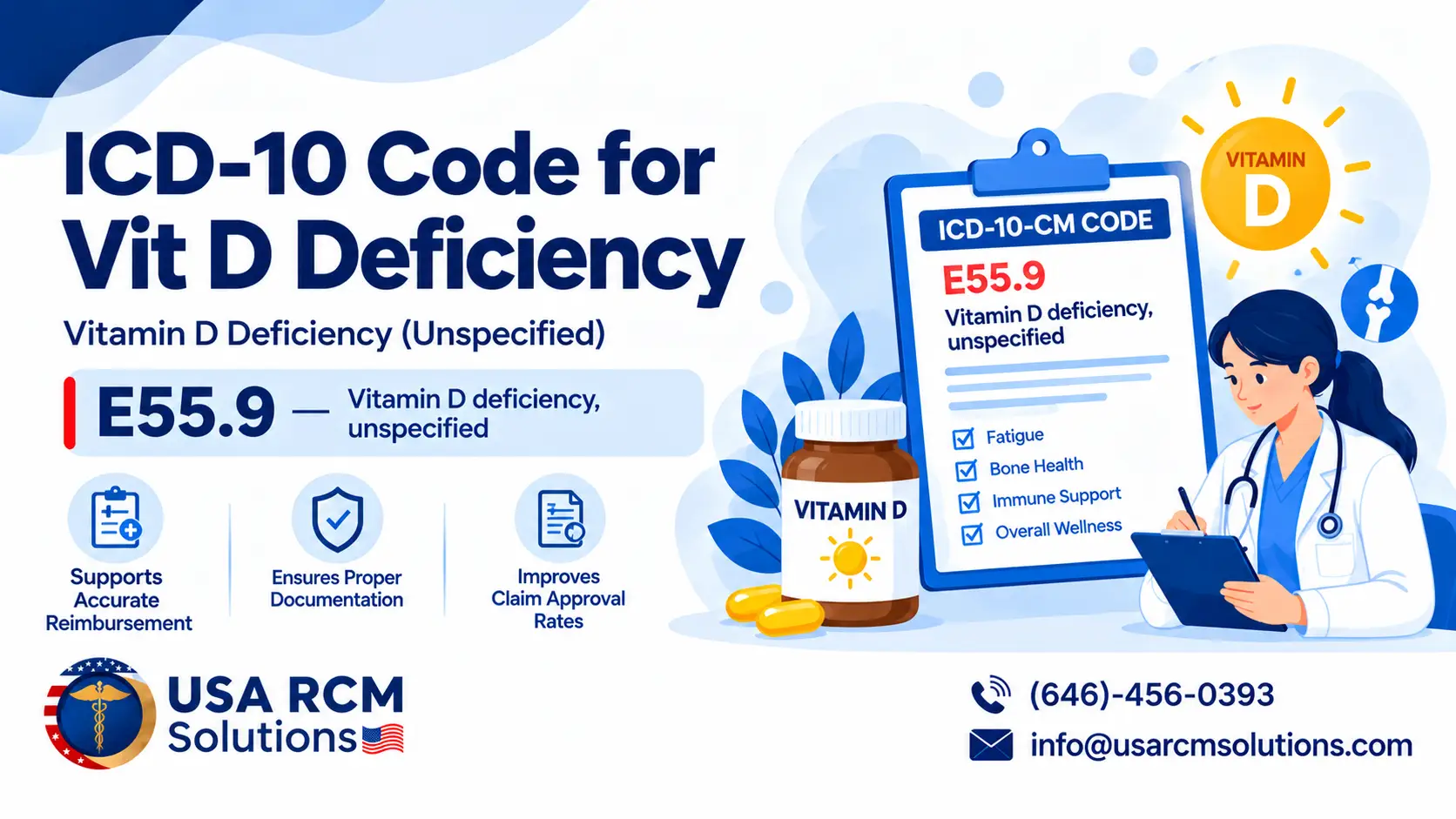
The ICD 10 code for vit d deficiency is E55.9. It means vitamin D deficiency, unspecified. Providers use it when they document low vitamin D without more detail. However, correct coding takes more than one code lookup. Lab orders, screening rules, and payer policies also shape payment. This guide explains each part in plain words.
Vitamin D problems are common, so these claims reach billing teams daily. Therefore, small coding mistakes add up fast. You will see tables, real examples, and a step-by-step process. So let us begin with the code itself.
10 Code for Vit D Deficiency (E55.9) Explained
E55.9 is the standard code for vitamin D deficiency without more detail. Most clinics use it every day. Billers also search for the vitamin D deficiency icd code. Others type the icd code for vitamin D deficiency instead. Both searches lead to E55.9 ICD 10.
E55.9 Code Description
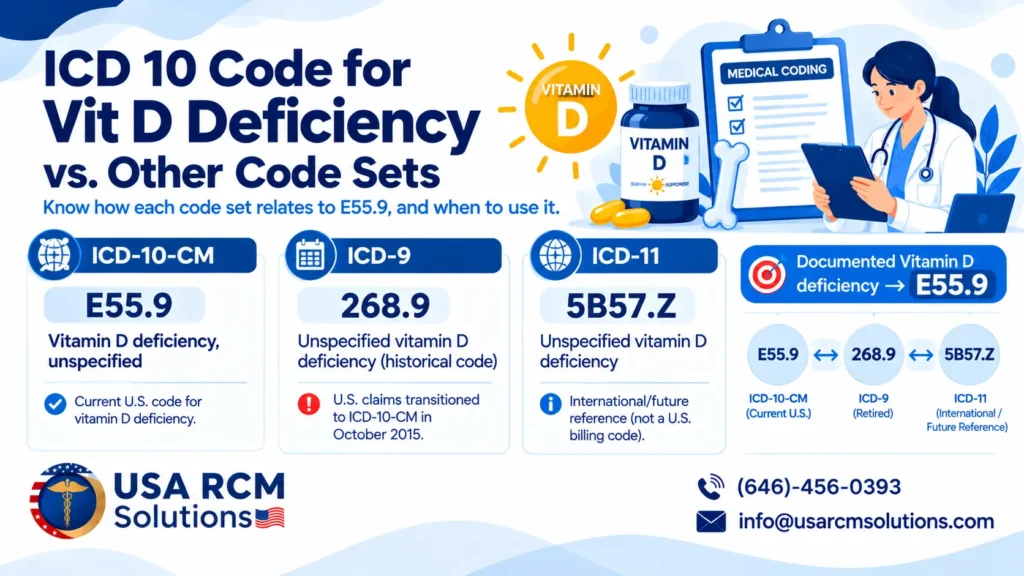
The official E55.9 code description is vitamin D deficiency, unspecified. Here, the provider documents a deficiency but gives no type or cause. Therefore, the coder selects E55.9. The E55 category header cannot be billed on its own. So the coder must pick a code with full detail.
The E55 Code Family
- E55: vitamin D deficiency (category header).
- E55.0: rickets, active.
- E55.9: vitamin D deficiency, unspecified.
Rickets affects growing bones, so providers document it mostly in children. Therefore, adult cases usually fall under E55.9. Always review the Excludes notes at the E55 category before you finalize the code.
Nutritional Deficiency: Where E55.9 Fits
ICD-10-CM groups E55.9 with other nutritional deficiency codes. These codes sit in the E50 to E64 range. Each one covers a lack of a vitamin, mineral, or nutrient. Because of this grouping, coders can find related options quickly.
A nutritional deficiency diagnosis still needs provider documentation. Coders cannot diagnose from a lab value alone. Therefore, a clear provider statement always comes first.
25-Hydroxy Vitamin D Test and Coding
The 25-hydroxy vitamin D test is the standard lab for checking vitamin D status. It measures the main circulating form in the blood. Labs report the result in ng/mL or nmol/L. Many labs flag levels below 20 ng/mL as low, but cutoffs vary.
Labs usually bill the test with CPT 82306. The diagnosis code tells the payer why the test was necessary. Therefore, the diagnosis and the test must match.
ICD-10 Code for Vitamin D 25 Hydroxy Screening
What is the ICD-10 code for screening for vitamin D deficiency? The usual code is Z13.21. It means encounter for screening for nutritional disorder. Use it when the patient has no signs, symptoms, or known diagnosis. However, many payers do not cover routine vitamin D screening. So check the payer policy before the test. Medicare patients may need an advance beneficiary notice.
History of Low Vitamin D ICD-10
History of low vitamin D ICD-10 coding uses Z86.39. It means personal history of other endocrine, nutritional, and metabolic disease. Use it only when the condition has resolved and needs no treatment. If the patient still takes supplements for the deficiency, code E55.9 instead. Therefore, always confirm the current status in the note.
An Illustrative Example: Symptoms Drive the Order
Here is an illustrative example. A patient reports fatigue and bone pain. The provider orders a 25-hydroxy vitamin D test. At that point, only symptoms exist. So the lab claim lists the documented symptoms.
Later, the result shows a very low level. The provider then documents vitamin D deficiency. At the follow-up visit, the coder reports E55.9. That sequence keeps every claim honest and easy to defend.
Step-by-Step Process for Coding Vitamin D Deficiency
- Read the provider note. Look for the stated diagnosis and the reason for the test.
- Confirm the visit type. Decide if it is screening, diagnostic, or follow-up.
- Match the code to the note. Use E55.9, Z13.21, or Z86.39 as the documentation supports.
- Add related conditions. Report documented causes and linked problems.
- Link the lab test. Connect CPT 82306 to the diagnosis that supports necessity.
- Check payer policy. Review covered diagnoses and frequency limits.
- Submit a clean claim. Run your edits before sending.
- Track results. Review denials and fix the root causes.
Vitamin D, Kidneys, and Acute Kidney Injury
The kidneys play a key role in vitamin D. They convert vitamin D into its active form. Therefore, kidney problems can disturb vitamin D balance. Acute kidney injury is a sudden loss of kidney function. Patients with it often have complex lab results and several diagnoses.
Coders must report each documented condition separately. For example, the ICD 10 Code for AKI is N17.9 when the type is unspecified. Chronic kidney disease uses N18 codes with a stage. However, no coder should assume vitamin D deficiency from kidney disease alone. The provider must document it.
Coding Vitamin D Deficiency With Other Conditions
Vitamin D deficiency often appears with other chronic problems. Older adults may also have heart rhythm disorders. In that case, coders may need Atrial Fibrillation ICD-10 Codes from the I48 category. Each condition needs its own provider documentation. Therefore, review the whole note before you assign codes.
Why Accurate Coding Matters for the ICD 10 Code for Vit D Deficiency
Accurate codes support payment and patient care. A wrong code can deny a lab claim. A missing code can hide medical necessity. Therefore, small fixes can bring real money back.
Here is another illustrative case. A clinic billed the lab test with a screening code. However, the note already documented a bone condition. So the payer denied the claim as routine screening. The team corrected the diagnosis and resubmitted it. Then the payer paid.
Documentation Tips for Providers
Good coding begins with good notes. Share these tips with your clinical team.
- State “vitamin D deficiency” clearly, not just “low D.”
- Record the lab value and the test date.
- Note the symptoms and the reason for testing.
- Document the cause, such as diet or malabsorption.
- Record the treatment plan and the follow-up date.
Key Optimization Methods
The table below shows practical ways to improve vitamin D coding.
| Method | What It Does | Expected Result |
| Provider documentation prompts | Asks for diagnosis, cause, and test reason | Fewer vague codes |
| Payer policy checks | Reviews covered diagnoses for CPT 82306 | Fewer medical necessity denials |
| Claim scrubbing | Flags missing or mismatched diagnosis links | Cleaner claims |
| Screening vs. diagnostic workflow | Separates screening visits from problem visits | Correct code selection |
| Regular coder education | Reviews annual code updates | Fewer coding errors |
| Denial trend review | Tracks rejections by lab and diagnosis | Targeted fixes |
Best Tools and Practices
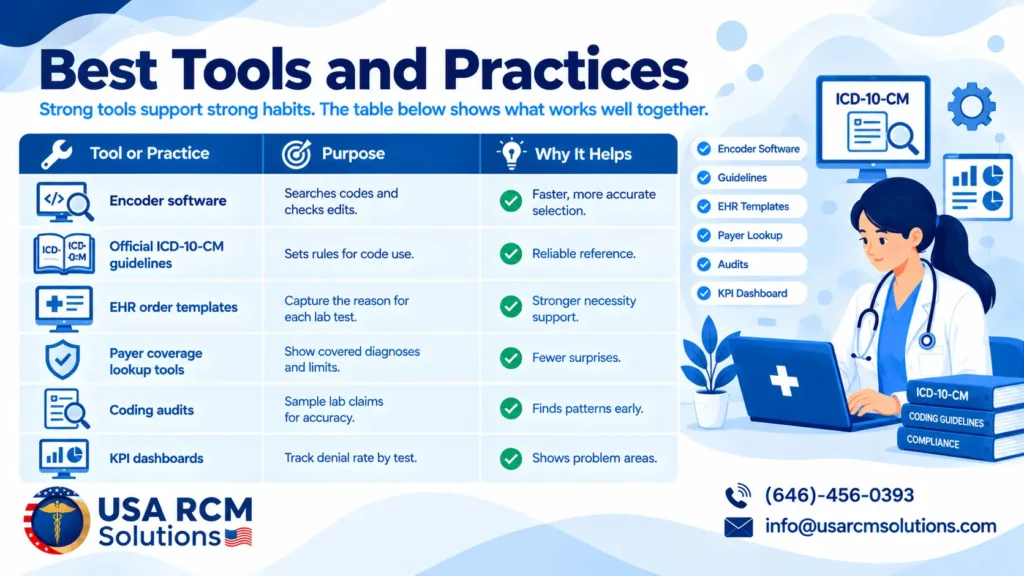
Strong tools support strong habits. The table below shows what works well together.
| Tool or Practice | Purpose | Why It Helps |
| Encoder software | Searches codes and checks edits | Faster, more accurate selection |
| Official ICD-10-CM guidelines | Sets rules for code use | Reliable reference |
| EHR order templates | Capture the reason for each lab test | Stronger necessity support |
| Payer coverage lookup tools | Show covered diagnoses and limits | Fewer surprises |
| Coding audits | Sample lab claims for accuracy | Finds patterns early |
| KPI dashboards | Track denial rate by test | Shows problem areas |
Common Mistakes With the ICD Code for Vitamin D Deficiency
Even experienced teams repeat the same errors. The table below shows the most common ones and better options.
| Common Mistake | Why It Hurts | Better Approach |
| Using Z13.21 when the patient has symptoms or a known diagnosis | Misstates the visit reason | Code the documented condition |
| Coding E55.9 from a lab value alone | Fails audit review | Wait for provider documentation |
| Mixing up E55.9 and E56.9 | Loses specificity | Use E55.9 when vitamin D is named |
| Using the old ICD-9 code 268.9 | Payers reject retired codes | Use ICD-10-CM codes only |
| Using Z86.39 for an active deficiency | Hides current treatment | Use E55.9 while treatment continues |
| Skipping related codes, such as the ICD 10 Code for AKI | Leaves the record incomplete | Add documented comorbidities |
Support for Coding and Revenue Teams
Coding does not happen in isolation. Documentation, credentialing, billing, and follow-up all affect payment. Therefore, many practices look for outside help.
Full-Service Support for Coding and Revenue Teams
USA RCM Solutions helps practices manage coding and revenue tasks together. Its service range supports the full cycle. The list below shows the main offerings.
- Medical Billing & Coding Services: accurate claims built on correct diagnosis codes.
- Medical Credentialing Services: payer enrollment and provider onboarding.
- Accounts Receivable Services: steady follow-up on aging claims.
- Virtual Medical Scribe: documentation support that saves provider time.
- Denial Management Services: root cause review, appeals, and prevention.
- Healthcare Marketing Services: patient acquisition and online visibility.
These services support one another. For instance, richer notes improve diagnosis specificity, and specific codes reduce denials. Meanwhile, denial reviews show which lab claims payers question most. As a result, teams fix the root problem instead of resubmitting the same claim.
How to Choose a Coding Partner
Choose a partner the way you would hire a key employee. Ask direct questions and expect clear answers.
- Coding credentials: Ask about certifications and ongoing education.
- Lab and specialty experience: Confirm they understand medical necessity rules.
- Audit support: Check how they handle payer reviews and appeals.
- Reporting: Request sample dashboards and monthly reports.
- Compliance: Confirm HIPAA safeguards and staff training.
- Clear pricing: Understand fees, contract terms, and exit options.
Future Trends in Vitamin D Coding
Coding keeps changing because technology and payer rules keep changing. The table below highlights trends worth watching.
| Trend | What It Means | Likely Impact |
| AI-assisted coding | Software suggests codes from clinical notes | Faster coding with human review |
| Automated medical necessity checks | Systems match tests to covered diagnoses | Fewer lab denials |
| ICD-11 transition planning | Teams study new codes and mappings | Smoother future change |
| Virtual documentation support | Remote scribes capture reasons for testing | Clearer, richer notes |
| Predictive denial analytics | Models flag risky claims before submission | Fewer denials |
| Patient-friendly lab portals | Patients see results and costs upfront | Fewer billing disputes |
Technology helps, but coders still make the final call. Experts must review every suggested code. Therefore, the best teams blend smart tools with trained people.
Conclusion
So, what is the icd 10 code for vit d deficiency? E55.9 covers vitamin D deficiency, unspecified. E55.0 covers active rickets. Screening visits use Z13.21, and resolved cases may use Z86.39.
Strong documentation drives every correct choice. Providers should state the diagnosis, the cause, and the reason for each 25-hydroxy test. Meanwhile, coders should match each lab claim to a supported diagnosis.
You can build this process in-house or add outside support. A partner like USA RCM Solutions can cover coding, denials, and follow-up together. Either way, start with a lab claim audit this week. Then fix your top documentation gaps, and review progress each month.
FAQs
What is the ICD 10 code for vit d deficiency?
The ICD 10 code for vit d deficiency is E55.9 when the provider documents the condition without more detail. This code means vitamin D deficiency, unspecified. Another option, E55.0, applies to active rickets. Always choose the code that matches the provider’s documentation.
What is the ICD-10 code for screening for vitamin D deficiency?
The usual screening code is Z13.21, which means encounter for screening for nutritional disorder. Use it only when the patient has no symptoms or known diagnosis. Many payers do not cover routine screening, so check the policy first. If the patient has symptoms, code those symptoms instead.
Which code should I use for a history of low vitamin D?
Use Z86.39 when the deficiency has resolved and needs no current treatment. This code covers a personal history of other endocrine, nutritional, and metabolic disease. However, a patient who still takes supplements for the deficiency needs E55.9. Therefore, always check the current status in the note.
Does the 25-hydroxy vitamin D test need a specific diagnosis?
Yes, the claim needs a diagnosis that shows medical necessity. Payers often list the diagnoses they cover for CPT 82306. A mismatch can trigger a denial, even when the test was appropriate. So review the payer policy and the provider note before you submit.