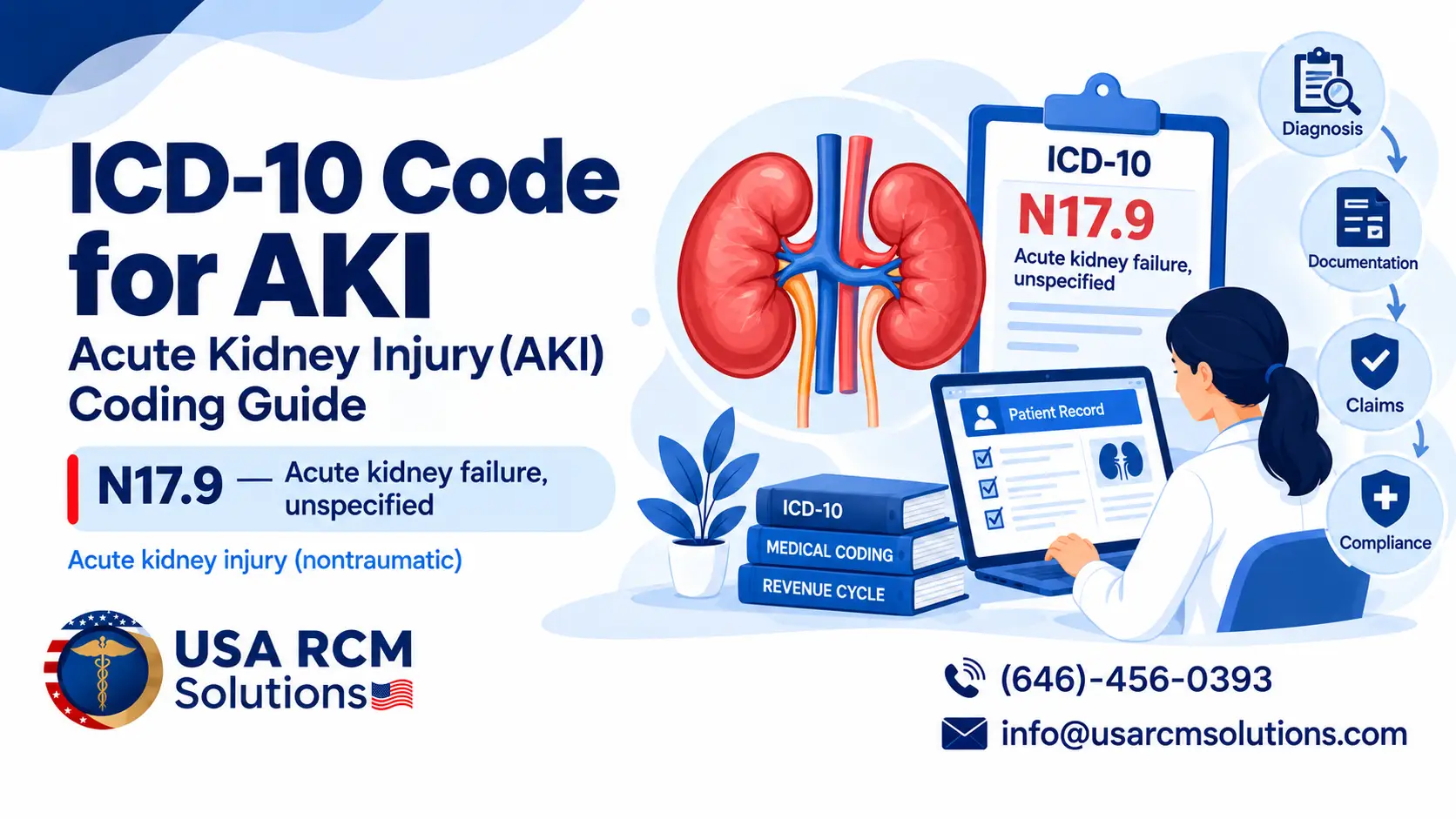
The ICD 10 code for AKI is N17.9. It stands for acute kidney failure, unspecified. Coders use it when a provider documents acute kidney injury without more detail. However, choosing the right code takes more than a quick lookup. Clear documentation, correct sequencing, and payer rules all matter. This guide explains each step in plain words.
Many claims fail because of small kidney coding errors. Therefore, billers and coders need a clear process. You will also see real examples, tables, and a simple checklist. So let us start with the condition itself.
ICD 10 Code for AKI: Understanding Acute Kidney Injury
Acute kidney injury is a sudden drop in kidney function. It usually develops over hours or days. The kidneys stop filtering waste well, so toxins and fluid build up. Doctors see it often in hospitals, especially in very sick patients.
Common causes include dehydration, infection, low blood pressure, and certain drugs. Blockages in the urinary tract can also cause it. Because causes differ, treatment plans differ too. Some patients recover fully, but others develop lasting damage.
What Does the Diagnosis AKI Stand For?
AKI stands for acute kidney injury. Older records may say acute renal failure or acute kidney failure. These terms describe the same broad problem. Therefore, the acute kidney injury icd 10 code falls in the N17 category. Coders should still follow the provider’s exact wording.
Kidney Injury Diagnosis: How Providers Confirm It
A kidney injury diagnosis relies on labs and clinical signs. Providers often follow KDIGO criteria. These criteria look at creatinine changes and urine output.
- Serum creatinine rises by 0.3 mg/dL or more within 48 hours.
- Creatinine reaches 1.5 times baseline within seven days.
- Urine output falls below 0.5 mL/kg per hour for six hours.
Any one of these findings can support the diagnosis. However, the provider must document the diagnosis in the chart. Coders cannot assign N17.9 from lab values alone. Therefore, a clear provider statement always comes first.
N17.9 ICD-10-CM: The Core Code Explained
N17.9 is the most common code in this family. Hospitals report it often for inpatient stays. Its official title is acute kidney failure, unspecified. Searches for icd 10 code aki usually lead straight to this code.
ICD-10 N17.9 Meaning
The ICD-10 N17.9 meaning is simple. Here, the provider documented acute kidney failure or injury. However, the record does not name a specific type. So the coder uses the unspecified code.
ICD 10 Code for AKI Unspecified vs. Specific Codes
The icd 10 code for aki unspecified is N17.9. Yet the N17 category offers more specific options. Here is the full family.
- N17.0: acute kidney failure with tubular necrosis.
- N17.1: acute kidney failure with acute cortical necrosis.
- N17.2: acute kidney failure with medullary necrosis.
- N17.8: other acute kidney failure.
- N17.9: acute kidney failure, unspecified.
Specific codes need specific documentation. For instance, acute tubular necrosis must appear in the provider’s notes. Coders cannot guess it from treatment or test results. This matters for payment, because inpatient severity grouping often treats N17.0 and N17.9 differently.
What Is the Correct AKI Condition Code?
The correct AKI condition code depends on the documentation. When the provider writes only AKI, N17.9 is correct. If the provider names acute tubular necrosis, N17.0 fits better. Always check the current-year code set before you submit.
What Is the ICD-9 Code for Unspecified Acute Kidney Injury?
The ICD-9 code for unspecified acute kidney injury was 584.9. The United States retired ICD-9 for claims on October 1, 2015. Since then, payers expect ICD-10-CM codes. However, old records and crosswalk tools still mention 584.9. In those cases, map it to N17.9 and confirm the documentation.
N17.9 Coding Guidelines Every Coder Should Follow
Good coding starts with a repeatable process. The steps below work for most inpatient and outpatient charts.
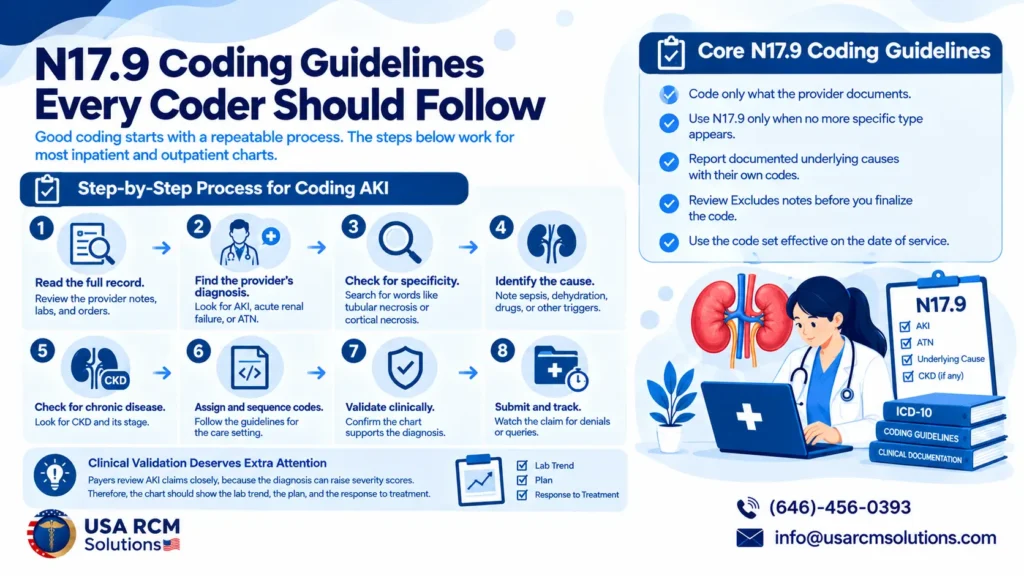
Step-by-Step Process for Coding AKI
- Read the full record. Review the provider notes, labs, and orders.
- Find the provider’s diagnosis. Look for AKI, acute renal failure, or ATN.
- Check for specificity. Search for words like tubular necrosis or cortical necrosis.
- Identify the cause. Note sepsis, dehydration, drugs, or other triggers.
- Check for chronic disease. Look for CKD and its stage.
- Assign and sequence codes. Follow the guidelines for the care setting.
- Validate clinically. Confirm the chart supports the diagnosis.
- Submit and track. Watch the claim for denials or queries.
Core N17.9 Coding Guidelines
- Code only what the provider documents.
- Use N17.9 only when no more specific type appears.
- Report documented underlying causes with their own codes.
- Review Excludes notes before you finalize the code.
- Use the code set effective on the date of service.
Clinical validation deserves extra attention. Payers review ICD 10 Code for AKI claims closely, because the diagnosis can raise severity scores. Therefore, the chart should show the lab trend, the plan, and the response to treatment.
How to Code AKI on CKD?
How to code AKI on CKD is a common question. Code both conditions, because they are separate problems. Assign N17.9 or a more specific N17 code for the AKI. Then add the matching N18 code for the CKD stage. Sequencing depends on the reason for the encounter and the facility rules. Hypertension with CKD uses combination codes, so review those rules too.
An Illustrative Example: AKI on CKD
Consider a 72-year-old patient with stage 3b CKD. The patient arrives with vomiting and dehydration. Labs show creatinine doubled from baseline. The provider documents AKI due to dehydration on CKD stage 3b. Therefore, the coder reports N17.9, N18.32, and E86.0. Sequencing follows the reason for the encounter.
Later, the provider might document acute tubular necrosis. In that case, the coder needs that documented diagnosis or a query response. Only then can the coder move from N17.9 to N17.0.
Why Accuracy Matters for the ICD 10 Code for AKI
Accurate codes tell the full patient story. They guide quality reports, risk scoring, and research. Therefore, one kidney code affects many downstream systems.
Money matters too. Kidney diagnoses often drive inpatient severity and payer review. An under-coded claim loses earned payment. However, an over-coded claim invites audits and takebacks. Both problems hurt the practice.
Documentation Tips for Providers
Good coding begins with good notes. Share these tips with your clinical team.
- State “acute kidney injury” or the exact type, such as ATN.
- Name the cause, such as sepsis or dehydration.
- Record the CKD stage when the patient has it.
- Link labs and treatment plans to the diagnosis.
- Update the diagnosis when the condition resolves.
An Illustrative Denial Case
Here is an illustrative case. A hospital submitted a claim with N17.9. Later, the payer denied it for weak clinical support. The chart showed only one creatinine value. So the team pulled the full lab trend and the provider’s plan. Then they appealed with the complete record, and the payer overturned the denial.
Key Optimization Methods
The table below shows practical ways to improve AKI coding.
| Method | What It Does | Expected Result |
| Provider documentation tips | Prompts providers to state type, cause, and stage | Fewer unspecified codes |
| Compliant CDI queries | Asks providers to clarify vague diagnoses | More accurate severity capture |
| Clinical validation checks | Compares labs with the diagnosis | Fewer audit takebacks |
| Code edits and scrubbers | Flags missing CKD or cause codes | Cleaner claims |
| Regular coder education | Reviews annual code changes | Fewer coding errors |
| Denial trend review | Tracks payer rejections by code | Targeted fixes |
Best Tools and Practices
Strong tools support strong habits. The table below shows what works well together.
| Tool or Practice | Purpose | Why It Helps |
| Encoder software | Guides code search and checks edits | Faster, more accurate coding |
| Official ICD-10-CM guidelines | Sets rules for sequencing and notes | Reliable reference |
| EHR templates | Prompt for cause and CKD stage | Complete documentation |
| CDI specialist review | Reviews charts before final coding | Better specificity |
| Coding audits | Samples AKI claims for accuracy | Finds patterns early |
| KPI dashboards | Tracks denial rate by diagnosis | Shows problem areas |
Common Mistakes When Using the ICD 10 Code for AKI
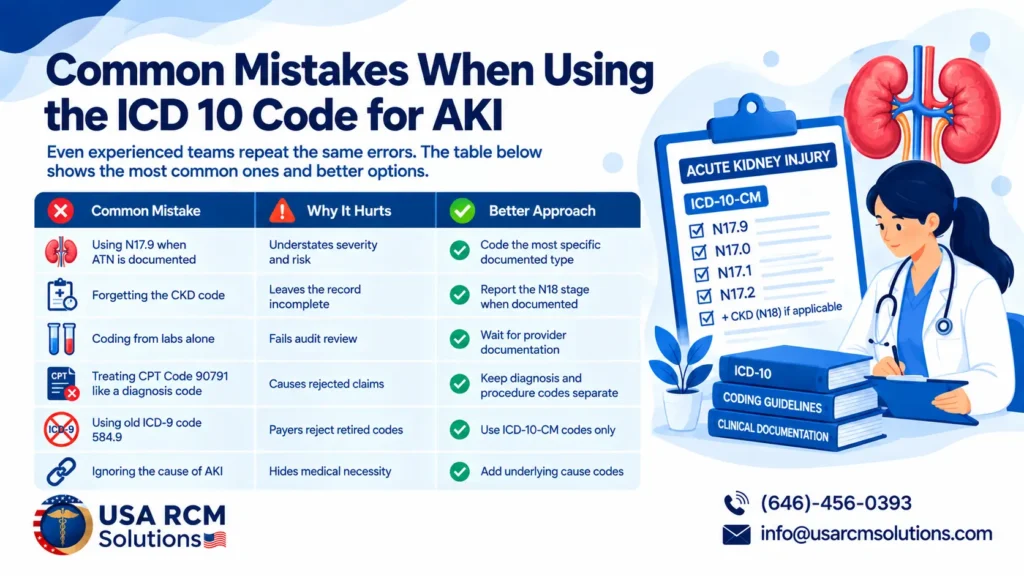
Even experienced teams repeat the same errors in ICD 10 Code for AKI. The table below shows the most common ones and better options.
| Common Mistake | Why It Hurts | Better Approach |
| Using N17.9 when ATN is documented | Understates severity and risk | Code the most specific documented type |
| Forgetting the CKD code | Leaves the record incomplete | Report the N18 stage when documented |
| Coding from labs alone | Fails audit review | Wait for provider documentation |
| Treating CPT Code 90791 like a diagnosis code | Causes rejected claims | Keep diagnosis and procedure codes separate |
| Using old ICD-9 code 584.9 | Payers reject retired codes | Use ICD-10-CM codes only |
| Ignoring the cause of AKI | Hides medical necessity | Add underlying cause codes |
CPT Code 90791 describes a psychiatric diagnostic evaluation. It is a procedure code, not a diagnosis. Claims need both kinds of codes, but each has its own job.
Specificity matters in every specialty. For example, the ICD-10 Code for Tick Bite depends on the injury site and external cause. AKI coding follows the same rule. Detail drives accuracy.
Support for Coding and Revenue Teams
Coding does not happen in isolation. Documentation, credentialing, billing, and follow-up all affect payment. Therefore, many practices look for outside help.
Full-Service Support for Coding and Revenue Teams
USA RCM Solutions helps practices manage coding and revenue tasks together. Its service range supports the full cycle. The list below shows the main offerings.
- Medical Billing & Coding Services: accurate claims built on correct diagnosis codes.
- Medical Credentialing Services: payer enrollment and provider onboarding.
- Accounts Receivable Services: steady follow-up on aging claims.
- Virtual Medical Scribe: documentation support that saves provider time.
- Denial Management Services: root cause review, appeals, and prevention.
- Healthcare Marketing Services: patient acquisition and online visibility.
These services support one another. For instance, richer notes improve diagnosis specificity, and specific codes reduce denials. Meanwhile, denial reviews show which kidney codes payers question most. As a result, teams fix the root problem instead of resubmitting the same claim.
How to Choose a Coding Partner
Choose a partner the way you would hire a key employee. Ask direct questions and expect clear answers.
- Coding credentials: Ask about certifications and ongoing education.
- Specialty experience: Confirm they know inpatient and outpatient rules.
- Audit support: Check how they handle payer reviews and appeals.
- Reporting: Request sample dashboards and monthly reports.
- Compliance: Confirm HIPAA safeguards and staff training.
- Clear pricing: Understand fees, contract terms, and exit options.
Future Trends in AKI Coding
Coding keeps changing because technology and payer rules keep changing. The table below highlights trends worth watching.
| Trend | What It Means | Likely Impact |
| AI-assisted coding | Software suggests codes from clinical notes | Faster coding with human review |
| Computer-assisted CDI | Tools flag vague AKI documentation | Better specificity |
| Predictive denial analytics | Models flag risky claims before submission | Fewer denials |
| Real-time clinical validation | Systems compare labs with diagnoses | Stronger audit defense |
| Remote documentation support | Virtual scribes capture clinical detail | Richer, clearer notes |
| Automated code update checks | Systems refresh edits each October | Fewer outdated-code errors |
Technology helps, but coders still make the final call. Experts must review every suggested code. Therefore, the best teams blend smart tools with trained people.
Conclusion
So, what is the icd 10 code for aki? N17.9 covers acute kidney failure, unspecified. Codes N17.0 through N17.8 cover more specific types. The right choice always depends on provider documentation.
Coders should also report CKD stages and underlying causes when the chart supports them. Clinical validation protects the claim during audits. Meanwhile, strong documentation habits reduce unspecified codes and denials.
You can build this process in-house or add outside support. A partner like USA RCM Solutions can cover coding, denials, and follow-up together. Either way, start with a chart audit this week. Then fix your top documentation gaps, and review progress each month.
FAQs
What is the ICD 10 code for AKI?
The ICD 10 code for AKI is N17.9 when the provider documents acute kidney injury without a specific type. This code means acute kidney failure, unspecified. More specific codes exist in the N17 category, such as N17.0 for tubular necrosis. Always choose the most specific code the documentation supports.
Can I report N17.9 together with a CKD code?
Yes, you can report both when the provider documents both conditions. AKI and CKD are separate problems, so each needs its own code. Use N17.9 or a more specific N17 code for the AKI. Then add the N18 code that matches the documented CKD stage.
What is the difference between N17.9 and N17.0?
N17.9 means the provider did not specify the type of acute kidney failure. N17.0 means the provider documented acute tubular necrosis. Because of this, N17.0 needs clear support in the notes. Coders should never assume acute tubular necrosis from labs or treatment alone.
How can a practice reduce denials on AKI claims?
Start with strong documentation, because it drives code accuracy. Next, validate the diagnosis against labs and the treatment plan. Then audit AKI claims regularly and track denial reasons by payer. Teams that follow this routine usually fix problems before payers find them.